Redbreast Sunfish
Lepomis auritus
The Atlantic slope's river sunfish — a current-tolerant, long-eared, orange-breasted panfish that thrives in the flowing water where bluegill will not hold.
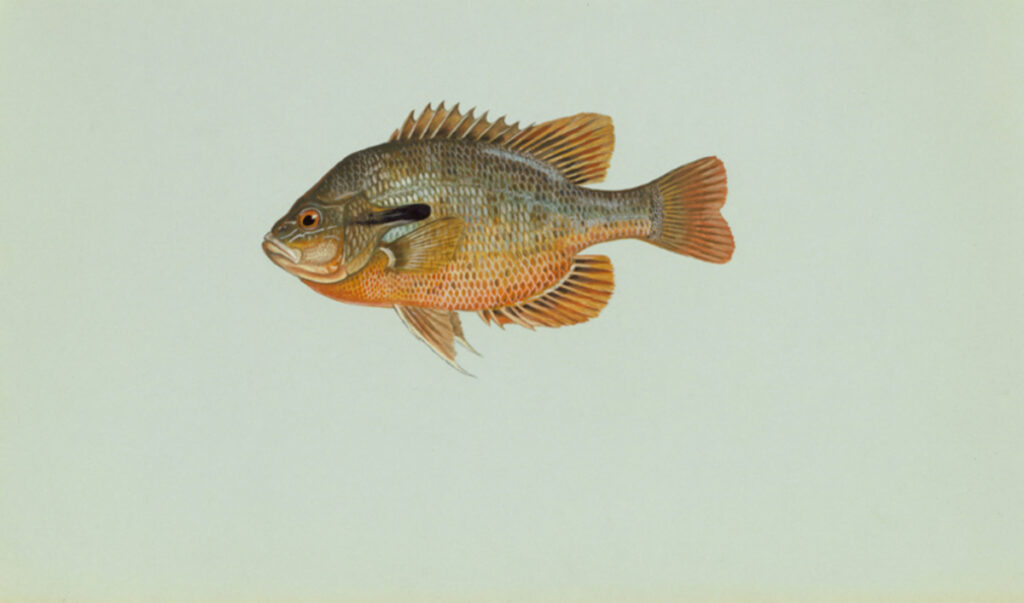
Identification
Redbreast sunfish are deep-bodied and heavily laterally compressed, and the Virginia Department of Wildlife Resources describes the colouring as olive-brown over the back, shifting to blue and gold along the sides, with a vivid orange-to-yellow breast that gives the species its name. On breeding males the breast colour is intense enough to be visible through clear water from several feet away.
The diagnostic feature is the ear flap: long and entirely black, with no pale border and no coloured spot. The Florida Fish and Wildlife Conservation Commission reduces identification to that one character — a very long black ear flap that sets it apart from other Florida sunfish.
The comparison that most often causes trouble is longear sunfish, which also has an elongated dark flap. The separator is the margin: longear’s flap is typically bordered in white, redbreast’s is entirely black. Geography usually settles it anyway, since the two species’ native ranges barely overlap — longear west of the Appalachians, redbreast on the Atlantic and eastern Gulf slope.
Range and distribution
The USFWS ecological risk screening summary gives the native range as Atlantic and Gulf Slope drainages from New Brunswick south to central Florida and west to the Apalachicola and Choctawhatchee drainages. That is a long, narrow, coast-parallel range covering the whole eastern seaboard river system — the Susquehanna, Potomac, Rappahannock, James, Roanoke, Cape Fear, Pee Dee, Santee, Savannah, Altamaha, Suwannee and St. Johns among them.
Virginia DWR describes the species as native across most of Virginia with the exception of the southwest, where it was introduced and now sustains viable populations — a useful illustration of how the native/introduced line runs along the Appalachian divide rather than along state boundaries.
Beyond the native range, USFWS documents established populations in Alabama, Arkansas, Florida (beyond its native portions), Georgia, Kentucky, Louisiana, Missouri, North Carolina, South Carolina, Tennessee, Texas, Virginia and West Virginia, plus Puerto Rico. Introductions to Europe did not persist. The climate matching in the USFWS screening gives a Climate 6 score of 0.756 and identifies establishment concern across most of the contiguous United States east of the Continental Divide — meaning that where redbreast are moved east of the Rockies, they will generally take.
Habitat: the river sunfish
Redbreast are the most consistently riverine of the common sunfishes, which is the single most useful thing to know about them. FWC states directly that redbreast thrive in flowing waters, though they also inhabit backwater areas with sandy bottoms, and that they are prevalent throughout north Florida’s river systems but absent from the south of the state.
Virginia DWR makes the same point comparatively: redbreast inhabit streams and reservoirs throughout Virginia, holding around submerged structure or near the shoreline where there are overhanging banks, and they demonstrate greater adaptability than many of their sunfish relatives, capable of thriving in swifter currents.
USFWS describes the habitat preference as slow-moving or sluggish water such as pools and backwaters of streams and rivers, with a pH range of 7.0–7.5. Reading those accounts together, the accurate picture is a fish of moderate-gradient rivers that uses pools, eddies and undercut banks within flowing systems — not a backwater specialist like bluegill, and not a fast-water fish either, but comfortable in current that bluegill would avoid.
In practice, on an Atlantic slope river, redbreast are the sunfish holding on the structure edges of the main channel, under overhanging banks, around blowdowns and along rock ledges, while bluegill are in the oxbows and sloughs.
Water temperature
Redbreast are the warmest-preferring of the four common sunfishes, and the numbers should be read carefully. USFWS gives a preferred temperature range of 27–29°C (81–84°F), with tolerance across a much wider band of 4–22°C (39–72°F) and recorded survival in water as warm as 33–35°C (91–95°F).
Those figures look inconsistent until you understand what they are. The 81–84°F preference is a compiled preference figure, not a growth study — it describes where the fish would choose to be in a thermal gradient, not the only water it will occupy. The 39–72°F tolerance band and the 91–95°F survival ceiling describe the extremes it endures. Spawning begins far below the preference band, at 17–20°C (63–68°F).
The practical reading for a live river gauge: redbreast are active and feeding across a very wide range, they begin nesting once the river reaches the low-to-mid 60s, and they hold up better in summer-warmed water than the rock basses or smallmouth bass sharing the same rivers. On a hot southeastern river in August, redbreast are often the game fish still feeding when everything else has gone off.
It is worth flagging plainly that no federal habitat suitability model or state thermal criterion has been published for redbreast sunfish, and the figures above come from a screening compilation rather than from dedicated thermal research. The literature for this species is thinner than for bluegill.
Life history
Redbreast are nest spawners. USFWS gives a spring-through-summer breeding season beginning when water temperatures reach 17–20°C, with females laying approximately 1,000 eggs in male-constructed nests and males providing parental care until the hatchlings disperse. Virginia DWR narrows the Virginia season to May through July, with males building nests in sandy or gravelly substrate near shorelines and defending the eggs until hatching.
Growth is slow. FWC notes that development is relatively slow compared to some sunfish, with fish taking approximately two to three years to reach 6 inches. USFWS gives maturity at around two years and a lifespan of approximately 8 years, with typical adult sizes of 2 to 9 inches and 3 to 8 ounces, and a maximum recorded length of about 30.5 cm (12 inches). Virginia DWR gives 3.5 to 8-plus inches for adults with a lifespan around 8 years.
The Florida state record of 2.08 pounds represents an exceptional fish; anything over a pound is a notable redbreast anywhere in the range.
Diet
Redbreast have the broadest diet of the common sunfishes, and FWC says so directly: their diet is the most varied among sunfish, taking bottom-dwelling insect larvae, snails, clams, shrimp, crayfish and small fish.
Virginia DWR describes them as opportunistic, consuming benthic macroinvertebrates, small molluscs and crustaceans, small fish and terrestrial insects, and adapting their diet to seasonal food availability. USFWS notes that adults consume terrestrial insects along with both immature and adult aquatic insects.
That dietary breadth — bottom invertebrates, molluscs, crustaceans, drifting insects, surface terrestrials and fish — is part of why redbreast do so well in rivers. A fish that can shift between crayfish on the bottom, caddis larvae in the drift and beetles off the surface is well suited to a system where food availability changes with flow.
Angling
Redbreast are the defining panfish of Atlantic slope river fishing, from the Susquehanna and the Potomac south through the Virginia and Carolina piedmont rivers to the blackwater systems of Georgia and north Florida. On rivers like the Shenandoah, the James, the Rappahannock, the Edisto, the Altamaha and the Suwannee, they are the fish that fills the day between larger targets.
Their habits make them accessible in a way that reservoir sunfish are not. They hold on visible structure — undercut banks, blowdowns, rock ledges, current seams — in water an angler can read from a canoe, and their dietary breadth means they respond to almost any small presentation, on the surface or below it. FWC notes that the live baits effective for bluegill work equally well for redbreast.
The concentrated period is the May-to-July nesting season, when males occupy sandy and gravelly shallows near shore and defend them. Outside that window redbreast disperse along structure through the whole river.
As a table fish they are the equal of bluegill: a small, firm white fillet, best from clean, flowing water.
Conservation
Redbreast sunfish are secure and unlisted throughout their native Atlantic and Gulf Slope range. No authority ranks the species as at risk, and there is no evidence of range-wide decline.
The conservation attention the species receives is as an introduced fish. The USFWS ecological risk screening summary exists because redbreast have been widely moved west and south of their native drainages, establishing in at least fourteen states and Puerto Rico, with a climate match indicating high establishment potential across most of the country east of the Continental Divide. Where redbreast establish outside their native range, they occupy the flowing-water sunfish niche that native species — longear in the interior highlands, for instance — would otherwise hold, though the interactions have not been well studied.
Within the native range, the practical issues for redbreast are the ordinary ones for piedmont and coastal-plain rivers: sedimentation of the sand and gravel shallows they nest on, loss of overhanging bank cover and woody structure, and altered flow regimes below impoundments. Because redbreast tolerate warm water better than most river game fish, they are among the species likely to persist longest as eastern rivers warm — which makes them a poor early-warning indicator, and a useful reminder that abundance in a warming river is not the same as river health.
Where to catch it
82 waterways on GuidedFloats list redbreast sunfish, across 12 states. Each page carries live gauge readings, access notes, and the guides who fish it.
Alabama 4
- Choctawhatchee River305 cfs
- Hatchet Creek62 cfs
- Tallapoosa River1,260 cfs
- Tensaw River-781 cfs
Delaware 1
- Brandywine Creek268 cfs
Florida 2
- Santa Fe River965 cfs
- Suwannee River6,170 cfs
Georgia 10
- Altamaha River3,740 cfs
- Broad River196 cfs
- Flint River1,270 cfs
- Kinchafoonee Creek137 cfs
- Middle Oconee River105 cfs
- Ocmulgee River1,370 cfs
- Ogeechee River25 cfs
- Satilla River2,420 cfs
- Soque River74 cfs
- Spring Creek278 cfs
Louisiana 1
Maryland 10
- Antietam Creek113 cfs
- Big Pipe Creek37 cfs
- Conococheague Creek220 cfs
- Deer Creek45 cfs
- Licking Creek66 cfs
- Monocacy River273 cfs
- Patuxent River28 cfs
- Tonoloway Creek23 cfs
- Town Creek21 cfs
- Tuckahoe Creek36 cfs
North Carolina 11
- Catawba River2,970 cfs
- Cheoah River98 cfs
- Deep River56 cfs
- French Broad River1,010 cfs
- Haw River104 cfs
- Linville River63 cfs
- Lumber River104 cfs
- Neuse River469 cfs
- Tar River3 cfs
- Valley River64 cfs
- Wilson Creek
South Carolina 9
- Broad River1,120 cfs
- Catawba River1,190 cfs
- Congaree River3,530 cfs
- Middle Tyger River21 cfs
- Neal Shoals Reservoir
- Ninetynine Islands Reservoir
- Pacolet River177 cfs
- Parr Shoals Reservoir
- Wateree River Tailrace2,750 cfs
Tennessee 6
- Big Limestone Creek28 cfs
- Clear Creek6 cfs
- French Broad River1,270 cfs
- Nolichucky River1,000 cfs
- Nolichucky River below Nolichucky Dam901 cfs
- Spring Creek
Texas 3
- Blanco River5 cfs
- Nueces River75 cfs
- Pedernales River7 cfs
Virginia 20
- Bullpasture River74 cfs
- Calfpasture River54 cfs
- Cedar Creek31 cfs
- Clinch River449 cfs
- Cowpasture River277 cfs
- Dan River715 cfs
- Hazel River152 cfs
- James River986 cfs
- Linville Creek26 cfs
- Maury River104 cfs
- North Fork Shenandoah River297 cfs
- North River180 cfs
- Opequon Creek12 cfs
- Pamunkey River216 cfs
- Passage Creek16 cfs
- Pedlar River6 cfs
- Pound River below Flannagan Dam
- Rapidan River73 cfs
- Shenandoah River845 cfs
- South Fork Shenandoah River353 cfs
West Virginia 5
- Back Creek29 cfs
- Cacapon River270 cfs
- Laurel Creek107 cfs
- Opequon Creek105 cfs
- Patterson Creek70 cfs
References
- Ecological Risk Screening Summary: Redbreast Sunfish (Lepomis auritus) — U.S. Fish and Wildlife Service
- Redbreast Sunfish species profile — Virginia Department of Wildlife Resources
- Redbreast Sunfish species profile — Florida Fish and Wildlife Conservation Commission
- Bluegill (Lepomis macrochirus) species profile — hybridization with redbreast sunfish — USGS Nonindigenous Aquatic Species Database
- Habitat Suitability Index Models: Bluegill (FWS/OBS-82/10.8) — citation record — U.S. Geological Survey / U.S. Fish and Wildlife Service
- Habitat Suitability Index Models: Bluegill (Stuber, Gebhart & Maughan 1982), full text — U.S. Fish and Wildlife Service
- Longear Sunfish field guide (ear flap comparison) — Missouri Department of Conservation
- Longear Sunfish (Lepomis megalotis) — ear flap comparison — Texas Parks and Wildlife Department
- Redear Sunfish species profile (ear flap comparison) — Florida Fish and Wildlife Conservation Commission
- IGFA World Records search — International Game Fish Association