Chinook Salmon
Oncorhynchus tshawytscha
The largest Pacific salmon, split into spring, summer, fall and winter runs, with nine West Coast populations protected under the Endangered Species Act.
Identification
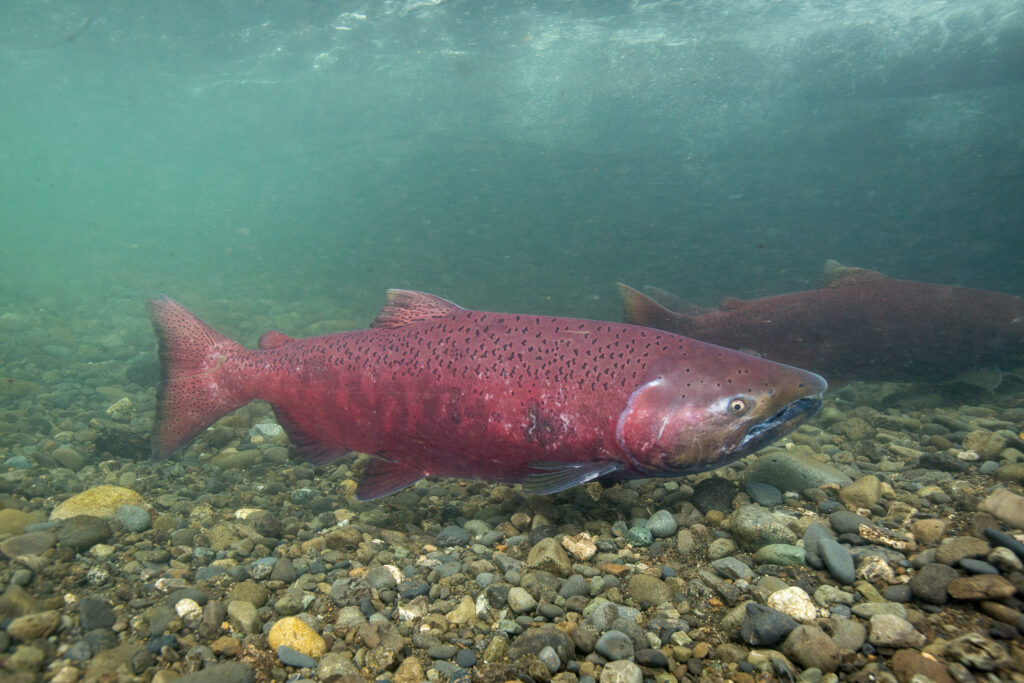
Chinook are the largest of the Pacific salmon and the heaviest-bodied. Ocean-phase fish are blue-green to blue-black across the back, silver on the flanks and white below, with irregular black spotting on the back, the dorsal fin and both lobes of the tail. The most reliable field mark is the mouth: the gum line at the base of the teeth is black, which is why fish taken in Puget Sound salt water are called blackmouth. The Alaska Department of Fish and Game uses the irregular back and dorsal spotting together with that black gum line as the primary diagnostic pair, and the Oregon Department of Fish and Wildlife gives the same black lower-jaw gum line as the separator from coho.
Spawning fish darken to olive, bronze or a dull maroon-black. Males develop a hooked kype and a ridged back; both sexes lose the silver guanine layer as the skin thickens. Anal fin ray counts of 15 to 17 distinguish Chinook from the trout-lineage salmonids they share water with, a character the Michigan Department of Natural Resources uses on Great Lakes fish where several introduced salmonids overlap.
Range and distribution
The native range runs from Monterey Bay north to the Chukchi Sea in North America and from Hokkaido to the Anadyr River in Asia. ADF&G identifies the Yukon, Kuskokwim, Nushagak, Susitna, Kenai, Copper, Alsek, Taku and Stikine as Alaska’s principal Chinook rivers. South of Alaska the species is concentrated in the Columbia and Snake systems, Puget Sound and its rivers, the coastal drainages of Washington and Oregon, and California’s Central Valley — where the Sacramento still carries four distinct runs — plus coastal rivers as far south as the San Lorenzo.
Chinook are the deepest-penetrating Pacific salmon in several basins. Historically they ascended the Columbia past the site of Grand Coulee Dam and the Snake into central Idaho, and in Alaska they still run more than a thousand miles up the Yukon. That reach is precisely what makes them vulnerable to mainstem dams and to warm water in the lower rivers they must transit.
Run timing
No aspect of Chinook biology is more confusing, or more often stated wrongly, than run timing. Runs are named for the season the adults enter fresh water, not the season they spawn. Nearly all Chinook spawn in late summer or fall regardless of run name. NOAA Fisheries describes spring-run fish as entering rivers in spring and fall-run fish in fall, with the Sacramento River winter-run as the outlier that spawns during summer.
Spring-run fish enter fresh water sexually immature, often months before spawning, and hold through the summer in deep cold pools while their gonads mature on stored fat. The California Department of Fish and Wildlife records Central Valley spring-run entering the Sacramento from late March through September and spawning from mid-August through early October — a holding period of up to six months without feeding. Fall-run fish enter mature and spawn quickly, usually in the lower and middle river. In Oregon, ODFW puts spring-run spawning from August into early November and fall-run from October into March.
Sacramento River winter-run are unique. Adults begin entering in November and continue into early August, and CDFW gives spawning as mid-April through August, peaking in June and July. That places egg incubation in the hottest months of the year, which is why the population depends absolutely on cold water released from Shasta Lake.
Whether these run types should be treated as separate conservation units is genuinely contested. Genomic work has tied early migration to a small region of one chromosome — the greb1L/RoSA locus — rather than to diffuse polygenic variation. A review in the Journal of Heredity lays out the disagreement plainly: the older polygenic reading found spring-run fish more closely related to nearby fall-run fish in the same river than to spring-run fish elsewhere, so run timing was treated as diversity within a unit; the large-effect-locus evidence challenges that, and federal and California determinations have reached different conclusions from the same data.
Habitat and water temperature
Chinook need clean, well-oxygenated gravel and cold water at every freshwater stage, and the thermal numbers are unusually well documented. EPA Region 10’s guidance, as summarised by the California Department of Fish and Game, sets below 55°F (13°C) for spawning, egg incubation and fry emergence; below 61°F (16°C) for core juvenile rearing; below 59°F (15°C) for smoltification; and below 64°F (18°C) for adult migration, relaxing to 68°F (20°C) in lower basins. All are seven-day averages of the daily maximum, not instantaneous limits.
The peer-reviewed synthesis by Richter and Kolmes (2005) gives Chinook-specific values: incubation best below 12°C (54°F), juvenile rearing optimum near 14.8°C (59°F), adult migration blockage at 21–23°C (70–73°F), and a lethality threshold of 22°C (72°F) as a daily maximum. The Alaska Department of Fish and Game’s literature review on temperature and freshwater fishes reports Chinook fry losing equilibrium at 23.8°C (74.8°F) and adults avoiding water above 15°C (59°F) regardless of what they had been acclimated to.
Incubation is the tightest constraint. NOAA Fisheries treats 53.6°F as the limit for safe egg development in Sacramento River winter-run, and reports that in the drought year 2021 roughly 75 percent of about 31 million eggs died from high water temperature, with 77 percent and 86 percent losses in 2014 and 2015. The State Water Resources Control Board’s 2026 Sacramento River Temperature Management Plan accordingly manages Shasta releases to a 53.5°F daily average at Clear Creek through the spawning and incubation season. CDFW states the run’s overall requirement as water between 42.5 and 57.5°F.
Rivers are getting warmer. Isaak and colleagues (2018) measured mean annual warming of 0.18°C per decade in Northwest rivers from 1996 to 2015, and 0.27°C per decade in July over the longer 1976–2015 record.
Life history
Chinook are anadromous and semelparous: they spawn once and die. ADF&G states it without qualification — “all Chinook salmon die after spawning” — and ODFW records adults dying within about two weeks of spawning. Maturity is variable, from age two to age seven, which is why a single spawning run contains fish of wildly different sizes.
The death is not incidental exhaustion but a directed physiological collapse. Adults stop feeding on entering fresh water and run the entire migration, gonad development and spawning on stored energy. Work published by the U.S. Geological Survey on the cortisol stress response in maturing Chinook found that both resting and stressed cortisol rose through the final three months before spawning, and that this elevated cortisol “is accompanied by energy depletion and reduces the immune capacity of sexually maturing individuals, thus increasing their susceptibility to parasites and pathogens.” The digestive tract atrophies, the skin loses its protective structure and fungal infection takes hold before death. The same study notes the mechanism helps explain the very high pre-spawning mortality seen in some threatened populations.
Juveniles follow two broad pathways. Ocean-type fish migrate to salt water within their first few months, rearing in estuaries; stream-type fish spend a full year or more in fresh water first. WDFW puts Washington freshwater residence at three months to a year depending on race and location, with northern populations staying longer because growth is slower in less productive streams. Ocean residence typically runs one to five years.
Diet
Freshwater juveniles take plankton, drifting aquatic insects and terrestrial insects. At sea, Chinook are the most piscivorous of the Pacific salmon: ADF&G lists herring, pilchard, sandlance, squid and crustaceans as the adult diet. In the Great Lakes, the Michigan DNR reports that the same feeding behaviour is directed at alewife and rainbow smelt. Adults cease feeding once they enter fresh water to spawn — a fact with direct bearing on how they respond to anything presented to them there.
Great Lakes populations
Chinook are not native to the Great Lakes but are now the dominant open-water predator across much of the basin. The Michigan DNR records that although Chinook were stocked as early as the 1870s, “it wasn’t until Michigan planted them in 1967 that they became established”. The purpose was to convert a runaway population of invasive alewife into a fishery, following the collapse of native lake trout under sea lamprey predation. The Great Lakes Fishery Commission records that stocking across the basin exceeded 25 million fingerlings a year by the early 1980s, and that Chinook subsequently began reproducing naturally in Lakes Michigan, Huron and Ontario.
Great Lakes Chinook complete the entire life cycle in fresh water, using the lakes in place of the ocean. Adults ascend tributaries from late summer — Michigan DNR notes fish are present in catchable numbers by mid-August — and spawn in fall, then die exactly as sea-run fish do. Michigan’s state record exceeds 46 pounds, though the DNR notes fish over 20 pounds are now considered large. Stocking has been reduced in recent years because the alewife forage base has thinned, a consequence of zebra and quagga mussel invasion and declining zooplankton that the Fishery Commission identifies as forcing a basin-wide rethink of salmon management.
Angling
Chinook behaviour in rivers is governed by the fact that they are not feeding. Adults that have entered fresh water are running on a fixed energy budget toward a fixed deadline, and their responses to objects in the water are aggression, territoriality or reflex rather than hunger. This is why river-caught Chinook so often take things that resemble nothing they ate at sea.
Holding behaviour follows temperature and oxygen. Spring-run fish, which must survive months in fresh water before spawning, seek out the deepest, coldest, most shaded pools available and concentrate wherever cold tributaries or groundwater enter — the same thermal refuges that determine whether the run survives a hot summer at all. Fall-run fish move through more quickly and hold in the tailouts and runs adjacent to spawning gravel. When mainstem temperatures approach the 21–23°C blockage range identified by Richter and Kolmes, upstream movement stops entirely and fish stack below the thermal barrier until it breaks — behaviour that live water-temperature readings on a river gauge will often predict before anything is visible on the water.
Because Chinook mature between ages two and seven, a run contains everything from small precocious males to fish several times their weight. Size within a run is a function of ocean age, not of a separate stock.
Conservation
NOAA Fisheries lists nine Chinook Evolutionarily Significant Units under the Endangered Species Act. Two are endangered: Sacramento River winter-run and Upper Columbia River spring-run. Seven are threatened: California Coastal, Central Valley spring-run, Lower Columbia River, Puget Sound, Snake River fall-run, Snake River spring/summer-run, and Upper Willamette River. The 2005 final listing determinations reaffirmed this structure.
The listing dates matter. Sacramento River winter-run was listed threatened in 1989 and 1990 and reclassified as endangered on January 4, 1994; it is one of NOAA’s nine national “Species in the Spotlight.” Puget Sound Chinook was listed threatened on March 24, 1999. CDFW separately lists Sacramento winter-run as endangered under the California Endangered Species Act (1989) and Central Valley spring-run as threatened under both state and federal acts (1999).
Three commonly cited “candidate” Chinook populations are no longer current. NOAA’s species page still lists Upper Klamath-Trinity Rivers, Gulf of Alaska and Washington Coast as candidates, but the agency’s own register of “not warranted” 12-month findings records that listing was found not warranted for Washington Coast Chinook on February 19, 2026 (91 FR 7964) and for Gulf of Alaska Chinook on May 14, 2026 (91 FR 27271). NOAA’s own 12-month finding concluded the three Gulf of Alaska ESUs are “not currently in danger of extinction throughout all or a significant portion of their ranges.” Oregon Coast and Southern Oregon/Northern California Coastal Chinook were likewise found not warranted on December 9, 2025. An earlier Upper Klamath-Trinity petition was found not warranted (81 FR 3346), though a positive 90-day finding in February 2018 triggered a further status review. California, working under its own statute, listed Upper Klamath-Trinity River spring Chinook as threatened under CESA in 2021 — a divergence between state and federal conclusions on the same fish.
The threats NOAA identifies are consistent across ESUs: dams and culverts blocking access to spawning grounds and impeding juvenile migration, habitat degradation and loss — 98 percent of riparian habitat along the Sacramento is gone — climate change and drought, and harvest. Warming compounds all of them, because every barrier that slows a fish increases the time it spends in water that is already near its thermal limit.
Where to catch it
76 waterways on GuidedFloats list chinook salmon, across 10 states. Each page carries live gauge readings, access notes, and the guides who fish it.
Alaska 12
- Bradley River below Bradley Lake Dam1 cfs
- Chena River2,470 cfs
- Chena River below Moose Creek Dam1,880 cfs
- Cooper Creek29 cfs
- Copper River51,200 cfs
- Gulkana River1,040 cfs
- Kenai River4,270 cfs
- Salcha River2,080 cfs
- Situk River611 cfs
- Stikine River81,500 cfs
- Taku River20,300 cfs
- Talkeetna River3,490 cfs
California 18
- American River1,500 cfs
- Carquinez Strait
- Cosumnes River60 cfs
- Eel River82 cfs
- Klamath River1,240 cfs
- Lower Sacramento River6,020 cfs
- Navarro River4 cfs
- Russian River156 cfs
- Scott River10 cfs
- Shasta River123 cfs
- Smith River191 cfs
- South Fork Eel River14 cfs
- Stanislaus River846 cfs
- Suisun Bay
- Trinity River369 cfs
- Tuolumne River1,170 cfs
- Van Duzen River7 cfs
- Yuba River551 cfs
Idaho 4
- Clearwater River3,180 cfs
- Coeur d'Alene Lake
- Salmon River1,120 cfs
- Valley Creek91 cfs
Michigan 4
- Manistee River1,160 cfs
- Muskegon River1,370 cfs
- Pere Marquette River608 cfs
- Rifle River338 cfs
New York 3
- Cattaraugus Creek205 cfs
- Genesee River919 cfs
- Salmon River236 cfs
North Dakota 2
- Missouri River (North Dakota)13,000 cfs
- Tobacco Garden Creek3 cfs
Oregon 15
- Clackamas River619 cfs
- Columbia River74,000 cfs
- Deschutes River3,950 cfs
- Grande Ronde River591 cfs
- John Day River190 cfs
- McKenzie River1,710 cfs
- Nehalem River93 cfs
- North Santiam River1,320 cfs
- North Umpqua River744 cfs
- Rogue River1,150 cfs
- Sandy River274 cfs
- Siuslaw River Estuary
- South Santiam River1,150 cfs
- Umpqua River1,000 cfs
- Willamette River6,700 cfs
South Dakota 1
Washington 16
- Bogachiel River171 cfs
- Chehalis River27 cfs
- Cowlitz River4,040 cfs
- Dungeness River62 cfs
- Hoh River555 cfs
- Humptulips River166 cfs
- Klickitat River596 cfs
- Lake Chelan
- Methow River317 cfs
- Queets River684 cfs
- Skagit River6,370 cfs
- Skykomish River537 cfs
- Snoqualmie River687 cfs
- Sultan River185 cfs
- Wenatchee River333 cfs
- Yakima River718 cfs
Wisconsin 1
- Bois Brule River113 cfs
References
- Chinook Salmon (Protected) — NOAA Fisheries
- Chinook Salmon (Protected): Spotlight — NOAA Fisheries
- Sacramento River Winter-run Chinook Salmon — NOAA Fisheries West Coast Region
- Puget Sound Chinook Salmon — NOAA Fisheries West Coast Region
- "Not Warranted" 12-Month Findings — NOAA Fisheries
- 12-Month Finding on a Petition to List Gulf of Alaska Chinook Salmon — NOAA Fisheries
- Notice of 12-Month Finding on a Petition To List the Oregon Coast and Southern Oregon and Northern California Coastal Chinook Salmon ESUs — Federal Register / NMFS
- 90-Day Finding on a Petition To List Chinook Salmon in the Upper Klamath-Trinity Rivers Basin — NOAA Fisheries
- Final Listing Determinations for 16 ESUs of West Coast Salmon — Federal Register / NMFS
- River Temperatures and Survival of Endangered California Winter-Run Chinook Salmon — NOAA Fisheries
- 2026 Sacramento River Temperature Management Plan — California State Water Resources Control Board
- Effects of Water Temperature on Anadromous Salmonids (DFG Exhibit 4) — California Department of Fish and Game / State Water Resources Control Board
- Maximum Temperature Limits for Chinook, Coho, and Chum Salmon, and Steelhead Trout in the Pacific Northwest (Richter & Kolmes 2005, Reviews in Fisheries Science 13:23-49) — NOAA
- Influence of Temperature on Freshwater Fishes: A Literature Review with Emphasis on Species in Alaska (Technical Report 91-1) — Alaska Department of Fish and Game, Habitat Division
- Global Warming of Salmon and Trout Rivers in the Northwestern U.S. (Isaak et al. 2018, Transactions of the American Fisheries Society 147:566-587) — USDA Forest Service Rocky Mountain Research Station
- Scope of the cortisol stress response in Chinook salmon during maturation — U.S. Geological Survey
- Implications of Large-Effect Loci for Conservation: A Review and Case Study with Pacific Salmon (Waples et al. 2022, Journal of Heredity 113:121-144) — Oxford Academic
- Chinook Salmon Species Profile — Alaska Department of Fish and Game
- Chinook salmon (Oncorhynchus tshawytscha) — Washington Department of Fish and Wildlife
- Chinook salmon — Oregon Department of Fish and Wildlife
- Spring-run Chinook Salmon — California Department of Fish and Wildlife
- Winter-run Chinook Salmon — California Department of Fish and Wildlife
- California Fish and Game Commission Notice of Findings: Upper Klamath and Trinity River Spring Chinook Salmon — California Department of Fish and Wildlife
- Chinook salmon — Michigan Department of Natural Resources
- Pacific Salmon in the Great Lakes (eForum) — Great Lakes Fishery Commission