Redear Sunfish
Lepomis microlophus
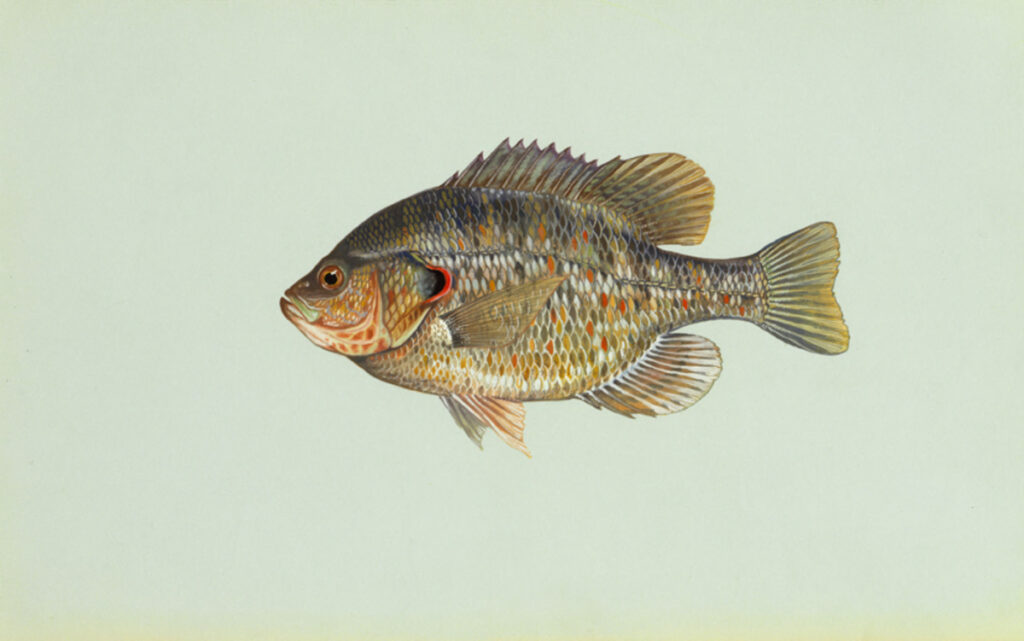
The shellcracker — a large, deep-bodied southern sunfish with molar-like throat teeth built to crush snails and mussels, and the only North American sunfish used as a biological control on invasive mussels.
Identification
Redear sunfish are among the largest and most heavily built of the true sunfishes. The Missouri Department of Conservation describes them as deep and slab-sided with a small mouth, golden or light olive green over the back and sides, a yellow to orange belly, and dark vertical bars on the flanks that show most clearly on younger fish.
The diagnostic mark is the ear flap: black, with a whitish border and a prominent orange or red spot on the rear margin. That red-orange crescent is what gives the fish its name and separates it cleanly from bluegill, whose ear flap is entirely dark with no coloured spot and no pale edge. The Florida Fish and Wildlife Conservation Commission reduces the whole identification to a single line: a bright red mark on the back edge of the gill cover.
Body proportions help too. Redear run larger and heavier than bluegill in the same water — MDC gives 8 to 10.5 inches and 6.5 to 12 ounces as typical, against 6 to 8 inches for bluegill — and FWC notes that fish over a pound are common in Florida.
The shellcracker: pharyngeal teeth and a molluscivore diet
Redear are not generalist sunfish. They are specialized molluscivores, and the specialization is anatomical. MDC describes throat teeth with broad, flattened surfaces used for crushing shells, and it is that machinery that earns the fish the name shellcracker.
The USFWS ecological risk screening summary for the species is specific: redear possess both upper and lower pharyngeal teeth, including molariform teeth, and use them to crush shells and molluscs, which usually comprise 50 to 100 percent of their total food volume. Gastropods, small mussels and ostracods make up the bulk. USFWS also notes that redear generate greater crushing forces than competing sunfish such as pumpkinseed.
A 1993 USGS review, “How well can fishes prey on zebra mussels in eastern North America?”, places redear in a very short list. Only freshwater drum and two centrarchids — redear sunfish and pumpkinseed — possess both upper and lower pharyngeal teeth, and are therefore likely to consume more zebra mussels than any other species in the fauna.
That capability has been tested at scale. Wong and colleagues, publishing in Biological Control (2012), stocked redear at a density of 0.42 fish per cubic metre into an enclosure in a quagga-mussel-infested southwestern lake. Within roughly two and a half months, mussel density had fallen to 8 percent of initial levels, mussel growth had stalled relative to controls, and recruitment of juveniles appeared suppressed. Stomach contents from captured fish contained broken quagga mussel shells alongside zooplankton, benthic organisms and microalgae. Complete eradication was not achieved, and the authors were careful about that, but redear remain the only North American sunfish seriously proposed as a biological control on invasive dreissenid mussels.
MDC’s summary of the diet is consistent: carnivorous, feeding primarily on snails and other molluscs.
Range and distribution
USFWS gives the native range as Atlantic and Gulf Slope drainages from about the Savannah River in South Carolina to the Nueces River in Texas, and northward into the Mississippi basin. MDC treats redear as native to the southern half of Missouri.
The introduced range is enormous. Redear have been stocked intentionally for sport across the contiguous United States — California, Arizona, the Great Lakes region and numerous eastern states — and internationally into Morocco, Panama, Puerto Rico and South Africa. MDC notes that redear are widely stocked in small reservoirs and ponds throughout Missouri, well outside their native southern half of the state.
The stocking rationale is usually twofold: redear grow larger than bluegill, and because they feed on molluscs rather than on the invertebrates and zooplankton bluegill target, the two species partition food rather than competing directly. In practice this makes redear a common companion species in bass-bluegill pond stockings.
Habitat and water temperature
Redear are the least riverine of the common sunfishes, and the site’s stream-focused readers should know that up front. MDC describes them as preferring warm, clear water with no noticeable current and an abundance of aquatic plants, favouring protected areas in streams and avoiding the main channel. USFWS describes the habitat as ponds, swamps and lakes, and vegetated pools, usually with mud or sand bottoms. FWC adds that redear favour hard-bottom areas and tend to hold deeper than bluegill.
In a river context this means redear are a backwater, oxbow and slough fish rather than a fish of the running channel. Where a low-gradient river has extensive off-channel habitat — vegetated sloughs, borrow pits, connected oxbows with mussel and snail beds — redear can be abundant. In a high-gradient Ozark float stream, they are effectively absent from the flowing water and confined to whatever slack, weedy margins exist.
On temperature, the record is thinner than for bluegill and it is worth saying so. No adult thermal optimum, stress threshold or lethal limit has been published specifically for redear sunfish. The one clean figure available is from USFWS: optimal incubation temperature for redear eggs is 22–24°C (72–75°F). Because redear and bluegill occupy the same waters and the same thermal guild, the bluegill figures from the USFWS habitat suitability model — adult growth optimum near 27°C (81°F), no growth above 30°C (86°F) or below 10°C (50°F), upper incipient lethal 35°C (95°F) — are the best available proxy, and should be read as a proxy rather than as measurements on this species.
Two practical caveats for anyone reading a live gauge: redear hold deeper than bluegill, so surface temperature can overstate the water they are in; and USFWS notes the species tolerates low salinity — under 4 ppt routinely, up to 12 ppt — which matters in coastal-plain rivers with tidal influence.
Life history
Redear are colonial nest spawners. MDC gives a Missouri season of May or June, sometimes with a second round in August, with fish excavating saucer-shaped depressions in silt or gravel and nesting in colonies. USFWS gives an April-to-August season across the range, extending February to October in Florida, with males guarding nests for 6 to 10 days until the eggs hatch and with distinct pairing behaviour during spawning. FWC notes that in Florida, peak spawning activity coincides with the full moons of March and April.
Growth and longevity: MDC gives a Missouri lifespan of up to 6 years; USFWS gives a maximum reported age of 7 years, with maturity reached at 1 to 2 years. Maximum recorded length is 43.2 cm. The gap between MDC’s typical Missouri fish (8 to 10.5 inches) and Florida’s 4.86-pound state record reflects a real latitudinal gradient: redear grow substantially larger in the long growing seasons of the Gulf states and the desert Southwest reservoirs than they do at the northern edge of the range.
Angling
Redear have a reputation as a difficult sunfish to catch on purpose, and the reason is dietary. A fish that takes 50 to 100 percent of its food volume as snails and small mussels off hard bottom is not looking up, and is not interested in the mid-water presentations that catch bluegill. Redear are typically taken on or very near the bottom — FWC’s guidance for the species during the spring spawn is simply earthworms.
The predictable window is the colonial spawn. In Florida that is timed to the March and April full moons; in Missouri it is May and June, with a possible August repeat. Outside those weeks, redear disperse to deeper hard-bottom areas and become an incidental catch.
Because redear run larger than bluegill and fight harder for their size, they are a disproportionately valued panfish in the South and in western reservoirs, where introduced populations feeding on abundant invasive mussels have produced some of the largest redear on record.
Conservation
Redear sunfish carry no conservation concern in their native range and are not listed by any authority. The species’ conservation profile is instead an introduced-species profile: USFWS’s ecological risk screening summary exists precisely because redear have been moved so widely, and the species is now established well beyond the southeastern drainages it evolved in.
The ecological consequences of those introductions cut both ways. As a specialized molluscivore, redear can suppress native snail and mussel assemblages in waters where they are not native — a genuine concern in systems with imperilled freshwater mollusc faunas. In waters already overrun by invasive dreissenids, that same specialization is being deliberately harnessed as biological control. Which of those framings applies depends entirely on which river the fish is in.
Where to catch it
148 waterways on GuidedFloats list redear sunfish, across 17 states. Each page carries live gauge readings, access notes, and the guides who fish it.
Alabama 10
- Bayou Sara
- Black Warrior River below Selden Dam
- Cahaba River236 cfs
- Choccolocco Creek158 cfs
- Conecuh River1,430 cfs
- Conecuh River below Point A Dam589 cfs
- Fish River58 cfs
- Lake Tuscaloosa
- Mobile River-4,400 cfs
- Tensaw River-1,360 cfs
Arizona 2
Arkansas 4
- Bayou Bartholomew1 cfs
- Bayou Macon13 cfs
- Bayou Meto
- Bear Bayou
Delaware 2
Florida 14
- Chipola River883 cfs
- Lake Minnehaha
- Lake Rosalie
- Lake Seminole
- Lake Talquin
- Lake Trafford
- Lake Weohyakapka
- Myakka River
- Ochlockonee River1,310 cfs
- Peace River1,160 cfs
- Santa Fe River965 cfs
- St. Johns River3,700 cfs
- Wakulla River696 cfs
- Withlacoochee River431 cfs
Georgia 2
- Kinchafoonee Creek137 cfs
- Spring Creek276 cfs
Hawaii 2
Indiana 6
Kansas 1
Kentucky 2
Louisiana 62
- Abita River
- Alligator Bayou
- Amite River321 cfs
- Atchafalaya River44,900 cfs
- Bayou Anacoco31 cfs
- Bayou Bartholomew5 cfs
- Bayou Bonne Idee
- Bayou Cocodrie62 cfs
- Bayou Conway
- Bayou Courtableau-5 cfs
- Bayou D'Arbonne
- Bayou D'Arbonne
- Bayou Darby
- Bayou de Loutre
- Bayou Des Cannes1 cfs
- Bayou Des Glaises11 cfs
- Bayou DeSiard
- Bayou Fountain
- Bayou Francois
- Bayou Fusilier
- Bayou Grosse Tete
- Bayou Lacassine
- Bayou Lafourche388 cfs
- Bayou Liberty
- Bayou Macon
- Bayou Mallet
- Bayou Manchac
- Bayou Milhomme
- Bayou Nezpique9 cfs
- Bayou Pierre160 cfs
- Bayou Plaquemine Brule
- Bayou Queue de Tortue
- Bayou Rapides
- Bayou San Patricio
- Bayou Teche
- Bayou Toro1 cfs
- Black Bayou
- Bodcau Bayou314 cfs
- Bogue Chitto River613 cfs
- Bushley Bayou
- Chauvin Bayou
- Chemin-A-Haut Bayou
- Choctaw Bayou
- Cross Bayou
- Cypress Bayou4 cfs
- Flagon Bayou
- Gilmer Bayou
- Henderson Bayou
- Lake Bistineau
- Lake Claiborne
- Lake D'Arbonne
- Little Corney Bayou
- Loggy Bayou
- Paw Paw Bayou
- Red Chute Bayou246 cfs
- Shettleworth Bayou
- Tangipahoa River361 cfs
- Tchefuncte River58 cfs
- Twelvemile Bayou
- White Bayou
- Willow Chute Bayou
- Youngs Bayou
Maryland 1
- Tuckahoe Creek35 cfs
Mississippi 8
- Bayou Pierre
- Luxapallila Creek88 cfs
- Pascagoula River
- Ross Barnett Reservoir
- Steele Bayou
- Strong River43 cfs
- Tombigbee River230 cfs
- Wolf River (Mississippi)43 cfs
Oklahoma 4
South Carolina 4
Tennessee 5
- Duck River372 cfs
- Elk River6 cfs
- Reelfoot Lake
- Running Reelfoot Bayou
- South Chickamauga Creek115 cfs
Texas 19
- Austin Bayou
- Bairds Bayou
- Bayou Lanana1 cfs
- Big Cypress Bayou20 cfs
- Greens Bayou
- Highland Bayou
- Housen Bayou
- Hurricane Bayou
- Lake Charlotte
- Linnville Bayou
- Luce Bayou4 cfs
- Medina River17 cfs
- Mustang Bayou
- Palo Gaucho Bayou2 cfs
- Pine Island Bayou2 cfs
- Turtle Bayou
- Village Creek96 cfs
- Whiteoak Bayou19 cfs
- Winters Bayou
References
- Redear Sunfish field guide — Missouri Department of Conservation
- Ecological Risk Screening Summary: Redear Sunfish (Lepomis microlophus) — U.S. Fish and Wildlife Service
- Redear Sunfish species profile — Florida Fish and Wildlife Conservation Commission
- How well can fishes prey on zebra mussels in eastern North America? (French 1993) — U.S. Geological Survey publications warehouse
- Invasive quagga mussels can be attenuated by redear sunfish in the Southwestern United States (Wong et al. 2012, Biological Control) — Biological Control / Invasive Mussel Collaborative
- Habitat Suitability Index Models: Bluegill (FWS/OBS-82/10.8) — citation record — U.S. Geological Survey / U.S. Fish and Wildlife Service
- Habitat Suitability Index Models: Bluegill (Stuber, Gebhart & Maughan 1982), full text — U.S. Fish and Wildlife Service
- Bluegill field guide — Missouri Department of Conservation
- Bluegill (Lepomis macrochirus) species profile — hybridization records — USGS Nonindigenous Aquatic Species Database
- IGFA World Records search — International Game Fish Association