Longear Sunfish
Lepomis megalotis
The small-stream sunfish of the Ozarks — turquoise-vermiculated, orange-bellied, black-and-white eared, and a serious candidate for the most colourful freshwater fish in North America.
Identification
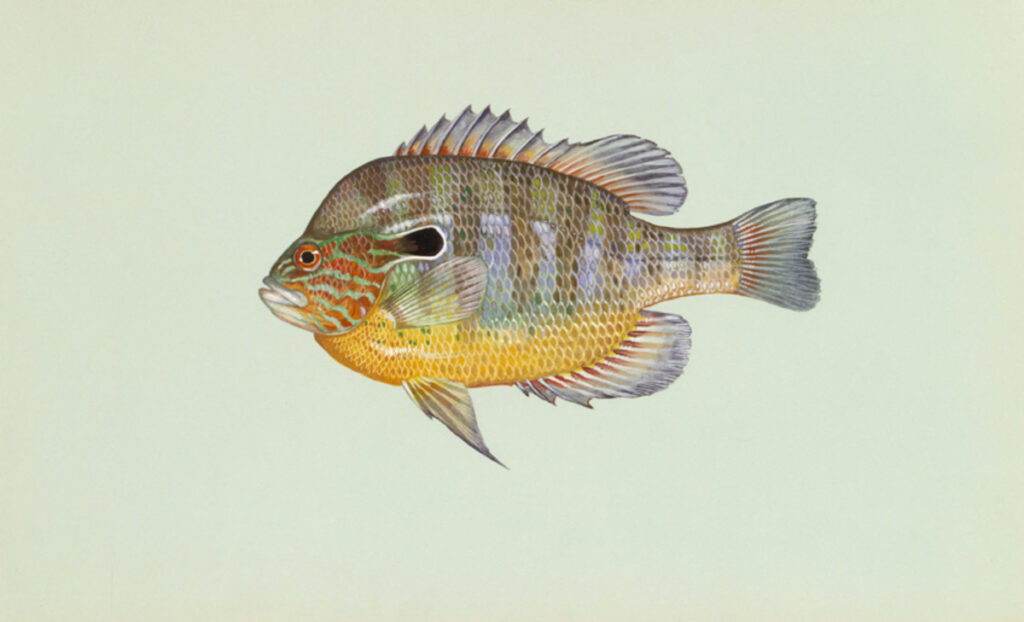
Longear sunfish are small, deep-bodied and, in breeding condition, extravagantly coloured. The Missouri Department of Conservation describes a deep-bodied, slab-sided fish with a moderate-sized mouth whose upper jaw nearly reaches the front of the eye — a larger mouth than bluegill’s, smaller than a green sunfish’s.
The colour description is worth quoting in detail because it is what makes the species memorable. MDC records the back and sides as blue-green speckled with yellow and emerald, the belly yellow to orange, and the head olive or light orange with sky-blue vermiculations — undulating, worm-like markings across the cheek and gill cover. Texas Parks and Wildlife puts breeding males as bright orange or scarlet with turquoise markings on the head and fins.
The name comes from the ear flap, which is elongated, black, and typically bordered in white. TPWD notes it is always trimmed in white, which is the single most useful separator from bluegill (dark flap, no pale margin) and redear (dark flap with a pale margin and a red-orange spot). On adult males the flap is genuinely long, angling backward and upward well past the rear of the gill cover.
The claim often made for this fish — that it is the most colourful freshwater fish in North America — is a matter of taste rather than a measurable fact. It is a defensible claim. A breeding male longear over pale Ozark chert in clear water in June is, by any reasonable standard, extraordinary.
Range and distribution
The USGS Nonindigenous Aquatic Species database gives the native range as the St. Lawrence and Great Lakes, Hudson Bay, Mississippi River and Gulf Slope drainages west of the Appalachian Mountains — Quebec and Ontario west to Minnesota, south to the Florida panhandle, southern Texas and northeastern Mexico. TPWD describes the species as occurring throughout Texas except the headwaters of the Canadian and Brazos rivers.
Missouri is the fish’s heartland. MDC calls longear the most abundant and generally distributed sunfish in the southern half of the state, and notes it is particularly abundant in Ozark streams of all sizes except the extreme headwaters. The watershed assessments bear this out: the Black River assessment records that the most abundant centrarchids in the basin were longear sunfish, shadow bass and smallmouth bass, and lists green sunfish and longear among the most widely distributed fish species in the watershed. The Spring River assessment lists longear among the species occurring in streams throughout the watershed.
USGS also records introduced occurrences in 21 states, with the primary pathway given as accidental stocking through stock contamination with other centrarchids — longear travelling as an unnoticed passenger in bass and bluegill shipments. Impacts in those waters are recorded as unknown, because no studies have been done.
Taxonomy: one species or six?
Longear sunfish is not a settled species, and the picture has changed substantially in recent years. Kim, Bauer and Near (2022, Systematic Biology 71(2):273–285) applied phylogenomic methods to the L. megalotis complex and concluded that the evidence from genomics and phenotype warrants recognizing six relatively ancient evolutionary lineages, in place of the two species — L. megalotis and L. peltastes — previously accepted.
The study is also a useful methodological caution. The authors found that hybridization actively interfered with species delimitation: introgressed populations, apparently the result of secondary contact or rare hybridization between non-sister species, artificially lowered the number of species recovered when included in the analyses. Segregating admixed individuals recovered the six lineages cleanly.
What this means practically is that “longear sunfish” as most anglers and most state agencies use the term is a species complex, and the fish in an Ozark stream, a Great Lakes tributary and a Texas river may not be conspecific under current understanding. State agency accounts, including MDC’s, still use the traditional single-species treatment; that is a reasonable working convention, not a resolved question.
Habitat and water temperature
Longear are the classic small-stream sunfish of the Ozarks. MDC describes them as avoiding strong currents, preferring reservoirs, ponds and stream pools, and favouring clear, permanent-flowing streams with sandy or rocky bottoms and aquatic vegetation. TPWD describes them in small streams and creeks associated with vegetation, avoiding strong currents by holding in pools, inlets and water off the main channel.
The distinction that matters on a river page is the one against bluegill. Bluegill want genuinely slack water and low gradient — the USFWS habitat model gives an optimal stream gradient of 0.5 m/km or less. Longear tolerate the moderate-gradient, clear, gravel-bottomed Ozark stream that bluegill do poorly in, holding in the pools and current seams rather than in backwaters. In a typical Ozark float stream, longear will be the sunfish present in the flowing water, bluegill the one in the backwater.
On temperature the record is thin, and the honest position is to say so. No thermal optimum, stress threshold or lethal limit has been published for longear sunfish. As a warmwater centrarchid overlapping bluegill, a working band of roughly 72–84°F is the most that can be given, with the bluegill figures from the USFWS habitat model — optimum near 27°C (81°F), no growth above 30°C (86°F), upper incipient lethal 35°C (95°F) — as the nearest measured proxy.
One direct observation of longear thermal behaviour does exist, and it is an Ozark river study. A USGS-catalogued paper, “Natural thermal refugia for temperate warmwater stream fishes” (North American Journal of Fisheries Management 16(4), 1996), worked in the Ozark National Scenic Riverways in Shannon County, Missouri, on a spring branch holding at 13.5 ± 1°C (about 56°F) and running warmer than the adjacent stream through winter. Longear sunfish increased their use of the refuge during cold periods and had greater stomach contents than fish in the main stream, though reproductive output was comparable. For a species with almost no thermal literature, that is a genuinely informative result: spring inflows matter to longear in winter, not just in summer.
Life history
Longear spawn later and longer than most Missouri sunfish. MDC gives mid-May through early or mid-August, with males constructing evenly rounded nests over small chert gravel and guarding for more than two weeks after spawning — a notably long guarding period for a fish this size. TPWD describes males nesting in gravel and attracting females through rapid swimming displays, then chasing the females off and defending the nest vigorously despite their small size, continuing protection for a week or more after hatching until larvae disperse.
Growth is slow and the fish stays small. A detailed Arkansas study — Bacon and Kilambi (1968), Journal of the Arkansas Academy of Science vol. 22 — aged 702 longear from the Kings River and Beaver Reservoir. Calculated total lengths at each annulus for Kings River fish were:
- Females: 50, 75, 93, 108 and 121 mm at ages 1 through 5.
- Males: 49, 75, 94, 111, 126 and 139 mm at ages 1 through 6.
The largest fish in the entire collection was 155 mm (6.1 inches) at age 6, from the Kings River. Fish reached 127 mm (5 inches) at the end of the fifth growing season, some at the end of the fourth. MDC gives a lifespan of up to 6 years, which matches. This is a fish that takes half a decade to reach 5 inches.
Diet
MDC describes longear as carnivorous, feeding on insects, small crustaceans and small fish. TPWD notes that insects and even small fish become part of the diet as fish approach adulthood. The moderately large mouth — larger than bluegill’s — gives longear access to a wider prey size range than its body size suggests, and in Ozark streams they take drifting aquatic insect larvae, terrestrial insects off the surface, small crustaceans and occasional fish fry.
The thermal refugia study adds an ecological detail worth noting: longear using the warm winter spring branch had fuller stomachs than fish in the main stream, which suggests that winter feeding opportunity, not just winter survival, drives the refuge behaviour.
Angling
Longear are the fish that fills the gaps on an Ozark float trip. They occupy pools and current seams in every stream size from small creeks to the big float rivers, they are abundant, they are aggressive out of proportion to their size, and they will hit small presentations all day. On rivers like the Black, the Current, the Jacks Fork, the Eleven Point and the James, they are typically the most-caught fish of the day.
At 5 to 6 inches they are too small to be a meaningful table fish, and their value is not culinary. It is that a longear in breeding colour is one of the most striking animals in an American river, and that they are catchable by anyone, at any skill level, on the simplest possible tackle.
Conservation
Longear sunfish are secure and abundant across their native range, and no authority lists them as at risk. USGS records established introduced populations across much of the eastern United States, with impacts unknown for lack of study, and notes substantial ongoing debate about whether populations in drainages such as the Tennessee, the Potomac and Minnesota are native or introduced — a question complicated by identification accuracy and by the taxonomic revision described above.
The species’ dependence on clear, permanent-flowing water with clean gravel is the practical conservation link. Longear need chert gravel free of silt for nesting, and clear water for the visual courtship displays that structure their breeding. Sedimentation, dewatering of small tributaries and loss of pool habitat all bear directly on them, and because they are the numerically dominant sunfish across most Ozark stream miles, their status is a reasonable proxy for the condition of the stream itself.
Where to catch it
109 waterways on GuidedFloats list longear sunfish, across 13 states. Each page carries live gauge readings, access notes, and the guides who fish it.
Alabama 8
- Cahaba River234 cfs
- Choccolocco Creek158 cfs
- Conecuh River1,490 cfs
- Conecuh River below Point A Dam564 cfs
- Hatchet Creek62 cfs
- Lake Tuscaloosa
- Locust Fork51 cfs
- Tallapoosa River1,260 cfs
Arkansas 13
- Bayou Deview
- Buffalo River107 cfs
- Caddo River24 cfs
- Deep Bayou
- Frog Bayou
- Illinois Bayou4 cfs
- Kings River55 cfs
- Mammoth Spring
- Osage Creek26 cfs
- Ouachita River10 cfs
- Saline River13 cfs
- South Fork Spring River4 cfs
- Spring River299 cfs
Georgia 1
- Middle Oconee River105 cfs
Illinois 6
- Cache River1 cfs
- Embarras River55 cfs
- Little Wabash River77 cfs
- Mackinaw River100 cfs
- Macoupin Creek14 cfs
- Vermilion River150 cfs
Indiana 7
- Big Raccoon Creek104 cfs
- Blue River13 cfs
- Eagle Creek14 cfs
- Flatrock River47 cfs
- Mississinewa River18 cfs
- Sugar Creek44 cfs
- Wildcat Creek139 cfs
Kentucky 7
- Bayou de Chien19 cfs
- Elkhorn Creek128 cfs
- Levisa Fork below Fishtrap Dam
- Rockcastle River63 cfs
- Royal Springs1 cfs
- South Elkhorn Creek4 cfs
- Tygarts Creek30 cfs
Louisiana 16
- Abita River
- Alligator Bayou
- Bayou Darby
- Bayou Fountain
- Bayou Francois
- Bayou Fusilier
- Bayou Grand Cane
- Bayou San Patricio
- Big Colewa Bayou
- Bogue Chitto River613 cfs
- Cross Bayou
- Flagon Bayou
- Kisatchie Bayou
- Tangipahoa River361 cfs
- Tchefuncte River58 cfs
- White Bayou
Mississippi 7
- Harris Bayou
- Luxapallila Creek87 cfs
- Okatoma Creek78 cfs
- Pascagoula River
- Pearl River909 cfs
- Richies Bayou
- Strong River43 cfs
Missouri 11
- Big River133 cfs
- Big Spring272 cfs
- Bryant Creek140 cfs
- East Fork Black River below Taum Sauk Reservoir6 cfs
- Greer Spring193 cfs
- Huzzah Creek59 cfs
- Little North Fork River
- North Fork Spring River8 cfs
- Pearson Creek5 cfs
- Roubidoux Creek
- Spring River74 cfs
Ohio 4
- Hocking River516 cfs
- Kokosing River46 cfs
- Little Miami River72 cfs
- Little Muskingum River144 cfs
Oklahoma 9
- Blue River43 cfs
- Flint Creek4 cfs
- Glover River
- Honey Creek30 cfs
- Kiamichi River2 cfs
- McGee Creek Reservoir
- Mountain Fork8 cfs
- North Fork Red River below Altus Dam1 cfs
- Sager Creek8 cfs
Tennessee 5
- Buffalo River (Tennessee)302 cfs
- Clear Creek6 cfs
- Daddys Creek15 cfs
- Reelfoot Lake
- Spring Creek
Texas 15
- Bayou Lanana1 cfs
- Frio River62 cfs
- Greens Bayou
- Highland Bayou
- Housen Bayou
- Hurricane Bayou
- Linnville Bayou
- Llano River449 cfs
- Luce Bayou4 cfs
- Mustang Bayou
- Palo Gaucho Bayou2 cfs
- Pecan Bayou12 cfs
- San Marcos River87 cfs
- Whiteoak Bayou19 cfs
- Winters Bayou
References
- Longear Sunfish field guide — Missouri Department of Conservation
- Longear Sunfish (Lepomis megalotis) species profile — USGS Nonindigenous Aquatic Species Database
- Longear Sunfish (Lepomis megalotis) — Texas Parks and Wildlife Department
- Introgression and Species Delimitation in the Longear Sunfish Lepomis megalotis (Kim, Bauer & Near 2022, Systematic Biology 71(2):273-285) — Oxford University Press / Society of Systematic Biologists
- Some Aspects of the Age and Growth of the Longear Sunfish in Arkansas Waters (Bacon & Kilambi 1968) — Journal of the Arkansas Academy of Science / University of Arkansas ScholarWorks
- Natural thermal refugia for temperate warmwater stream fishes — U.S. Geological Survey publications warehouse
- Black River Watershed Inventory and Assessment — Missouri Department of Conservation
- Spring River (South Missouri) Watershed Inventory and Assessment — Missouri Department of Conservation
- Habitat Suitability Index Models: Bluegill (FWS/OBS-82/10.8) — citation record — U.S. Geological Survey / U.S. Fish and Wildlife Service
- Habitat Suitability Index Models: Bluegill (Stuber, Gebhart & Maughan 1982), full text — U.S. Fish and Wildlife Service
- Bluegill field guide — Missouri Department of Conservation
- IGFA World Records search — International Game Fish Association