Muskellunge
Esox masquinongy
A low-density apex predator of cool rivers and lakes, roughly one adult per two or three acres — which, not cunning, is the real reason muskellunge are hard to catch.
Identification
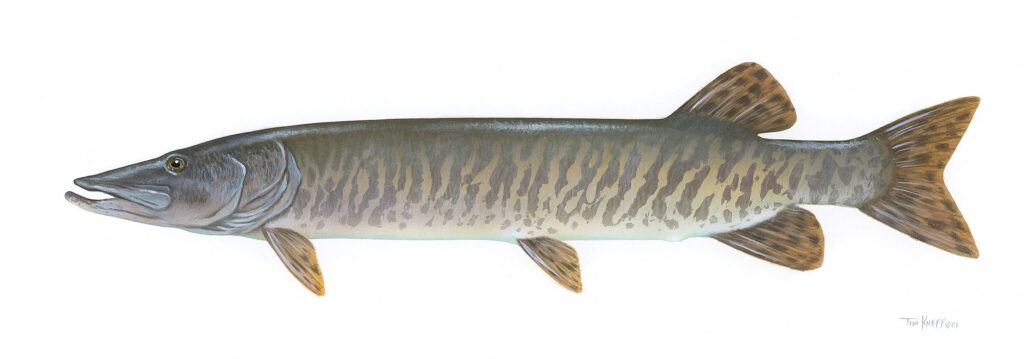
Muskellunge are the largest member of the pike family in North America — long, cylindrical, with dorsal and anal fins set far back and a long flattened head. Wisconsin describes the back, head and upper sides as iridescent green-gold to light brown with cream-coloured or pearly-white bellies, with vertical bars or spots on the lighter ground.
That pattern is the first and most important character, because it is inverted relative to northern pike. Muskellunge carry dark markings on a light background; pike carry light spots on a dark background. Iowa describes muskellunge markings as highly variable dark vertical bars on an olive to dark grey base. In some populations the bars are strong, in others they are broken into spots, and in clear-water fish they can be nearly absent — but they are never light-on-dark.
Fin shape helps: Wisconsin notes that muskellunge fins are pointed and usually rust-coloured, while pike fins are rounded, and Iowa records that a true muskellunge’s tail splits into two points where a pike’s or a tiger’s splits into two rounded lobes.
Muskellunge versus northern pike
Colour is diagnostic but degrades on faded or hybrid fish, so two structural characters settle the question.
Head scaling. In muskellunge, both the cheek and the gill cover are scaled only on their upper halves — Wisconsin describes it from the other direction as the lower gill cover and cheek lacking scales. In northern pike the cheek is fully scaled. The tiger muskellunge, the pike × muskellunge hybrid, is intermediate: New Jersey describes it as having partly scaled gill covers and a fully scaled cheek like the northern pike, with a deeper body and a more rounded tail than a true muskellunge.
Submandibular pore counts. Turning the fish over and counting the sensory pores along each side of the underside of the lower jaw is the most objective character available. Missouri gives muskellunge 6 to 9 pores along each side; Iowa gives the split as pike with five or fewer per side and muskellunge with six or more. New Jersey puts tiger muskellunge at 5 to 6 per side, which sits exactly on the boundary and is why pore count alone cannot separate a hybrid from either parent.
Range and distribution
The USFWS ecological risk screening gives the native range as the St. Lawrence–Great Lakes, Hudson Bay (Red River) and Mississippi River basins. The riverine component of that range is substantial and often overlooked. In Wisconsin the species occupies all three drainage basins but is most prevalent in the Chippewa, Flambeau, St. Croix, Black and Wisconsin rivers. In North Carolina, native muskellunge occupy the New, Nolichucky and French Broad rivers. In New York, native populations belong to the Allegheny and St. Lawrence basin watersheds, with self-sustaining fisheries managed in the St. Lawrence, Erie–Niagara and Susquehanna systems.
Wisconsin quantifies its holdings precisely: muskellunge occupy 667 lakes totalling 588,822 acres and 100 segments on 48 rivers, with nearly 90 per cent of musky waters in the north of the state. Of those 667 lakes, 302 are sustained by natural reproduction alone, 188 combine natural reproduction with supplemental stocking, and 115 require stocking to maintain the fishery.
Elsewhere the species exists only where it is put. Missouri states plainly that muskellunge are not native to the state, have been stocked into selected lakes since 1966, and that there is no evidence of successful spawning in Missouri — those populations are entirely stocking-dependent.
Habitat and water temperature
Muskellunge use clear to moderately stained water with structure. USFWS describes habitat as clear vegetated lakes and the quiet pools and backwaters of creeks and rivers; the National Park Service is more specific for large rivers — large rivers with slow currents and deep pools. North Carolina describes the requirement for its river populations as coolwater rivers and lakes with abundant woody debris, vegetation and rocky habitat. New York’s assessment characterises habitat as medium to large rivers and cool lakes with low gradient, aquatic vegetation and woody debris.
The thermal picture involves a real disagreement in the literature. The Royal Ontario Museum gives a preferred range of 22–26°C (72–79°F) and notes tolerance of water to 32°C (90°F), classing the species as warmwater. USFWS, drawing on FishBase, gives an occupied range of 0.55–25.5°C with optimum growth near 25.5°C (78°F) and tolerance to 90°F. Against those figures, direct telemetry of 30 tagged muskellunge in a thermally enriched Tennessee reservoir found fish selecting a preferred thermal niche of 22.3°C ± 1.8 during May to early August, when temperatures from 7.1 to 33.3°C were available — mean tag temperatures were 18.9°C in spring, 22.1°C in summer, 16.5°C in autumn and 9.8°C in winter. Where a growth-rate optimum and an observed field selection disagree, the field selection is the better predictor of where fish actually are.
The upper end of that range has a documented consequence. A 2023 study in Transactions of the American Fisheries Society found that muskellunge angled at water temperatures spanning 19.6–32.6°C (roughly 67–91°F) suffered 30.0 per cent mortality compared with 11.3 per cent for controls, with five-day cumulative temperature and net handling time both positively related to mortality. Thirty-two of the fish were caught above 25°C (77°F). Earlier work below 25°C had reported 0–5 per cent mortality. The 77°F line is therefore not a comfort threshold — it is the point at which the physiological cost of capture changes category.
Life history
Muskellunge spawn from mid-April to late May, peaking early in that window. Wisconsin gives the temperature requirement as 50 to 60°F, and the state’s species page narrows the optimum to about 55°F with a range of 49–60°F; Missouri gives early April at about 50°F. Females produce between 20,000 and 200,000 eggs per year, broadcast over shoreline areas with no parental care, hatching in about two weeks. Wisconsin notes that adult spawners return to the same spawning ground in consecutive years.
Maturity is late. Wisconsin gives males maturing at four to five years and 28 to 31 inches, and females at five to seven years and 30 to 36 inches. Growth from there is slow and long: roughly 11 inches at age 1, 34 inches at age 7, 40 inches at age 9, and 50 inches at age 17, with an ultimate length statewide around 56 inches. Lifespan is typically about 18 years with documented fish to 30. Late maturity plus slow growth means the large fish in any population are old fish, and any given year class contributes to the trophy component for decades.
Diet
Muskellunge are apex predators that take unusually large prey. Wisconsin records them handling prey up to two-thirds of their own body length — the fact sheet’s own example is a 50-inch musky taking a 33-inch meal. North Carolina records suckers as a particular staple in river populations, alongside salamanders, small mammals and other large items. The National Park Service notes that muskellunge tend to use whatever prey species is most abundant in a given water rather than specialising.
Angling: why muskellunge are hard to catch
The muskellunge’s reputation for difficulty is usually explained by intelligence or wariness. The measured explanation is simpler and better supported: there are very few of them, and they do not feed often.
Density comes first. Wisconsin’s management assessment states that most musky waters contain less than one adult per acre, and the state’s fact sheet puts the typical figure at about one adult for every two or three acres. In rivers the figure is far lower still: North Carolina reports that in some rivers there may be as few as one adult fish for every 12 to 14 acres of pool habitat. An apex predator sitting at the top of a food web is necessarily rare, and a river musky population is spread thinner than almost any other target species.
Catch rates follow directly from that. Wisconsin’s creel data give 0.037 fish per hour across its Class A and B waters — about 27 hours of fishing per muskellunge caught — improving only to 0.043 fish per hour, or 23 hours per fish, on designated action waters. Those numbers are what low density looks like from the angler’s side of the transaction. They are not evidence of unusual caution in the fish.
Feeding behaviour reinforces it. A 2025 study in Environmental Biology of Fishes tested muskellunge foraging across simulated day, twilight and night conditions with and without vegetation, and found that capture efficiency and success did not depend on light intensity or vegetation, even though prey showed reduced anti-predator behaviour in low light. Prey species mattered more than light — bluegill were less vulnerable than golden shiner. The authors attributed the pattern to a slow stalking or ambush strategy with inherently low capture rates, which is precisely why muskellunge forage across a large portion of the daily cycle rather than concentrating in a twilight window.
That is a meaningful contrast with walleye. A walleye has a measurable low-light advantage that compresses its feeding into a predictable part of the day. A muskellunge does not, which is why muskellunge activity is far less tied to dawn and dusk than folklore suggests, and why Wisconsin’s own guidance notes daytime fishing proving most successful. The practical implication of the whole picture is that muskellunge encounters are governed by water covered and fish present, not by timing a feeding window.
Conservation
NatureServe assigns muskellunge a global rank of G5, secure, last reviewed in August 2015. New York ranks the species S4 and lists it as a Species of Greatest Conservation Need, recording a long-term North American increase of roughly 25 per cent but a declining and most-at-risk St. Lawrence River population. USFWS notes that native populations are protected in parts of Tennessee and Ohio, with native Tennessee fish treated as endangered by the state wildlife agency and heritage programme.
New York identifies four principal threats: viral haemorrhagic septicaemia, which caused a widespread die-off of adult muskellunge in the St. Lawrence River between 2005 and 2008; invasive round goby acting as disease reservoir, egg predator and competitor; loss of spawning and nursery habitat to development and altered water levels; and negative interaction with northern pike. USGS records that pike introductions compete with native muskellunge and that pike, spawning earlier, may prey on younger muskellunge. For a species this slow to mature and this thinly distributed, none of those pressures is easily absorbed.
Where to catch it
77 waterways on GuidedFloats list muskellunge, across 17 states. Each page carries live gauge readings, access notes, and the guides who fish it.
Illinois 1
Iowa 3
Kentucky 8
- Big South Fork73 cfs
- Cave Run Lake
- Elkhorn Creek147 cfs
- Green River (Kentucky)447 cfs
- Green River Lake
- Red River7 cfs
- Rockcastle River72 cfs
- Rough River Lake
Maine 4
- Aroostook River182 cfs
- Fish River133 cfs
- Meduxnekeag River42 cfs
- St. Croix River373 cfs
Maryland 2
- Monocacy River304 cfs
- Potomac River5,250 cfs
Michigan 4
Minnesota 8
- Kettle River88 cfs
- Lake Minnetonka
- Lake of the Woods
- Leech Lake
- Mille Lacs Lake
- Mississippi River8,040 cfs
- Rainy River6,590 cfs
- St. Croix River3,500 cfs
New Jersey 1
- Delaware River5,490 cfs
New York 3
- Black River4,650 cfs
- Chautauqua Lake
- Oswegatchie River905 cfs
North Carolina 2
- French Broad River1,050 cfs
- Yadkin River2,230 cfs
North Dakota 1
Ohio 5
Pennsylvania 6
- Allegheny Reservoir
- Clarion River513 cfs
- Glendale Lake
- Lake Arthur
- Pymatuning Reservoir
- Susquehanna River16,600 cfs
Tennessee 3
- Clinch River714 cfs
- French Broad River1,360 cfs
- Nolichucky River964 cfs
Virginia 7
- Clinch River453 cfs
- Dan River695 cfs
- James River1,060 cfs
- New River2,500 cfs
- Pound River below Flannagan Dam
- Shenandoah River845 cfs
- South Fork Shenandoah River357 cfs
West Virginia 9
- Cheat River3,300 cfs
- Elk River (West Virginia)3,500 cfs
- Gauley River1,910 cfs
- Gauley River below Summersville Dam
- Greenbrier River1,520 cfs
- South Branch Potomac River1,530 cfs
- Tygart Lake
- Tygart Valley River613 cfs
- West Fork River below Stonewall Jackson Dam375 cfs
Wisconsin 10
- Anvil Lake
- Chippewa River1,500 cfs
- Fox River (Wisconsin)1,160 cfs
- Lac Vieux Desert
- Lake Monona
- Lake Waubesa
- Namekagon River43 cfs
- Peshtigo River243 cfs
- Wisconsin River5,390 cfs
- Wolf River1,570 cfs
References
- Esox masquinongy — Muskellunge, global conservation status rank — NatureServe Explorer
- Muskellunge fact sheet — Wisconsin Department of Natural Resources
- Muskellunge Management update — Wisconsin Department of Natural Resources
- Muskellunge — Fishes of Wisconsin — Wisconsin Department of Natural Resources
- Muskellunge — Field Guide — Missouri Department of Conservation
- Muskellunge — North Carolina Wildlife Resources Commission
- Species Status Assessment: Muskellunge (SWAP 2025) — New York State Department of Environmental Conservation
- Ecological Risk Screening Summary — Muskellunge (Esox masquinongy) — U.S. Fish and Wildlife Service
- Thermal ecology of subadult and adult muskellunge in a thermally enriched reservoir — U.S. Geological Survey Publications Warehouse (Cole and Bettoli 2014, Fisheries Management and Ecology)
- Evaluating Muskellunge catch-and-release mortality at elevated summer water temperature — U.S. Geological Survey Publications Warehouse (Transactions of the American Fisheries Society, 2023)
- Foraging behavior of muskellunge Esox masquinongy as influenced by simulated light intensity, habitat complexity, and prey species — Environmental Biology of Fishes (Einfalt, Detmer and Wahl 2025)
- Muskellunge (Esox masquinongy) — life history — Ontario Freshwater Fishes Life History Database, Royal Ontario Museum
- Muskellunge (Esox masquinongy) — National Park Service, Mississippi National River and Recreation Area
- Know Your Catch: How to ID Northern Pike and Muskies — Iowa Department of Natural Resources
- Tiger Muskellunge — Delaware River species account — New Jersey Division of Fish and Wildlife
- Northern Pike (Esox lucius) — Species Profile, Nonindigenous Aquatic Species — U.S. Geological Survey
- IGFA Game Fish Records — International Game Fish Association