Freshwater Drum
Aplodinotus grunniens
The only member of the drum family that lives its whole life in fresh water, named for the grunt it makes with muscles drummed against its swim bladder.
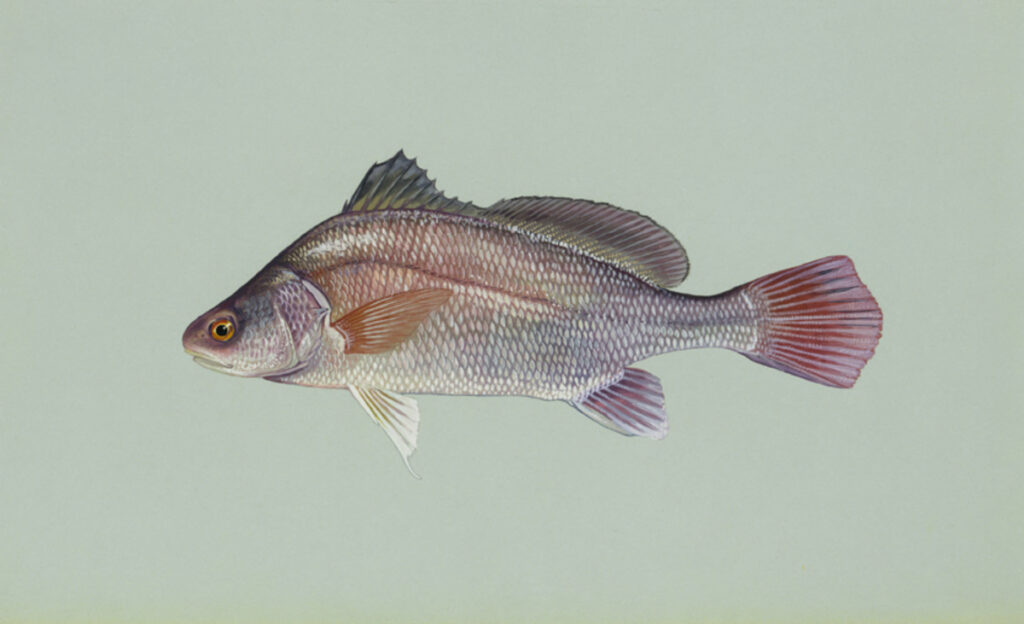
The freshwater drum is the odd one out in North American fresh water: a member of Sciaenidae, the family of croakers, seatrout, weakfish and redfish, all of which are otherwise saltwater or estuarine fishes. Ohio’s Division of Wildlife records it as the only drum species in Ohio; Montana’s field guide calls it the only member of the drum family native to Montana. It is a marine family’s freshwater outlier, and it carries most of the family’s marine equipment with it — the sound-producing swim bladder, the outsized ear stones, the crushing throat teeth — into rivers a thousand miles from salt water.
Identification
A drum is unmistakable once seen. The body is deep and humpbacked, tapering to a small head with a blunt, subterminal mouth set well under a rounded snout — the profile of a fish that feeds on the bottom. Colour is silver to pearl-grey, darker over the back. Missouri notes the milky-white lips and white pelvic fins, often tinged orange, and a long dorsal fin divided into two sections. Ohio describes the fish as silver-grey with a sub-terminal mouth and a rounded tail.
The single most reliable character is at the back end: the lateral line continues out onto the tail fin — unique among Montana’s fishes, and unusual generally. Combined with the rounded caudal fin and the humpbacked profile, it separates drum from carp, buffalo and every sunfish at a glance.
The grunt
The family name is descriptive, not decorative. Missouri’s field guide puts it directly: drum “get their name from the grunting, croaking, or ‘drumming’ sound they make using specialised muscles associated with the swim bladder.” Montana describes the same mechanism — the fish “produce sound by ‘drumming’ muscles against their gas bladders” — and Ohio notes that these specialised muscles vibrate against the air bladder to make drumming or croaking sounds.
Mechanically, sciaenid sonic muscles are attached to or adjacent to the swim bladder wall and contract at very high frequency, using the gas-filled bladder as a resonator and radiator — the general principle is reviewed in Fine and Parmentier’s account of swim-bladder sound production. The sound is audible through a boat hull and through the air from a fish held out of water. Its function is thought to be primarily reproductive: Missouri notes that scientists believe the vocalisations function chiefly in breeding behaviour, and drum are loudest during the spawning period. The sound is distinctive enough that it now has an applied use — passive acoustic monitoring has been used to detect the arrival of drum in river systems where they were not previously recorded.
Lucky stones
All bony fishes carry otoliths — paired calcium carbonate stones in the inner ear used for balance and hearing. In drum they are exceptionally large, hard, and marked on one face with a groove that many people read as the letter L, and it is these ear stones that beachcombers know as “lucky stones.” They wash up in numbers on Great Lakes shorelines, particularly along Lake Erie.
They are also an archaeological record. Missouri notes that “various groups of Native Americans used the otoliths (ear bones) as jewelry”, and because otolith size scales predictably with fish length, drum otoliths recovered from prehistoric middens have been used to reconstruct the size of fish taken centuries ago — the approach taken in Witt’s 1960 Copeia paper on length and weight of ancient freshwater drum calculated from otoliths found in Indian middens. The same durable, well-marked structure makes drum unusually easy to age, and the species is long-lived: Missouri records individuals surviving up to 13 years, and other populations considerably longer.
Throat teeth and what they actually eat
Drum have heavy pharyngeal teeth — cobblestone-like grinding plates in the throat, backed by powerful muscle — that are obviously built for crushing shelled prey. What they crush, and how much of it, turns out to depend heavily on where the fish lives, and the agencies disagree in an instructive way.
Montana lists the diet as fish, insects, clams and snails, and states that “snails and small clams are the predominant foods.” Ohio lists snails and other molluscs, crayfish, fish and aquatic insects. Missouri contradicts the assumption outright: “Long thought to be a mollusk eater (because of its heavy ‘throat teeth’), this species actually eats mainly fish, crayfish, and immature aquatic insects.”
Both are probably right for their own waters. The drum is an opportunist with the hardware to take molluscs when molluscs are abundant and the flexibility to ignore them when they are not — which is exactly what you would expect of a fish spanning the continent from Hudson Bay to Central America. The useful conclusion is that the presence of crushing dentition tells you what a drum can eat, not what it does eat in any particular river.
Zebra mussels
That crushing apparatus took on new significance after Dreissena polymorpha reached the Great Lakes in the late 1980s. Freshwater drum proved to be one of the few native North American fishes able to make substantial use of the invader. John French III’s 1997 study in the Journal of Freshwater Ecology examined the pharyngeal teeth of the freshwater drum as a predator of the zebra mussel, and Morrison and colleagues documented predation on zebra mussels by freshwater drum and yellow perch in western Lake Erie in the Journal of Great Lakes Research the same year. French had already looked at the effect of zebra mussel consumption on drum growth in Lake Erie.
The honest framing is that drum eat zebra mussels in quantity but do not control them. The U.S. Geological Survey’s nonindigenous species database records only that dreissenids are used by numerous predators including waterfowl, fish and crayfish, and rates that evidence as anecdotal. A drum population capable of consuming a meaningful fraction of a zebra mussel bed in a bay is nowhere near capable of reversing an invasion across a lake, and no agency claims otherwise.
Habitat and spawning
Drum are big-water fish. Montana finds them in deep pools of large streams, lakes and reservoirs with clean bottoms and moderate turbidity; Ohio notes they tolerate murky conditions but favour clear water and clean sand and gravel substrates; Missouri finds them statewide but “most abundant in the Missouri and Mississippi rivers and downstream sections of their larger tributaries.” On a river, that means deep holes, the scoured ground below wing dams and bridge piers, sandy and gravelly runs, and the tailwater immediately below a lock and dam.
Spawning is unusual for a freshwater fish. Montana records drum spawning in May and June at 65 to 70°F, in schools near the surface, sometimes well offshore, with buoyant eggs — a marine trait carried into fresh water. Ohio describes broadcast spawning in shallow water from spring through late summer, with floating eggs hatching in roughly a day and no parental care. Larvae drift at the surface before dropping to the bottom, and larval drum, with unusually large mouths for their size, can take fish fry as well as microcrustaceans and zooplankton.
The angling picture
Drum are bottom-oriented, and their behaviour is shaped by the fact that they hunt largely by touch and taste on substrate rather than by sight in the water column. They work sand and gravel, root out molluscs and crayfish, and in summer they move: a study of summer nocturnal patterns in freshwater drum documented an increase in activity after dark, consistent with a fish that does not depend on light to feed.
They are heavily built, deep-bodied and strong, and they fight low and in circles rather than running — the same body plan as their marine relatives, applied to river current. Physiological work on catch-and-release angling in freshwater drum indicates the species is a robust subject for release. In much of the Mississippi basin drum are treated as a nuisance catch under the name sheepshead; in Louisiana and the lower river they are gaspergou, a food fish with a long culinary tradition. The fish has not changed; the regional attitude has.
Where to catch it
181 waterways on GuidedFloats list freshwater drum, across 23 states. Each page carries live gauge readings, access notes, and the guides who fish it.
Alabama 8
- Alabama River below Millers Ferry
- Black Warrior River below Bankhead Lock and Dam
- Black Warrior River below Selden Dam
- Coosa River2,340 cfs
- Lake Tuscaloosa
- Mobile River-4,400 cfs
- Tensaw River-1,360 cfs
- Tombigbee River below Coffeeville Lock and Dam1,870 cfs
Arkansas 7
- Bayou Bartholomew1 cfs
- Bayou Deview
- Bayou Macon13 cfs
- Bayou Meto
- Bear Bayou
- Deep Bayou
- Saline River13 cfs
Illinois 15
- Big Muddy River47 cfs
- Cache River1 cfs
- Channel Lake
- Embarras River55 cfs
- Fox Lake
- Iroquois River122 cfs
- Kaskaskia River165 cfs
- Kishwaukee River804 cfs
- Little Wabash River77 cfs
- Mackinaw River100 cfs
- Macoupin Creek14 cfs
- Pecatonica River1,180 cfs
- Rock River4,860 cfs
- Vermilion River150 cfs
- Wabash River9,390 cfs
Indiana 6
- Cecil M. Harden Lake
- Eagle Creek14 cfs
- East Fork White River
- Flatrock River47 cfs
- Mississinewa River19 cfs
- Salamonie Lake
Iowa 9
- Beaver Creek828 cfs
- Big Bear Creek212 cfs
- Black Hawk Creek783 cfs
- Black Hawk Lake
- Iowa River4,520 cfs
- Maquoketa River2,410 cfs
- Rathbun Lake
- Spirit Lake
- Wapsipinicon River3,330 cfs
Kansas 11
- Cedar Bluff Reservoir
- Clinton Lake
- Cottonwood River104 cfs
- Fall River20 cfs
- Kanopolis Lake
- Marais des Cygnes River43 cfs
- Perry Lake
- Pomona Lake
- Stranger Creek39 cfs
- Verdigris River68 cfs
- Walnut River174 cfs
Kentucky 6
- Bayou de Chien19 cfs
- Dix River29 cfs
- Kentucky River867 cfs
- Levisa Fork below Fishtrap Dam
- Rough River Lake
- Taylorsville Lake
Louisiana 30
- Alligator Bayou
- Bayou Bartholomew5 cfs
- Bayou Bonne Idee
- Bayou Conway
- Bayou Courtableau-5 cfs
- Bayou D'Arbonne
- Bayou de Loutre
- Bayou Des Glaises11 cfs
- Bayou Fountain
- Bayou Fusilier
- Bayou Lafourche388 cfs
- Bayou Mallet
- Bayou Nezpique9 cfs
- Bayou Perot
- Bayou Queue de Tortue
- Bayou Rapides
- Bayou Teche
- Big Colewa Bayou
- Chauvin Bayou
- Choctaw Bayou
- Cross Bayou
- Gilmer Bayou
- Henderson Bayou
- Loggy Bayou
- Paw Paw Bayou
- Red Chute Bayou246 cfs
- Shettleworth Bayou
- Twelvemile Bayou
- Willow Chute Bayou
- Youngs Bayou
Minnesota 4
- Cannon River541 cfs
- Lake Traverse
- Mississippi River6,000 cfs
- Orwell Lake
Mississippi 5
- Harris Bayou
- Porter Bayou12 cfs
- Richies Bayou
- Steele Bayou
- Tombigbee River230 cfs
Missouri 1
- Spring Creek8 cfs
Nebraska 12
- Bazile Creek44 cfs
- Big Blue River973 cfs
- Bow Creek37 cfs
- Cedar River259 cfs
- Frenchman Creek14 cfs
- Logan Creek215 cfs
- Loup River266 cfs
- Middle Loup River1,270 cfs
- North Loup River401 cfs
- Ponca Creek9 cfs
- Sappa Creek
- Wahoo Creek140 cfs
New Mexico 3
North Dakota 18
- Apple Creek
- Baldhill Creek45 cfs
- Devils Lake
- Dry Lake
- Eastern Stump Lake
- Homme Reservoir
- James River263 cfs
- Lake Ashtabula
- Lake Darling
- Little Missouri River21 cfs
- Morrison Lake
- Pipestem Creek9 cfs
- Red River of the North2,350 cfs
- Sheyenne River251 cfs
- Sheyenne River below Baldhill Dam161 cfs
- Sheyenne River below Devils Lake Outlet5 cfs
- Tobacco Garden Creek2 cfs
- White Earth Lake
Ohio 14
- Cuyahoga River357 cfs
- Great Miami River1,810 cfs
- Hocking River516 cfs
- Indian Lake
- Kokosing River47 cfs
- Licking River
- Mahoning River458 cfs
- Maumee River989 cfs
- Mosquito Creek below Mosquito Creek Dam3 cfs
- Muskingum River2,520 cfs
- Sandusky River69 cfs
- Scioto River2,160 cfs
- Tuscarawas River
- Walhonding River
Oklahoma 5
- Big Cabin Creek2 cfs
- Fort Cobb Reservoir
- Kiamichi River2 cfs
- Lake Thunderbird
- North Fork Red River below Altus Dam1 cfs
South Carolina 1
South Dakota 5
- Belle Fourche River11 cfs
- Cheyenne River87 cfs
- Lake Kampeska
- Missouri River (South Dakota)
- White River95 cfs
Tennessee 4
Texas 9
- Austin Bayou
- Bayou Lanana1 cfs
- Brazos River461 cfs
- Hurricane Bayou
- Lake Livingston
- Luce Bayou4 cfs
- Palo Gaucho Bayou2 cfs
- Pecan Bayou12 cfs
- Sabine River412 cfs
Virginia 1
West Virginia 2
Wisconsin 5
- Chippewa River1,500 cfs
- Fox River (Wisconsin)1,160 cfs
- Lake Koshkonong
- Lake Waubesa
- Lake Winnebago
References
- Freshwater Drum — Field Guide — Missouri Department of Conservation
- Freshwater Drum — Ohio Department of Natural Resources, Division of Wildlife
- Freshwater Drum (Aplodinotus grunniens) — Montana Field Guide — Montana Natural Heritage Program and Montana Fish, Wildlife & Parks
- Pharyngeal Teeth of the Freshwater Drum (Aplodinotus grunniens), a Predator of the Zebra Mussel (Dreissena polymorpha) — French — Journal of Freshwater Ecology (1997)
- Predation on Zebra Mussels by Freshwater Drum and Yellow Perch in Western Lake Erie — Morrison et al. — Journal of Great Lakes Research (1997)
- The Effect of Zebra Mussel Consumption on Growth of Freshwater Drum in Lake Erie — French — Journal of Freshwater Ecology (1996)
- Length and Weight of Ancient Freshwater Drum, Aplodinotus grunniens, Calculated from Otoliths Found in Indian Middens — Witt — Copeia (1960)
- Summer Nocturnal Patterns in Freshwater Drum (Aplodinotus grunniens) — Rypel et al. — The American Midland Naturalist (2007)
- Physiological effects of catch-and-release angling on freshwater drum (Aplodinotus grunniens) — Card et al. — Fisheries Research (2021)
- Fish Sound Production: The Swim Bladder — Fine & Parmentier — Acoustics Today (2022)
- Dreissena polymorpha (zebra mussel) — impacts — U.S. Geological Survey Nonindigenous Aquatic Species Database
- IGFA World Records — International Game Fish Association