Bowfin
Amia calva
The last surviving member of the Amiiformes, an entire order otherwise known only from fossils, and now the subject of a caviar fishery that most states have no framework to manage.
The last of an order
The bowfin is the only living representative of the Amiiformes. Every other member of that order is a fossil. Ohio’s Department of Natural Resources states it directly: bowfin are “the only living member of their family,” a species “with no close Ohio relatives.” Missouri’s field guide places it in the family Amiidae within “the order Amiiformes.” Minnesota describes it as a “primitive fish” that “was around when dinosaurs roamed the earth.”
The technical framing is starker than the popular one. The bowfin belongs to Halecomorphi, a ray-finned fish group that, as the 2022 study which reopened bowfin taxonomy puts it, “separated from related lineages over 200 million years ago” and until recently contained “just one recognized living species in eastern North America.” This is not a fish that resembles an ancestral form. It is the only surviving branch of a group that was once diverse and is now, apart from this one animal, entirely extinct.
The taxonomy is contested, and honestly so
For more than 250 years the bowfin was a single species, Amia calva Linnaeus. That changed in 2022, when Brownstein and colleagues published “Hidden species diversity in an iconic living fossil vertebrate” in Biology Letters. Using genetic sequencing and morphological analysis, the team found evidence supporting “a second living species of Amia,” with origins traceable to the Plio-Pleistocene, resurrecting the name Amia ocellicauda Richardson, 1836. The same paper explicitly flagged “escalating conservation pressures from the caviar industry.”
Agencies have adopted the split unevenly, and the English names are not settled. The Missouri Department of Conservation now treats Missouri’s fish as Amia ocellicauda, which it calls the emerald bowfin, and describes Amia calva — which it calls the ruddy bowfin — as the East Coast species. The U.S. Fish and Wildlife Service species profile for Amia calva lists the common names “Bowfin, Ruddy Bowfin,” consistent with Missouri’s usage. Some ichthyological sources instead use “eyespot bowfin” for A. ocellicauda, after the tail spot. Meanwhile Ohio DNR still describes its fish as Amia calva.
The honest position is this: two species are now recognised in the primary literature, the geographic boundary between them is still being worked out, the common names are inconsistent between authorities, and most state fisheries documentation has not yet been revised. Anyone reading older material — or newer material from a state that has not updated — should assume “bowfin, Amia calva” may refer to either fish.
Breathing air, measured
Bowfin have a vascularised gas bladder that works as a lung. The Florida Fish and Wildlife Conservation Commission states the fish “has an air-bladder that functions like a lung, and can be seen gulping air.” Missouri notes bowfin “surface occasionally to renew the supply of air in the swim bladder, which functions something like a lung.” Minnesota describes them rising “to the surface and gulp air into their air bladders” to survive murky, oxygen-depleted water, and adds that they “can survive out of water for a considerable time.”
The respiratory physiology has been measured, and the numbers are more interesting than the summaries. Randall, Cameron, Daxboeck and Smatresk found that bowfin use the respiratory swimbladder to augment oxygen uptake “in normoxia at 30 degrees C” — that is, they breathe air even when the water holds plenty of oxygen — while still surviving when denied access to the surface. Crucially, the two organs divide the job: the gas bladder’s respiratory quotient was 0.21 against a gill respiratory quotient of 1.61, meaning “most of the CO2 is excreted into the water across the gills” while the bladder handles oxygen. The bowfin is not running a backup system. It is running two systems in parallel with different specialisations.
Control of that system is equally deliberate. Hedrick and Jones found that after branchial denervation, gill ventilation frequency in bowfin “was not significantly affected by aquatic hypoxia,” while hypoxia still increased air-breathing frequency, and identified a distinct class of air breaths that regulate gas bladder volume — buoyancy control rather than respiration. Earlier work by Hedrick, Katz and Jones used spectral analysis to demonstrate “a clear periodism to air-breathing in a primitive fish,” overturning the assumption that air-breathing fish surface irregularly.
The field consequence is straightforward. Florida places bowfin in “swamps, or backwaters of lowland streams,” living in “warm, poorly oxygenated waters.” Minnesota records a farmer finding “a live bowfin in moist soil when he ploughed a field that had been flooded a few weeks before.” On a waterway page, a low dissolved-oxygen reading in warm summer water is not a reason to expect fewer bowfin. It is a reason to expect bowfin and very little else.
The nest, and a month of fatherhood
Bowfin parental care is the most remarkable thing about the species after its taxonomy, and it is the male who does it.
Missouri reports that “males build nests in shallow, weedy sites, and they guard the eggs and fry,” with spawning lasting “from April into early June.” Florida describes males clearing “a nest among heavy vegetation. Eggs are laid at night and males guard them.” Ohio adds the duration, and it is the striking number: males construct nests in aquatic vegetation, often near large logs, and after hatching “the male guards the young for about a month, which is longer than any other species of fish in North America.”
The fry themselves behave unlike almost anything else in fresh water. Newly hatched bowfin use an adhesive attachment organ on the snout to anchor to the nest — Florida notes larvae using “an adhesive organ to anchor themselves,” and the structure has been examined in detail with scanning electron microscopy by Pinion and colleagues in a study of “the larval attachment organ of the bowfin Amia ocellicauda“ and its phylogenetic significance. Once free-swimming, the young form a dense, dark, slowly rotating ball — the “fry ball” — that moves through the shallows with the male beneath or beside it. Ohio describes the young congregating “in tight formations while the male aggressively defends them.”
A guarding male bowfin will strike at anything approaching the ball, which is the origin of much of the fish’s reputation for aggression. It is worth recognising for what it is: a month of continuous defence by a solitary parent, in shallow warm water, at considerable cost.
“Cajun caviar” and a fishery nobody is managing
Bowfin roe is now a commercial product. It is processed and sold as a domestic caviar substitute, marketed under names including “Cajun caviar,” and the trade has grown as sturgeon caviar has become scarce and expensive.
The Missouri Department of Conservation states the consequence plainly: bowfin “are increasingly vulnerable to overfishing, as their roe are becoming more valuable as an alternative source of caviar,” and warns that harvesting gravid females before spawning “can cause local extirpations.” That is an unusually direct warning for a species field guide.
The management gap was documented in the peer-reviewed literature by Sinopoli and Stewart in “A Synthesis of Management Regulations for Bowfin, and Conservation Implications of a Developing Caviar Fishery” in Fisheries, which examines exactly this: a commercial roe fishery developing across states whose bowfin management frameworks were built on the assumption that nobody wanted the fish. The 2022 taxonomic paper independently flagged the same pressure.
The biology makes the risk specific rather than theoretical. A roe fishery targets gravid females by definition. Bowfin females are the larger sex, they are the ones carrying the eggs, and the species depends on a single male guarding a single nest for a month to convert those eggs into fish. Removing the largest females immediately before spawning removes both the reproductive output and the reason the nest exists. This site does not restate regulations, and readers should consult their state agency directly — but it is worth knowing that in much of the bowfin’s range there is very little to consult.
Size, appearance and identification
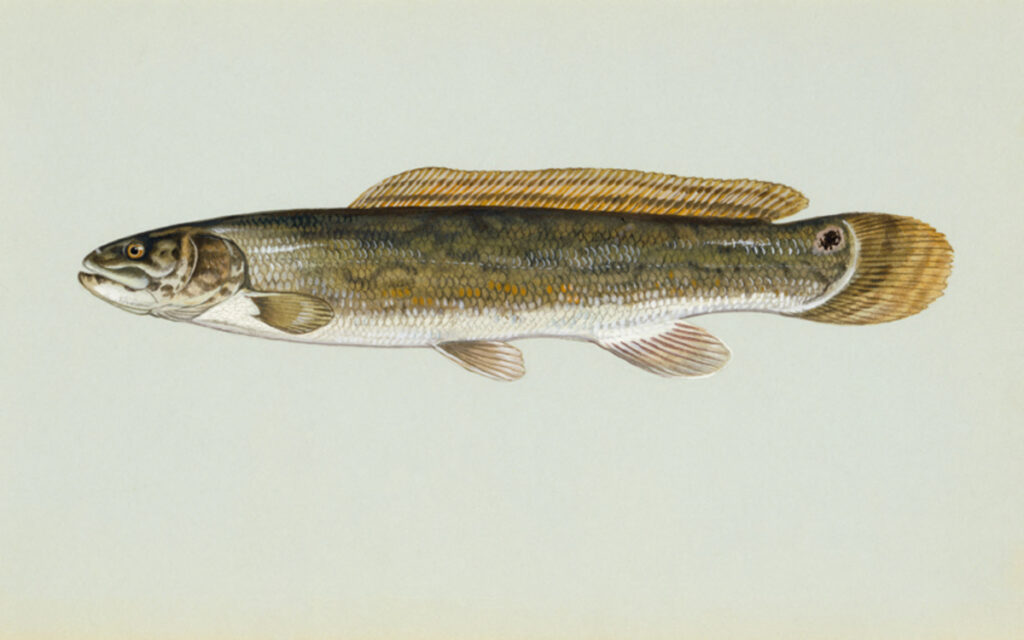
Bowfin are heavy-bodied, cylindrical fish with a long undulating dorsal fin running most of the back, a rounded tail, a bony plate under the jaw and two barbel-like nostril tubes. Minnesota describes a “medium-sized, greenish fish” with an olive-green cast, a scaleless head and two facial barbels, with males showing “a black spot circled in green at base of their tail.” That eyespot — prominent and ringed in males, faint or absent in females — is the field mark, and it is the feature behind the name ocellicauda.
Females run larger. Ohio gives males at 18–24 inches and 1–3 pounds, reaching 27 inches and 5 pounds, against females at 24–30 inches and 3–5 pounds, reaching 36 inches and 12 pounds. Missouri gives adults as 15–27 inches and 1–5 pounds. Florida’s state record is 19.0 pounds.
Habitat is consistent across the range: Ohio places bowfin in large natural lakes, rivers, oxbows and embayments with clear water and abundant rooted vegetation, most abundant in the bays and marshes of western Lake Erie, tolerant of algal turbidity but unable to survive clay silt.
The reputation, and why it is wrong
Bowfin were long treated as a nuisance — a predator that competed with bass and panfish, worth removing where it could be removed. That position was challenged directly in the American Fisheries Society’s own journal by Dennis Scarnecchia’s “A Reappraisal of Gars and Bowfins in Fishery Management” in 1992, and the profession has largely moved on.
What is left is a fish worth taking seriously on the evidence. It is the sole survivor of an order that has been separate from other ray-finned fishes for over 200 million years. It runs two respiratory systems in parallel with measurably different jobs. It provides the longest period of parental care of any North American fish. And it is now, without much of a management framework, being harvested for its eggs.
Where to catch it
144 waterways on GuidedFloats list bowfin, across 16 states. Each page carries live gauge readings, access notes, and the guides who fish it.
Alabama 6
- Bayou Sara
- Choctawhatchee River308 cfs
- Conecuh River below Point A Dam589 cfs
- Fish River58 cfs
- Mobile River-4,400 cfs
- Tensaw River-1,360 cfs
Arkansas 7
- Bayou Bartholomew1 cfs
- Bayou Deview
- Bayou Macon13 cfs
- Bayou Meto
- Bear Bayou
- Deep Bayou
- Saline River13 cfs
Delaware 1
- Marshyhope Creek13 cfs
Florida 9
- Lake Minnehaha
- Lake Rosalie
- Lake Seminole
- Lake Trafford
- Lake Weohyakapka
- Myakka River
- Ochlockonee River1,310 cfs
- Peace River1,160 cfs
- Santa Fe River965 cfs
Georgia 4
- Altamaha River3,740 cfs
- Ogeechee River24 cfs
- Satilla River2,400 cfs
- Spring Creek276 cfs
Illinois 4
- Cache River1 cfs
- Channel Lake
- Fox Lake
- Little Wabash River77 cfs
Kentucky 1
- Bayou de Chien19 cfs
Louisiana 64
- Abita River
- Alligator Bayou
- Bayou Anacoco31 cfs
- Bayou Bartholomew5 cfs
- Bayou Bonne Idee
- Bayou Cocodrie62 cfs
- Bayou Conway
- Bayou Courtableau-5 cfs
- Bayou D'Arbonne
- Bayou D'Arbonne
- Bayou Darby
- Bayou de Loutre
- Bayou Des Cannes1 cfs
- Bayou Des Glaises11 cfs
- Bayou DeSiard
- Bayou Dorcheat
- Bayou Dupre
- Bayou Fountain
- Bayou Francois
- Bayou Fusilier
- Bayou Grand Cane
- Bayou Grosse Tete
- Bayou Lacassine
- Bayou Lafourche388 cfs
- Bayou Liberty
- Bayou Macon
- Bayou Mallet
- Bayou Manchac
- Bayou Milhomme
- Bayou Nezpique9 cfs
- Bayou Perot
- Bayou Pierre160 cfs
- Bayou Plaquemine Brule
- Bayou Queue de Tortue
- Bayou Rapides
- Bayou San Patricio
- Bayou Teche
- Bayou Toro1 cfs
- Big Colewa Bayou
- Black Bayou
- Black Lake Bayou
- Bodcau Bayou314 cfs
- Bushley Bayou
- Chauvin Bayou
- Chemin-A-Haut Bayou
- Choctaw Bayou
- Cross Bayou
- Cypress Bayou4 cfs
- Flagon Bayou
- Gilmer Bayou
- Henderson Bayou
- Lake Bistineau
- Little Corney Bayou
- Loggy Bayou
- Paw Paw Bayou
- Red Chute Bayou246 cfs
- Saline Bayou18 cfs
- Shettleworth Bayou
- Tangipahoa River361 cfs
- Tchefuncte River58 cfs
- Twelvemile Bayou
- White Bayou
- Willow Chute Bayou
- Youngs Bayou
Mississippi 8
- Bayou Pierre
- Harris Bayou
- Jourdan River
- Old Fort Bayou
- Porter Bayou12 cfs
- Richies Bayou
- Steele Bayou
- Strong River43 cfs
North Carolina 6
- Currituck Sound
- Deep River56 cfs
- Lumber River105 cfs
- Neuse River506 cfs
- Pamlico River
- Tar River3 cfs
North Dakota 2
- Dry Lake
- Pipestem Creek9 cfs
South Carolina 4
- Ashley River
- Congaree River3,510 cfs
- Little Back River
- Wateree River Tailrace2,720 cfs
Tennessee 3
Texas 21
- Attoyac Bayou
- Austin Bayou
- Bairds Bayou
- Bastrop Bayou
- Bayou Lanana1 cfs
- Big Cypress Bayou20 cfs
- Black Cypress Bayou
- Chocolate Bayou14 cfs
- Housen Bayou
- Hurricane Bayou
- Lake Charlotte
- Linnville Bayou
- Little Cypress Bayou
- Luce Bayou4 cfs
- Mustang Bayou
- Neches River174 cfs
- Palo Gaucho Bayou2 cfs
- Pine Island Bayou2 cfs
- Turtle Bayou
- Village Creek96 cfs
- Winters Bayou
Vermont 2
- Little Otter Creek13 cfs
- Otter Creek646 cfs
Virginia 2
- Mattaponi River267 cfs
- Pamunkey River216 cfs
References
- Bowfin — Field Guide (Amia ocellicauda / Amia calva) — Missouri Department of Conservation
- Bowfin — Ohio Department of Natural Resources
- Bowfin — Minnesota Department of Natural Resources
- Bowfin — Freshwater Fish Profile — Florida Fish and Wildlife Conservation Commission
- Bowfin (Amia calva) — Species Profile — U.S. Fish and Wildlife Service
- Hidden species diversity in an iconic living fossil vertebrate — Brownstein CD, Kim D, Orr OD, Hogue GM, Tracy BH, Pugh MW, Singer R, Myles-McBurney C, Mollish JM, Simmons JW, David SR, Watkins-Colwell G, Hoffman EA, Near TJ — Biology Letters 18, 2022
- A Synthesis of Management Regulations for Bowfin, and Conservation Implications of a Developing Caviar Fishery — Sinopoli DA, Stewart DJ — Fisheries (American Fisheries Society), 2021
- Aspects of bimodal gas exchange in the bowfin, Amia calva L. (Actinopterygii: Amiiformes) — Randall DJ, Cameron JN, Daxboeck C, Smatresk N — Respiration Physiology 43(3):339-48, 1981
- Control of gill ventilation and air-breathing in the bowfin Amia calva — Hedrick MS, Jones DR — Journal of Experimental Biology 202(1):87-94, 1999
- Periodic air-breathing behaviour in a primitive fish revealed by spectral analysis — Hedrick M, Katz S, Jones D — Journal of Experimental Biology 197:429-36, 1994
- The larval attachment organ of the bowfin Amia ocellicauda Richardson, 1836 (Amiiformes: Amiidae) and its phylogenetic significance — Pinion AK, Britz R, Kubicek KM, Siegel DS, Conway KW — Journal of Fish Biology, 2023
- A Reappraisal of Gars and Bowfins in Fishery Management — Scarnecchia DL — Fisheries (American Fisheries Society), 1992
- IGFA World Records — International Game Fish Association