Northern Pike
Esox lucius
A circumpolar ambush predator of vegetated backwaters and slow river margins, with a hard upper lethal limit near 85°F and an unusual tolerance for near-anoxic water.
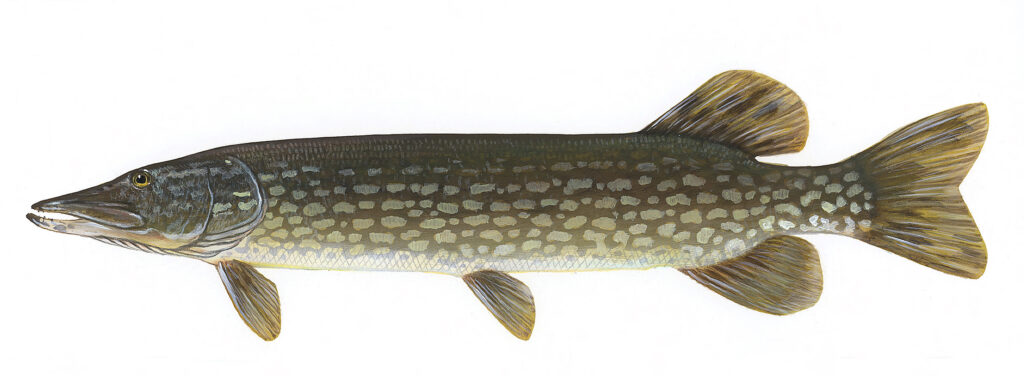
Identification
Northern pike are long, laterally compressed, torpedo-shaped fish with the dorsal and anal fins set far back near the tail — the classic ambush-predator layout. The head is long and flattened, and the National Park Service describes jaws lined with rows of needle-sharp and razor-edged teeth that slant back toward the throat.
The colour pattern is the single most useful field character, and it is the reverse of a muskellunge’s. Pike carry light spots on a dark background — Iowa describes them as light, bean-shaped spots arranged in horizontal rows across a dark green to olive body. Muskellunge carry dark markings on a light background. Anglers who remember only one thing about separating the two should remember that the pattern is inverted between them.
Northern pike versus muskellunge
Colour pattern is diagnostic but variable, so two structural characters are used to confirm. The first is scaling on the head. The Iowa Department of Natural Resources gives it simply: pike have scales covering the entire cheek, while in muskellunge the scales cover only the top half. Missouri describes muskellunge as having both the gill cover and the cheek scaled only on their upper halves. New Jersey’s account of the tiger muskellunge — the pike × muskellunge hybrid — confirms the pike pattern from the other direction, describing the hybrid as having partly scaled gill covers and a fully scaled cheek like the northern pike.
The second is pore counts. Turning the fish over and counting the sensory pores along the underside of each side of the lower jaw gives a clean split: Iowa gives pike five or fewer pores per side and muskellunge six or more; Missouri independently gives muskellunge 6 to 9 pores along each side of the lower jaw. New Jersey puts tiger muskellunge at 5 to 6 per side, which is exactly where a hybrid should fall and exactly why pore count alone will not settle a hybrid.
Tail shape provides a third check. Iowa notes that true muskellunge tails split into two points, while pike and tiger muskellunge tails split into two rounded lobes; Wisconsin adds that muskellunge fins are pointed and often rust-coloured while pike fins are rounded.
Range and distribution
Northern pike are circumpolar. The USFWS ecological risk screening gives the North American native range as the Atlantic, Arctic, Pacific, Great Lakes and Mississippi basins from Labrador to Alaska and south to Pennsylvania and Nebraska. Alaska illustrates the native-versus-introduced split within a single state: the Alaska Department of Fish and Game describes pike as native from the Interior to the Arctic coast and southwest to the Bristol Bay drainages, while illegally stocked pike have established themselves in the Susitna drainage and on the Kenai Peninsula.
Outside the native range the species is a documented problem. USGS records pike as extensively introduced across the continental United States and extirpated in California, and summarises the ecological effect as significant reduction of prey density and, in some cases, species elimination. Documented impacts include threats to native cutthroat and bull trout in Montana, to isolated stickleback populations in Alaska that have evolved distinctive traits over roughly 22,000 years, and suspected destruction of a premier landlocked salmon population in Maine.
Habitat and water temperature
Pike are a vegetation-and-margin fish. USFWS describes habitat as clear vegetated lakes and the quiet pools and backwaters of creeks and rivers, usually at one to five metres. The Royal Ontario Museum gives essentially the same picture — clear, cool to warm, weedy bays of lakes and slow, meandering, heavily vegetated rivers. In riverine settings this translates to vegetated side channels, sloughs and backwaters rather than the main current thread.
Thermally, the Royal Ontario Museum gives a preferred range of 17–24°C (63–75°F) and classes pike as a coolwater species. The Fisheries and Oceans Canada biological synopsis is more precise about the difference between preference and performance: growth rate increases rapidly above 10°C and is highest between 19°C for biomass and 21°C for length, with young-of-year preferring slightly warmer water at 22–23°C. The same synopsis gives the upper lethal temperature as 29.4°C, about 85°F, citing Casselman, and notes tolerance down to 0.1°C.
Oxygen is the other half of the story, and pike tolerance here is remarkable. The synopsis records pike surviving concentrations as low as 0.3 mg/l in shallow lakes and being taken alive at 0.04 mg/l, while noting they begin seeking higher oxygen below 4 mg/l and stop feeding below 2 mg/l. In practice this means pike will occupy warm, weedy, oxygen-poor backwater that most other large predators cannot use — up to the point where the temperature itself becomes limiting.
Life history
Pike spawn earlier than almost any other North American freshwater predator. Alaska describes spawning in the spring soon after the ice goes out, in the grassy margins of a lake shore, slow stream or slough. The DFO synopsis gives the migration trigger as water warming to 8–12°C, at which point fish leave still water and move up tributaries into flooded marsh. The Royal Ontario Museum gives a broader spawning range of 4–11°C. Spawning occurs during the day, with fish swimming over vegetation in very shallow water and releasing eggs and sperm simultaneously; eggs adhere to submerged plants and are deposited over two to five days. There is no parental care.
Growth is fast. The DFO synopsis offers a rule of thumb for the Great Lakes of about 10 mm of length per week post-hatch, producing a 15 cm fish by the end of the first summer. Growth then varies enormously with latitude and forage: Alaska records that in the Interior a 12-inch pike may be two to three years old and a 25-inch, five-pound fish six to eight years, with fish over 15 pounds commonly 10 to 17 years old. Longevity is high — the Royal Ontario Museum gives 10 to 26 years and both DFO and USFWS record a maximum of 30.
Early development is temperature-sensitive in ways that matter for river populations. A 2022 study in Knowledge and Management of Aquatic Ecosystems incubated pike embryos at 8, 10, 12, 14 and 16°C and found survival of well-formed post-hatch stages was broadly similar from 10 to 16°C (70–76 per cent), that development took three times as long at 8°C as at 16°C, and that larvae at 16°C were largest and best provisioned at first feeding while those at 8°C were smallest. Malformation rates stayed under 4 per cent throughout.
Diet
Pike are opportunistic piscivores with a strong preference for prey shape. The National Park Service notes they prefer cylindrical fish without spines because those are easier to swallow, and records consumption of up to a fifth of body weight per day. The DFO synopsis identifies yellow perch as the dominant prey across much of the range, with invertebrates taken opportunistically when fish are unavailable, and gives optimal prey size as one-third to one-half the pike’s own body length. Alaska records adults eating whitefish, suckers, burbot, smaller pike and juvenile salmon, with large adults taking voles, shrews, red squirrels and small waterfowl.
Cannibalism is not incidental. In waters where forage is limited, pike populations frequently become dense and stunted, and the smaller size classes become a substantial part of the diet of larger fish.
Angling
Pike behaviour is legible because the fish is built for one thing. The body plan — dorsal and anal fins set far back, huge caudal, laterally compressed body — is optimised for a single explosive acceleration from a standing start over a short distance. That mechanical constraint dictates almost everything else: pike hold adjacent to cover with a clear lane to open water, they commit to prey that pass within a few body lengths, and they do not pursue over distance.
In rivers this puts pike in specific and predictable water. Vegetated backwaters, slough mouths, eddies behind woody debris, and the slack margins of side channels all provide the combination pike need — vegetation or structure to hide against, slack water so holding costs nothing, and adjacent moving water delivering prey. Pike are conspicuously absent from the main current thread that holds walleye and sauger.
Season and temperature move them within that template. Spring concentrates fish in the shallowest flooded vegetation available as the spawning migration runs at 46–54°F. Through summer, the combination of an 85°F lethal ceiling and a preference band topping out around 75°F pushes river pike toward cooler, deeper or better-oxygenated water; in shallow backwater systems this can mean the fish simply vacate reaches that stratify or warm through. Autumn cooling produces heavy feeding as fish rebuild condition. Live water-temperature readings are useful at both ends: readings in the high 40s bracket the spawn, and readings pushing 80°F and above indicate a reach approaching the species’ physiological ceiling.
Conservation
Northern pike are not federally listed and are secure across their native range; the U.S. Fish and Wildlife Service presents them as a common and highly sought recreational species. The conservation issue attached to pike is therefore not their scarcity but their spread. Illegal introductions have created established populations in Pacific and Rocky Mountain drainages where native salmonids and small isolated endemics are vulnerable, and several state and federal agencies actively manage against them there. Where pike are native, the principal habitat concern is the loss of the shallow flooded vegetation the species requires to spawn — the exact habitat most commonly removed by shoreline development, channelisation and stabilised water levels.
Where to catch it
173 waterways on GuidedFloats list northern pike, across 24 states. Each page carries live gauge readings, access notes, and the guides who fish it.
Alaska 4
- Chena River2,470 cfs
- Chena River below Moose Creek Dam1,880 cfs
- Kvichak River28,600 cfs
- Salcha River2,080 cfs
Colorado 2
- Taylor Park Reservoir
- Yampa River117 cfs
Connecticut 3
- Connecticut River Estuary
- Housatonic River864 cfs
- Quinebaug River869 cfs
Idaho 5
Illinois 11
- Apple River102 cfs
- Channel Lake
- Fox Lake
- Fox River1,500 cfs
- Kankakee River1,610 cfs
- Kishwaukee River832 cfs
- Mackinaw River104 cfs
- Macoupin Creek15 cfs
- Pecatonica River1,180 cfs
- Rock River4,980 cfs
- Spring Brook2 cfs
Indiana 6
- Hamilton Lake
- Lake Maxinkuckee
- Mississinewa River22 cfs
- Pike Lake
- Sylvan Lake
- Tippecanoe River519 cfs
Iowa 15
- Beaver Creek894 cfs
- Big Bear Creek217 cfs
- Black Hawk Creek832 cfs
- Black Hawk Lake
- Cedar River9,550 cfs
- Clear Lake
- Maquoketa River2,440 cfs
- Spirit Lake
- Spring Creek
- Storm Lake
- Turkey River2,730 cfs
- Upper Iowa River725 cfs
- Wapsipinicon River3,280 cfs
- West Okoboji Lake
- Wolf Creek621 cfs
Maine 1
- Androscoggin River2,180 cfs
Massachusetts 3
- Connecticut River7,210 cfs
- Merrimack River2,870 cfs
- Westfield River574 cfs
Michigan 12
- Austin Lake
- Cisco Lake
- Grand River90 cfs
- Houghton Lake
- Intermediate Lake
- Lake Gogebic
- Lake St Helen
- Mullett Lake
- Otsego Lake
- Rifle River338 cfs
- Thornapple River208 cfs
- Van Etten Lake
Minnesota 15
- Cannon River539 cfs
- Crane Lake
- Kettle River89 cfs
- Lake Minnetonka
- Lake of the Woods
- Lake Traverse
- Leech Lake
- Lower Red Lake
- Mille Lacs Lake
- Minnehaha Creek below Grays Bay Dam
- Mississippi River6,000 cfs
- Orwell Lake
- Rainy River6,590 cfs
- St. Croix River3,500 cfs
- Upper Red Lake
Montana 4
- Clark Fork1,470 cfs
- Flathead Lake
- Hungry Horse Reservoir
- Jefferson River1,070 cfs
Nebraska 11
- Bazile Creek43 cfs
- Bow Creek37 cfs
- Cedar River262 cfs
- Dismal River255 cfs
- Elkhorn River1,210 cfs
- Frenchman Creek13 cfs
- Logan Creek205 cfs
- Middle Loup River1,200 cfs
- North Loup River391 cfs
- Ponca Creek8 cfs
- Spring Creek
New Jersey 1
- Passaic River1,110 cfs
New Mexico 4
- Eagle Nest Lake
- Rio Chama200 cfs
- Rio Chama below Abiquiu Dam182 cfs
- Rio Grande186 cfs
New York 11
- Black River4,650 cfs
- Cayuga Lake
- Conesus Lake
- Genesee River919 cfs
- Great Sacandaga Lake
- Lake George
- Mohawk River140 cfs
- Oswegatchie River905 cfs
- Owasco Lake
- Saranac River1,330 cfs
- Saratoga Lake
North Dakota 19
- Apple Creek
- Baldhill Creek48 cfs
- Devils Lake
- Dry Lake
- Eastern Stump Lake
- Homme Reservoir
- James River275 cfs
- Lake Ashtabula
- Lake Darling
- Missouri River (North Dakota)13,000 cfs
- Morrison Lake
- Pipestem Creek9 cfs
- Red River of the North2,330 cfs
- Sheyenne River254 cfs
- Sheyenne River below Baldhill Dam161 cfs
- Sheyenne River below Devils Lake Outlet4 cfs
- Short Creek Dam
- Tobacco Garden Creek3 cfs
- White Earth Lake
Ohio 8
- Chagrin River146 cfs
- Cuyahoga River368 cfs
- Mahoning River465 cfs
- Mosquito Creek below Mosquito Creek Dam3 cfs
- Mosquito Creek Lake
- Rocky River122 cfs
- Sandusky River66 cfs
- Tuscarawas River
Pennsylvania 4
Rhode Island 1
- Blackstone River506 cfs
South Dakota 6
- Belle Fourche Reservoir
- Belle Fourche River12 cfs
- Lake Kampeska
- Lake Oahe
- Missouri River (South Dakota)
- Pactola Reservoir
Vermont 8
- Lake Champlain
- Lake Memphremagog
- Lamoille River251 cfs
- Lewis Creek36 cfs
- Little Otter Creek13 cfs
- Missisquoi River969 cfs
- Otter Creek705 cfs
- Winooski River1,020 cfs
Washington 1
- Spokane River1,600 cfs
Wisconsin 18
- Anvil Lake
- Brule River526 cfs
- Chippewa River1,480 cfs
- Devils Lake
- Dorn Creek4 cfs
- Eau Galle River16 cfs
- Fox River (Wisconsin)1,160 cfs
- Geneva Lake
- Green Lake
- Lac Vieux Desert
- Lake Kegonsa
- Lake Koshkonong
- Lake Mendota
- Lake Waubesa
- Namekagon River44 cfs
- Peshtigo River243 cfs
- Tenmile Creek48 cfs
- Wolf River1,570 cfs
References
- Ecological Risk Screening Summary — Northern Pike (Esox lucius) — U.S. Fish and Wildlife Service
- Northern Pike (Esox lucius) — U.S. Fish and Wildlife Service
- A biological synopsis of northern pike (Esox lucius), Can. Manuscr. Rep. Fish. Aquat. Sci. 2885 — Fisheries and Oceans Canada (Harvey 2009)
- Northern Pike (Esox lucius) — Species Profile, Nonindigenous Aquatic Species — U.S. Geological Survey
- Northern Pike (Esox lucius) — life history — Ontario Freshwater Fishes Life History Database, Royal Ontario Museum
- Northern Pike species profile — Alaska Department of Fish and Game
- Northern Pike (Esox lucius) — National Park Service, Mississippi National River and Recreation Area
- Know Your Catch: How to ID Northern Pike and Muskies — Iowa Department of Natural Resources
- Muskellunge — Field Guide — Missouri Department of Conservation
- Tiger Muskellunge — Delaware River species account — New Jersey Division of Fish and Wildlife
- Effects of temperature on the survival and development of the early life stages of northern pike (Esox lucius) — Knowledge and Management of Aquatic Ecosystems (Réalis-Doyelle et al. 2022)
- Muskellunge fact sheet — Wisconsin Department of Natural Resources
- 12 of the Largest Northern Pike in IGFA World Record History — International Game Fish Association
- IGFA Game Fish Records — International Game Fish Association