Walleye
Sander vitreus
A cool-water river percid whose reflective eye buys it a real but narrow advantage in dim light — not darkness — and whose preferred band sits in the mid-60s to mid-70s Fahrenheit.
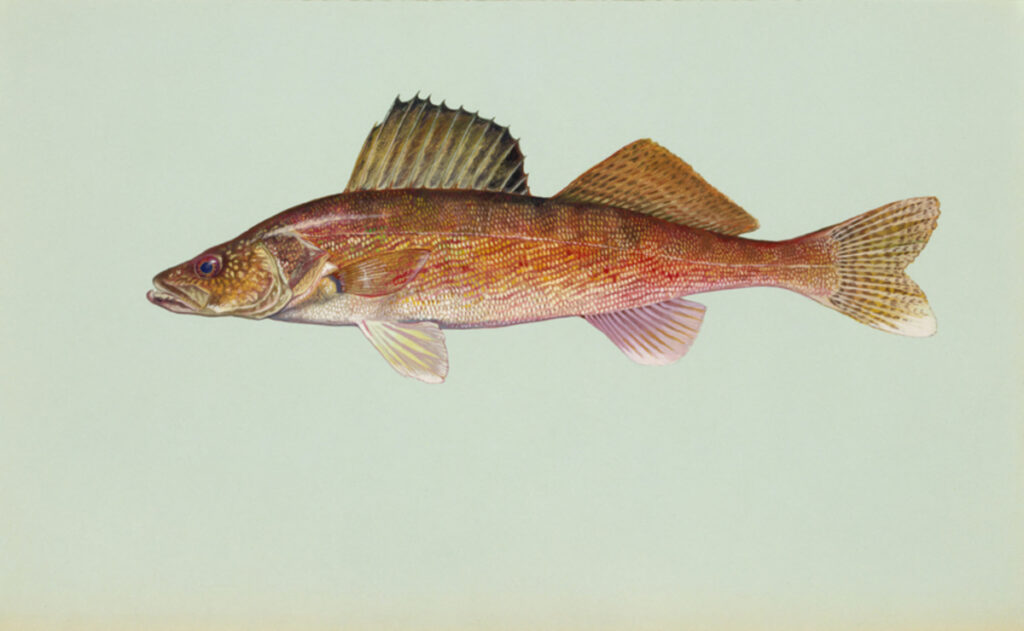
Identification
Walleye are elongate, nearly cylindrical percids with two separate dorsal fins, a forked tail, and a mouth full of long canine teeth. The back is olive to brassy gold, the flanks brassy or yellow with dark mottling, and the belly white. The Missouri Department of Conservation notes two features that carry most of the identification load: a large black blotch at the base of the last few spines of the spiny dorsal fin, and a conspicuously reflective eye. The species name vitreus means glassy, and Wisconsin’s fisheries program points out that the name refers directly to the large, glassy eye.
The second diagnostic feature is at the other end of the fish. The lower lobe of the caudal fin carries a distinct white or cream margin. On a live walleye in good light this tip is unmistakable, and it is the single fastest field character separating walleye from sauger.
Walleye, sauger and saugeye
Sauger overlap with walleye through most of the Mississippi, Missouri and Ohio systems, and the two are confused constantly. Three characters separate them reliably. First, the spiny dorsal fin: walleye carry a solid dark blotch at the rear base of the fin, while sauger carry rows of distinct dark spots on the fin membranes and lack the basal blotch. Second, the tail: walleye have the white lower-lobe tip, and in sauger that mark is absent or much reduced. Third, the body: sauger show discrete dark saddles or blotches on the flanks rather than the walleye’s diffuse mottling. The Missouri Department of Conservation adds a fourth, less convenient character: sauger have scales on the cheek, which in walleye are sparse or absent.
Complicating this is the saugeye, the walleye × sauger hybrid. The Ohio Division of Wildlife produces saugeye deliberately by fertilising walleye eggs with sauger milt and stocks them into reservoirs; the resulting fish are intermediate in almost every character. Saugeye typically show dark bars between the first few dorsal spines and a dusky blotch at the rear base of the fin, blotching smaller than a sauger’s, and a white tail tip more defined than a sauger’s but less than a walleye’s. Colour runs between the walleye’s grey-silver and the sauger’s bronze. Ohio also notes that while most saugeye are functionally sterile, a small fraction reproduce, and can backcross with either parent species.
Wild hybridisation is a separate question from hatchery production, and here the evidence is genuinely contested. Several state agencies list hybridisation with introduced walleye among the threats to native sauger, and Wyoming records the first documented hybrids in its Bighorn River population in 2014. But a microsatellite study of 925 fish from the upper Missouri drainage found only 18 hybrids — about 1.9 per cent — and 17 of those came from the Yellowstone drainage despite heavier walleye stocking in the Missouri itself. Bingham and colleagues concluded that introgression of walleye genes into native sauger was not an immediate threat in that system. The disagreement is real and unresolved.
Range and distribution
The native range covers the St. Lawrence–Great Lakes, Arctic and Mississippi basins from Quebec to the Northwest Territories, south to Alabama and Arkansas. Beyond that, walleye have been moved almost everywhere. The USGS Nonindigenous Aquatic Species database records walleye in 48 states, with the earliest introduction — to California’s Sacramento River — in 1874. Some populations are self-sustaining; others persist only through annual stocking.
The introductions are not ecologically neutral. USGS documents walleye consuming roughly two million salmonid smolts annually in the Columbia River, about a third of total predation loss there, and records a reservoir where yellow perch fell from 80 per cent of the fish community to 1 per cent following walleye establishment. Abundance in the Clark Fork and Pend Oreille rivers doubled between 2011 and 2014. Illegal stocking is described as a growing problem in western states.
Habitat and water temperature
Walleye are a cool-water species — the Minnesota DNR places them between trout and bass in thermal preference. The Royal Ontario Museum’s life-history database gives a preferred range of 19–23°C (66–73°F) and classes the species as coolwater. The USFWS ecological risk screening puts summer preference slightly higher at 20–24°C (68–75°F), notes that adults avoid water above 24°C where they can, and gives upper thermal tolerance as 29–34°C (84–93°F). Treating the mid-60s to mid-70s as the working band and 75°F as the point where fish begin actively avoiding surface water is consistent with both.
In rivers the species occupies pools, runs and backwaters of medium to large channels. Missouri’s account of Ozark stream walleye is specific: in waters like the Current River they hold in pools twelve feet deep or more where the bottom is broken by boulders and submerged logs, and move shallow at night. That vertical and diel pattern is the general river template — deep structured holding water by day, shallower feeding water after dark, with the whole system compressed or abandoned when summer temperatures climb.
Temperature also governs recruitment, not just adult comfort. A USGS-affiliated analysis of walleye recruitment across 359 Wisconsin lakes found the relationship between annual degree-days and age-0 walleye success varied by water body, with negative temperature effects strongest where largemouth bass were abundant. Wisconsin’s climate assessment frames the same problem plainly: the state sits near the southern edge of the historical range, and a few degrees of warming can move lakes outside the range for successful reproduction.
The eye: what the tapetum lucidum actually does
The reflective layer behind a walleye’s retina — the tapetum lucidum — is the most repeated fact about the species and the most frequently overstated. Minnesota describes it accurately as a reflective pigment layer that helps the fish see and feed at night or in turbid water, and notes the consequence for prey: yellow perch cannot see as well as walleye in low light and are correspondingly vulnerable after dark.
What the tapetum does not do is make walleye see in the dark. A 2025 study in Environmental Biology of Fishes measured foraging directly across ecologically realistic downwelling light levels and found that prey capture success in age-0 walleye peaked at low light, averaging 20.5 per cent between nautical and civil twilight at intensities of roughly 0.05–1 lux, and declined both as light increased and in complete darkness. The same work found broad spectral sensitivity greatest between 500 and 550 nm — green wavelengths, which is what penetrates most stained inland water.
The correct reading is therefore narrower and more useful than the folklore. Walleye are twilight and dim-light specialists with a competitive window measured in a couple of orders of magnitude of light intensity, not nocturnal hunters with unlimited night vision. Turbidity, cloud cover and depth all shift where in the day that window falls, which is why walleye in stained water feed through the day while walleye in clear water compress their feeding into dawn, dusk and night.
Life history
Walleye spawn in early spring. Wisconsin records upstream movement beginning at water temperatures of 38–44°F, with spawning peaking at 42–50°F; Minnesota gives the same 42–50°F peak. USFWS gives roughly 45°F as the typical trigger and 12 to 30 days for incubation depending on conditions. Spawning happens over rock, rubble and gravel — tributary gravel shoals, rocky points, the faces of dams, or wind-swept shallows in one to six feet of water. There is no parental care; eggs are broadcast and abandoned. A five-pound female deposits more than 100,000 eggs.
Maturity comes at three to four years for males and four to five for females. The Royal Ontario Museum gives a normal lifespan of 12 to 26 years, and USFWS records a maximum documented age of 29.
Diet
Young walleye take zooplankton and aquatic insects, and mayflies remain significant throughout life. Adults are predominantly piscivorous. Minnesota records heavy predation on yellow perch specifically, and the mechanism is visual: the walleye’s low-light advantage over its principal prey species is what makes the relationship work. In rivers the forage base shifts to shad, shiners and small suckers, with crayfish and leeches taken opportunistically.
Angling
Walleye behaviour in rivers is driven by three variables in combination — light, current and temperature — and none of them acts alone. The light response follows the physiology above: in clear water fish hold deep and structured through the middle of the day and move onto shallower feeding ground around twilight, while in turbid water the low-light window is effectively present all day and fish feed accordingly. Wisconsin makes the same observation from the fishery side: in clear waters walleye stay deep by day and move shallow at night, but in more turbid waters they can be caught throughout the day.
Current adds a second layer. River walleye are current-edge fish, holding in the slower water immediately adjacent to faster flow — behind boulders, along seams, in the scoured pools Missouri describes. That positioning is energetic, not preferential: the fish uses the structure to avoid paying for the current while remaining where drifting or disoriented forage arrives.
Temperature governs the seasonal frame. Walleye congregate near spawning gravel in the low 40s Fahrenheit, disperse afterward, feed heavily through the 60s, and in summer either hold deep or abandon warmed reaches entirely as water passes the mid-70s. Live water-temperature readings are therefore genuinely diagnostic on a river: a reach reading 72°F and a reach reading 82°F hold walleye in fundamentally different places, if at all.
Conservation and management
The species is globally secure. NatureServe assigns a global rank of G5, as reported through the Montana Field Guide, and there is no federal listing. Management concerns are local rather than global: recruitment failure at the warm southern edge of the range, the ecological cost of introductions outside it, and the interaction of both with stocking programmes. Missouri, for instance, reports walleye numbers increasing as a direct result of stocking. Where walleye have been introduced west of the native range, USGS documents them as a significant predator on native salmonids and a driver of forage-base collapse — the same trait that makes them a valued sport fish in their native rivers.
Where to catch it
231 waterways on GuidedFloats list walleye, across 32 states. Each page carries live gauge readings, access notes, and the guides who fish it.
Arkansas 7
- Beaver Lake
- Bull Shoals Lake
- Illinois Bayou4 cfs
- Lake Hamilton
- Mammoth Spring
- Spring River299 cfs
- Spring River
Colorado 2
Georgia 1
Illinois 10
- Apple River102 cfs
- Channel Lake
- Fox Lake
- Fox River1,500 cfs
- Kankakee River1,610 cfs
- Kishwaukee River832 cfs
- Macoupin Creek15 cfs
- Pecatonica River1,180 cfs
- Rock River4,980 cfs
- Wabash River9,570 cfs
Indiana 11
- Brookville Lake
- Cecil M. Harden Lake
- Hamilton Lake
- Lake Maxinkuckee
- Mississinewa Lake
- Monroe Lake
- Pike Lake
- Salamonie Lake
- Sylvan Lake
- Tippecanoe River519 cfs
- White River (Indiana)1,050 cfs
Iowa 17
- Beaver Creek894 cfs
- Big Bear Creek217 cfs
- Black Hawk Creek832 cfs
- Black Hawk Lake
- Cedar River9,550 cfs
- Clear Lake
- Iowa River4,540 cfs
- Maquoketa River2,440 cfs
- Rathbun Lake
- Spirit Lake
- Spring Creek
- Storm Lake
- Turkey River2,730 cfs
- Upper Iowa River725 cfs
- Wapsipinicon River3,280 cfs
- West Okoboji Lake
- Wolf Creek621 cfs
Kansas 13
- Cedar Bluff Reservoir
- Cheney Reservoir
- Clinton Lake
- Hillsdale Lake
- Horsethief Reservoir
- Kanopolis Lake
- Kansas River15,100 cfs
- Melvern Lake
- Milford Lake
- Perry Lake
- Pomona Lake
- Tuttle Creek Lake
- Wilson Lake
Kentucky 2
Maryland 2
- Potomac River5,250 cfs
- Youghiogheny River (Maryland)383 cfs
Massachusetts 1
- Connecticut River7,210 cfs
Michigan 13
- Austin Lake
- Cisco Lake
- Grand River90 cfs
- Houghton Lake
- Intermediate Lake
- Lake Gogebic
- Lake St Helen
- Mullett Lake
- Muskegon River1,370 cfs
- Otsego Lake
- Rifle River338 cfs
- Thornapple River208 cfs
- Van Etten Lake
Minnesota 15
- Cannon River539 cfs
- Crane Lake
- Kettle River89 cfs
- Lake Minnetonka
- Lake of the Woods
- Lake Traverse
- Leech Lake
- Lower Red Lake
- Mille Lacs Lake
- Minnehaha Creek below Grays Bay Dam
- Mississippi River6,000 cfs
- Orwell Lake
- Rainy River6,590 cfs
- St. Croix River3,500 cfs
- Upper Red Lake
Missouri 6
- Bryant Creek140 cfs
- Eleven Point River271 cfs
- Gasconade River479 cfs
- James River152 cfs
- Spring River78 cfs
- Table Rock Lake
Nebraska 13
- Bazile Creek43 cfs
- Big Blue River1,020 cfs
- Bow Creek37 cfs
- Cedar River262 cfs
- Elkhorn River1,210 cfs
- Frenchman Creek13 cfs
- Harlan County Lake
- Loup River287 cfs
- Middle Loup River1,200 cfs
- Niobrara River543 cfs
- North Loup River391 cfs
- Platte River5,750 cfs
- Ponca Creek8 cfs
Nevada 2
New Jersey 1
- Delaware River5,490 cfs
New Mexico 7
- Brantley Lake
- Conchas Lake
- Lake Sumner
- Rio Chama200 cfs
- Rio Grande below Elephant Butte Dam
- Santa Rosa Lake
- Ute Reservoir
New York 9
- Black River4,650 cfs
- Chautauqua Lake
- Conesus Lake
- Genesee River919 cfs
- Great Sacandaga Lake
- Mohawk River140 cfs
- Oswegatchie River905 cfs
- Saranac River1,330 cfs
- Saratoga Lake
North Carolina 1
- Catawba River2,940 cfs
North Dakota 19
- Apple Creek
- Baldhill Creek48 cfs
- Devils Lake
- Dry Lake
- Eastern Stump Lake
- Homme Reservoir
- James River275 cfs
- Lake Ashtabula
- Lake Darling
- Missouri River (North Dakota)13,000 cfs
- Morrison Lake
- Pipestem Creek9 cfs
- Red River of the North2,330 cfs
- Sheyenne River254 cfs
- Sheyenne River below Baldhill Dam161 cfs
- Sheyenne River below Devils Lake Outlet4 cfs
- Short Creek Dam
- Tobacco Garden Creek3 cfs
- White Earth Lake
Ohio 8
- Berlin Lake
- Caesar Creek Lake
- Cuyahoga River368 cfs
- Mahoning River465 cfs
- Maumee River1,100 cfs
- Mosquito Creek below Mosquito Creek Dam3 cfs
- Mosquito Creek Lake
- Sandusky River66 cfs
Oklahoma 6
- Canton Lake
- Fort Cobb Reservoir
- Lake Eucha
- Lake Hefner
- Lake Lawtonka
- North Fork Red River below Altus Dam1 cfs
Oregon 2
- Columbia River74,000 cfs
- Willamette River6,700 cfs
Pennsylvania 12
- Allegheny Reservoir
- Allegheny River below Kinzua Dam2,310 cfs
- Clarion River508 cfs
- Glendale Lake
- Lackawaxen River199 cfs
- Lake Arthur
- Lehigh River1,250 cfs
- Lehigh River below Francis E. Walter Dam700 cfs
- Pymatuning Reservoir
- Raystown Lake
- Susquehanna River16,600 cfs
- Youghiogheny River2,260 cfs
South Dakota 7
- Belle Fourche Reservoir
- Belle Fourche River12 cfs
- Cheyenne River80 cfs
- Lake Kampeska
- Lake Oahe
- Missouri River (South Dakota)
- White River97 cfs
Tennessee 5
- Clinch River714 cfs
- Cumberland River below Cordell Hull Dam
- French Broad River1,360 cfs
- Nolichucky River964 cfs
- Nolichucky River below Nolichucky Dam959 cfs
Vermont 7
- Lake Champlain
- Lake Memphremagog
- Lamoille River251 cfs
- Little Otter Creek13 cfs
- Missisquoi River969 cfs
- Otter Creek705 cfs
- Winooski River1,020 cfs
Virginia 3
- Clinch River453 cfs
- New River2,500 cfs
- Pound River below Flannagan Dam
Washington 2
- Moses Lake
- Spokane River1,600 cfs
West Virginia 7
- Cacapon River286 cfs
- Cheat River3,290 cfs
- Elk River (West Virginia)3,500 cfs
- Gauley River1,910 cfs
- Gauley River below Summersville Dam
- Tygart Lake
- Tygart Valley River606 cfs
Wisconsin 18
- Anvil Lake
- Brule River526 cfs
- Chippewa River1,480 cfs
- Devils Lake
- Eau Galle River16 cfs
- Fox River (Wisconsin)1,160 cfs
- Green Lake
- Lac Vieux Desert
- Lake Kegonsa
- Lake Koshkonong
- Lake Mendota
- Lake Monona
- Lake Waubesa
- Lake Winnebago
- Namekagon River44 cfs
- Peshtigo River243 cfs
- Wisconsin River5,390 cfs
- Wolf River1,570 cfs
Wyoming 2
References
- Walleye biology and identification — Minnesota Department of Natural Resources
- Ecological Risk Screening Summary — Walleye (Sander vitreus) — U.S. Fish and Wildlife Service
- Freshwater Fish of America — Walleye — U.S. Fish and Wildlife Service
- Walleye (Sander vitreus) — Species Profile, Nonindigenous Aquatic Species — U.S. Geological Survey
- Visual sensitivity, foraging behavior, and success of walleye (Sander vitreus) under ecologically relevant downwelling light conditions — Environmental Biology of Fishes (Michels et al. 2025)
- Walleye (Sander vitreus) — life history — Ontario Freshwater Fishes Life History Database, Royal Ontario Museum
- Walleye — Field Guide — Missouri Department of Conservation
- Sauger — Field Guide — Missouri Department of Conservation
- Walleye — Fishes of Wisconsin — Wisconsin Department of Natural Resources
- Walleye (Sander vitreus) species detail — Montana Field Guide, Montana Natural Heritage Program
- Saugeye — Ohio Department of Natural Resources, Division of Wildlife
- Near absence of hybridization between sauger and introduced walleye despite massive releases — Conservation Genetics (Bingham et al. 2012)
- Walleye recruitment success is less resilient to warming water temperatures in lakes with abundant largemouth bass populations — U.S. Geological Survey Publications Warehouse
- The impact of climate change on walleye — Wisconsin Initiative on Climate Change Impacts, 2021 Assessment Report
- Tennessee Fishing Records and Awards — Tennessee Wildlife Resources Agency
- The facts supporting the Harper walleye reinstatement — Freshwater Fishing Hall of Fame
- Sauger species account — Wyoming Game and Fish Department
- IGFA Game Fish Records — International Game Fish Association