Brook Trout
Salvelinus fontinalis
The native char of eastern North America, brook trout are a fish defined by cold groundwater, and cellular stress sets in near 70 degrees F.
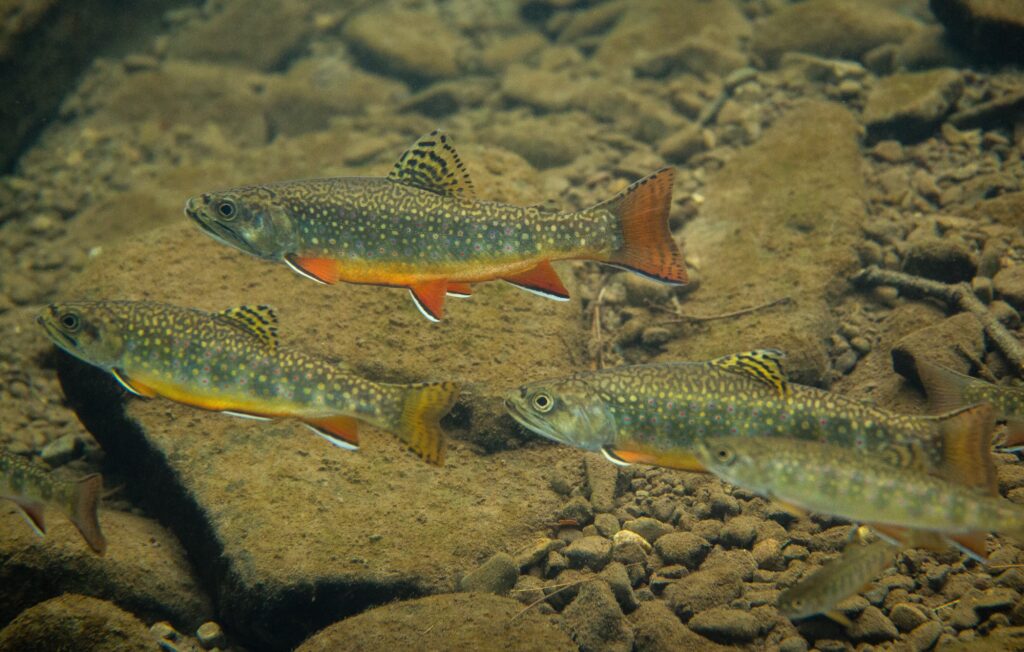
Identification
Brook trout are not trout. They are char, in the genus Salvelinus alongside lake trout, bull trout, Dolly Varden, and Arctic char, and they carry the diagnostic char pattern: light marks on a dark ground rather than dark spots on a light one. The back is dark olive to black, worked over with pale, worm-like vermiculations that run onto the dorsal fin and the top of the tail. The flanks carry cream spots mixed with a scatter of red dots, each ringed in a blue halo. That blue-haloed red spot is the single most reliable field mark on the species.
The lower fins settle the question in poor light. The pectoral, pelvic, and anal fins each carry a hard white leading edge backed by a black line, with orange behind it. The tail is square or barely notched, which is where the old name squaretail comes from. As spawning approaches, males intensify dramatically: the U.S. Fish and Wildlife Service describes flanks and belly turning orange-red with a black stripe along each side.
Size is a poor guide to identity, because it varies more with water than with genetics. In the acidic, nutrient-poor headwaters of Shenandoah National Park, adults run 6 to 13 inches, with rare fish near 16 inches in the larger streams, according to the National Park Service. In productive lakes and spring ponds the same species reaches 10 to 20 inches, and the USGS Nonindigenous Aquatic Species database gives a maximum of about 70 cm.
Range and distribution
The native range covers eastern North America: most of eastern Canada from Newfoundland to the western side of Hudson Bay, then south through the Atlantic, Great Lakes, and Mississippi basins to Minnesota, and down the Appalachians to northern Georgia. The Eastern Brook Trout Joint Venture works across the seventeen states of that southern and eastern portion.
Three ecological expressions survive within the native range. Stream-resident fish are by far the most numerous and the smallest. Coasters use Lake Superior and Lake Michigan as their growing water and return to tributaries to spawn. Salters are the coastal form, dropping into estuaries and brackish water to feed; Maine’s Department of Inland Fisheries and Wildlife reports that anadromous fish there spend 40 to 90 days in estuarine feeding before moving back to fresh water. Both coasters and salters are shadows of their former abundance.
Outside that native range brook trout are one of the most widely transplanted fish in the world. USGS records nonindigenous populations in 44 states, and the ecological consequences have been severe. In Colorado, stocked brook trout completely replaced greenback cutthroat trout in some drainages within five years. They displaced Lahontan cutthroat where the two met, contributed to the near-extinction of that subspecies in Lake Tahoe in the 1940s, and in Montana they compete with and hybridize with native bull trout, producing mostly sterile offspring.
Habitat and water temperature
Water temperature is the master variable for brook trout, and the numbers are well established. A synthesis of the laboratory literature prepared for water quality standards places the optimum growth range at 12.4 to 16 C (54 to 61 degrees F), with an upper optimum band extending to 17 to 19 C, and preferred temperatures in laboratory gradients spanning roughly 8.7 to 19 C. The same review gives an upper incipient lethal temperature of 24.3 to 25.3 C (76 to 78 degrees F) for fish acclimated at 15 to 20 C, and a critical thermal maximum of 28 to 30.8 C. Those figures come from the Nevada Division of Environmental Protection thermal tolerance analysis, which compiles Hokanson, McCormick, Cherry, and other primary studies.
The number that matters most in the field is lower than any lethal threshold. USGS researchers measured where physiological stress actually begins and found that gill heat shock protein-70 rises at 20.7 C and plasma glucose climbs at 21.2 C, or roughly 69 to 70 degrees F. Critically, field densities of brook trout were lowest at exactly those sites where summer temperatures were warm enough to trigger the response. That study, published by the U.S. Geological Survey, ties a cellular measurement directly to a distributional limit, which is rare and useful.
Management agencies apply a slightly more forgiving field rule. Maine treats 68 degrees F (20 C) as the practical upper limit, noting that trout are found in water up to 75 degrees F but that survival and growth depend on temperatures not exceeding 68 degrees F for extended periods and on dissolved oxygen staying at 5 ppm or better. Shenandoah National Park uses 20 C as the threshold for successful perennial-stream populations, noting elevated hatchling mortality above it. Wisconsin’s Department of Natural Resources lists a narrower preferred range of 53 to 57 degrees F. These are not contradictory so much as differently framed: the laboratory optimum, the stress onset, and the agency management line each answer a different question.
Duration matters as much as peak. USGS work on acclimation shows that brook trout held in warm water for long periods gain measurable thermal tolerance, and lose it again when moved back to cold. A stream reading 70 degrees F after a month of heat is a different fish habitat from a stream that spikes to 70 for two hours on one August afternoon.
Groundwater ties the whole system together. Brook trout concentrate at seeps, spring inflows, and confluences with colder tributaries during summer, and they spawn on groundwater upwelling in autumn. Where the aquifer connection is severed by withdrawal, channel incision, or riparian clearing, the fish go regardless of what the surface flow looks like.
Life history
Brook trout spawn in fall. Maine describes spawning in gravelly substrate over upwelling ground water in late September through November, earliest at high elevation and in the north. The National Park Service records early October through mid-November in Shenandoah streams, cued by decreasing daylight and cooling water. Females cut redds 4 to 12 inches deep and deposit 500 to 5,000 eggs depending on body size.
Incubation is slow and temperature-dependent. Wisconsin gives roughly 75 days at 48 degrees F; Minnesota’s DNR describes hatching in two to five months depending on water temperature. In Shenandoah, hatching begins in mid to late January and fry leave the gravel by mid-March.
They mature fast and die young. Maturity typically comes at age two or three, and sometimes at one. The most common age of a brook trout caught in a Maine lake is three years, and in a Maine stream two years. Few pass age three; Maine documents a nine-year-old as exceptional, and Wisconsin cites a five-to-six-year maximum. This short life is why brook trout populations swing hard with a run of bad water years and why a single failed year class shows up quickly.
Growth tracks productivity, not effort. Maine’s three-year-old lake fish average 13.3 inches across a 7.5 to 17.5 inch range, while wild stream fish sampled from 1959 to 1962 averaged just 7.8 inches at the same age.
Diet
Brook trout are opportunists that eat what the drift delivers. Maine lists worms, leeches, amphibians, crustaceans, mollusks, aquatic insects, terrestrial insects, and fish, and notes that fish do not become a significant part of the diet until a brook trout reaches 10 to 12 inches. That threshold explains a great deal about stream-resident populations, most of which never get there and remain invertebrate feeders for life.
Minnesota’s DNR describes young fish taking mayfly and damselfly larvae, flying insects, water beetles, snails, and worms, with larger individuals adding minnows. Terrestrial input matters disproportionately in small forested streams, where ants, beetles, and inchworms falling from a closed canopy can dominate summer stomach contents.
Angling
Brook trout have a reputation for being easy to catch, and the reputation is earned but misread. In infertile headwater streams the growing season is short and every drifting item has to be evaluated fast; a fish that hesitates does not make it to spawning age. The aggression is a consequence of scarcity, not naivety, and it disappears in productive spring creeks and lakes where the same species can be as selective as any brown trout.
Distribution within a river is thermal and seasonal. Through summer, brook trout stack at spring seeps, cold tributary mouths, and shaded plunge pools, sometimes at densities that look implausible for the surface area involved. This is the mechanism behind the familiar pattern of empty water and then a concentration: the fish have not moved randomly, they have moved to the coldest available oxygen-rich water. Live water temperature is the most predictive single number for a brook trout river in July and August, and the relevant question is not whether a reading is lethal but whether it has crossed roughly 68 to 70 degrees F, where growth stops and stress begins.
In autumn the pattern reverses. Fish leave lakes and mainstem holding water and move onto gravel with groundwater upwelling, which is often shallow, small, and easily disturbed. Spawning aggregations concentrate the entire reproductive output of a population into a few square meters of substrate.
Conservation
The species is globally secure and the eastern native populations are not. NatureServe ranks Salvelinus fontinalis G5, secure, on the strength of a very large number of subpopulations and a wide introduced range, while noting substantial contraction in the native East. The U.S. Fish and Wildlife Service determined in 2009 that the species is not a listable entity under the Endangered Species Act.
The regional picture is harder. The Eastern Brook Trout Joint Venture’s assessment found that only 8 percent of subwatersheds that historically supported wild brook trout in the eastern United States remain intact, defined as at least half of catchments still holding wild fish. The Roadmap to Restoration ranks the drivers by region: development, roads, and pasture dominate in the Northeast; development, dams, agriculture, and acid drainage from mining in the Mid-Atlantic; urban expansion, dams, and cropland in the Southeast Atlantic. Every one of those threats acts partly through temperature, by removing shade, widening channels, adding impervious runoff, or cutting off groundwater.
Maine holds the largest remaining reserve in the Northeast, with roughly 22,250 miles of stream supporting principal brook trout fisheries and 1,148 lakes covering 431,035 acres, and designated brook trout a State Heritage Fish in 2005.
Brook trout are also acid tolerant in a way that has shaped their persistence in the southern Appalachians. The National Park Service notes they are the most acid-tolerant fish in Shenandoah’s current fish community, reproducing successfully at pH as low as 4.5, which is why they held on in headwaters where other species failed during peak acid deposition.
Where brook trout have been introduced, the conservation calculus inverts. In the Rocky Mountains they occupy the mid-elevation reaches that native bull trout and cutthroat need, and warming is expected to compress native cold-water habitat further while brook trout advance upstream behind it. The Montana Fish, Wildlife and Parks account of bull trout decline lists brook trout competition and hybridization among the principal causes. The same fish is a conservation priority in Virginia and a removal target in Montana.
Where to catch it
267 waterways on GuidedFloats list brook trout, across 34 states. Each page carries live gauge readings, access notes, and the guides who fish it.
Arizona 2
- Oak Creek59 cfs
- West Fork Oak Creek3 cfs
Arkansas 2
- Little Red River226 cfs
- White River1,720 cfs
California 2
- Hat Creek120 cfs
- Merced River14 cfs
Colorado 12
- Animas River149 cfs
- Blue River below Green Mountain Reservoir188 cfs
- Boulder Creek12 cfs
- Cache la Poudre River26 cfs
- Clear Creek57 cfs
- Dolores River312 cfs
- Eagle River7 cfs
- East River64 cfs
- Fryingpan River76 cfs
- Roaring Fork River512 cfs
- Taylor River42 cfs
- Uncompahgre River65 cfs
Connecticut 7
- Farmington River594 cfs
- Natchaug River123 cfs
- Naugatuck River264 cfs
- Salmon Creek22 cfs
- Salmon River (Connecticut)86 cfs
- Saugatuck River11 cfs
- West Branch Farmington River151 cfs
Delaware 1
- Red Clay Creek38 cfs
Georgia 4
- Chattooga River182 cfs
- Soque River68 cfs
- Tallulah River54 cfs
- Toccoa River163 cfs
Idaho 14
- Big Lost River102 cfs
- Big Wood River54 cfs
- Henrys Fork92 cfs
- Henrys Lake
- Lochsa River359 cfs
- Mackay Reservoir
- Medicine Lodge Creek26 cfs
- Silver Creek92 cfs
- St. Joe River341 cfs
- Teton River406 cfs
- Thousand Springs Creek5 cfs
- Valley Creek91 cfs
- Warm Springs Creek29 cfs
- Warm Springs Creek40 cfs
Iowa 3
- Bloody Run Creek25 cfs
- Waterloo Creek
- Yellow River215 cfs
Maine 14
- Allagash River591 cfs
- Androscoggin River2,180 cfs
- Aroostook River182 cfs
- Branch Brook8 cfs
- East Branch Penobscot River476 cfs
- East Branch Penobscot River below Grand Lake Matagamon194 cfs
- Fish River133 cfs
- Grand Lake Stream369 cfs
- Kennebec River1,700 cfs
- Meduxnekeag River42 cfs
- Narraguagus River180 cfs
- Piscataquis River714 cfs
- St. Croix River373 cfs
- Stony Brook
Maryland 4
- Gunpowder Falls77 cfs
- Savage River74 cfs
- Wills Creek98 cfs
- Youghiogheny River (Maryland)383 cfs
Massachusetts 10
- Deerfield River932 cfs
- Indian Head River37 cfs
- Jones River27 cfs
- Millers River331 cfs
- Monatiquot River16 cfs
- Quashnet River13 cfs
- Quinebaug River80 cfs
- Swift River126 cfs
- West River
- Westfield River574 cfs
Michigan 7
- Au Sable River1,270 cfs
- Boardman River117 cfs
- Jordan River185 cfs
- Manistee River1,160 cfs
- Pere Marquette River608 cfs
- Presque Isle River84 cfs
- Rifle River338 cfs
Minnesota 5
- Crooked Creek
- Root River983 cfs
- Rush Creek
- South Fork Root River201 cfs
- Straight River35 cfs
Montana 10
- Big Hole River471 cfs
- Big Spring Creek152 cfs
- Gallatin River360 cfs
- Hungry Horse Reservoir
- Lake Como
- Madison River below Hebgen Lake707 cfs
- Rock Creek270 cfs
- Ruby River53 cfs
- Stillwater River414 cfs
- Warm Springs Creek58 cfs
Nebraska 1
- Long Pine Creek146 cfs
Nevada 5
- Lamoille Creek3 cfs
- Lehman Creek4 cfs
- Marlette Lake
- South Fork Reservoir
- Steptoe Creek2 cfs
New Hampshire 20
- Ammonoosuc River124 cfs
- Androscoggin River (New Hampshire)1,430 cfs
- Ashuelot River429 cfs
- Ashuelot River below Surry Mountain Dam129 cfs
- Baker River95 cfs
- Bearcamp River45 cfs
- Beaver Brook25 cfs
- Cold River31 cfs
- Connecticut River (New Hampshire)467 cfs
- Contoocook River98 cfs
- Contoocook River below Hopkinton Dam485 cfs
- Diamond River263 cfs
- East Branch Pemigewasset River169 cfs
- Nubanusit Brook below MacDowell Dam
- Peabody River74 cfs
- Pemigewasset River573 cfs
- Piscataquog River34 cfs
- Saco River406 cfs
- Upper Ammonoosuc River330 cfs
- Winnicut River41 cfs
New Jersey 3
- Musconetcong River154 cfs
- Rockaway River74 cfs
- South Branch Raritan River52 cfs
New Mexico 5
- Cimarron River2 cfs
- Costilla Creek
- Pecos River116 cfs
- Rio Chama below El Vado Dam153 cfs
- Rio Nambe11 cfs
New York 11
- Ausable River688 cfs
- Battenkill318 cfs
- Beaverkill314 cfs
- Esopus Creek801 cfs
- Mongaup River123 cfs
- Neversink River180 cfs
- Oatka Creek46 cfs
- Oswegatchie River905 cfs
- Saranac River1,330 cfs
- Schoharie Creek
- Willowemoc Creek82 cfs
North Carolina 11
- Cataloochee Creek42 cfs
- Cheoah River99 cfs
- Davidson River63 cfs
- Linville River63 cfs
- Nantahala River87 cfs
- South Toe River114 cfs
- Tuckasegee River614 cfs
- Valley River66 cfs
- Watauga River106 cfs
- Wilson Creek
- Yadkin River below W. Kerr Scott Dam940 cfs
Oregon 2
Pennsylvania 25
- Aquashicola Creek57 cfs
- Aughwick Creek65 cfs
- Bald Eagle Creek298 cfs
- Big Spring Run1 cfs
- Brodhead Creek71 cfs
- Buck Run17 cfs
- Fishing Creek75 cfs
- Jordan Creek62 cfs
- Kettle Creek43 cfs
- Kishacoquillas Creek192 cfs
- Lackawaxen River199 cfs
- Lehigh River below Francis E. Walter Dam700 cfs
- Little Juniata River190 cfs
- Little Lehigh Creek5 cfs
- Loyalsock Creek266 cfs
- Monocacy Creek26 cfs
- Penns Creek298 cfs
- Pine Creek145 cfs
- Pohopoco Creek97 cfs
- Shohola Creek45 cfs
- Spring Creek80 cfs
- Spring Creek56 cfs
- Spring Creek4 cfs
- Tobyhanna Creek180 cfs
- Yellow Breeches Creek153 cfs
Rhode Island 9
- Adamsville Brook28 cfs
- Beaver River28 cfs
- Branch River109 cfs
- Chipuxet River32 cfs
- Nipmuc River11 cfs
- Peeptoad Brook2 cfs
- Usquepaug River98 cfs
- Wood River142 cfs
- Woonasquatucket River42 cfs
South Carolina 1
- North Saluda River6 cfs
South Dakota 15
- Battle Creek
- Bear Butte Creek1 cfs
- Castle Creek
- Deerfield Reservoir
- Elk Creek
- Fall River25 cfs
- French Creek1 cfs
- Grace Coolidge Creek1 cfs
- Little Spearfish Creek12 cfs
- Pactola Reservoir
- Rapid Creek25 cfs
- Rapid Creek below Pactola Dam17 cfs
- Spearfish Creek35 cfs
- Spring Creek
- Whitewood Creek5 cfs
Tennessee 2
- Little River67 cfs
- Watauga River413 cfs
Utah 7
- Ashley Creek168 cfs
- Big Brush Creek44 cfs
- Chalk Creek14 cfs
- Duchesne River108 cfs
- Lake Fork River7 cfs
- Logan River92 cfs
- South Fork Ogden River8 cfs
Vermont 13
- Ayers Brook15 cfs
- Batten Kill
- Lamoille River251 cfs
- Lewis Creek36 cfs
- Moose River92 cfs
- Ompompanoosuc River63 cfs
- Ottauquechee River35 cfs
- Passumpsic River402 cfs
- Ranch Brook7 cfs
- Waterbury Reservoir
- Wells River69 cfs
- West River311 cfs
- White River (Vermont)556 cfs
Virginia 7
- Bullpasture River81 cfs
- Jackson River200 cfs
- North River189 cfs
- Passage Creek17 cfs
- Pedlar River6 cfs
- Pound River below Flannagan Dam
- Rapidan River80 cfs
West Virginia 9
- Back Creek32 cfs
- Cheat River3,290 cfs
- Cranberry River329 cfs
- Gauley River below Summersville Dam
- Howard Creek
- Laurel Creek115 cfs
- Shavers Fork215 cfs
- Warm Springs Run3 cfs
- Williams River482 cfs
Wisconsin 14
- Big Roche A Cri Creek24 cfs
- Black Earth Creek41 cfs
- Bois Brule River113 cfs
- Brule River526 cfs
- Chaffee Creek12 cfs
- Dorn Creek4 cfs
- Eau Galle River16 cfs
- Kinnickinnic River96 cfs
- Namekagon River44 cfs
- Peshtigo River243 cfs
- Tenmile Creek48 cfs
- Tomorrow River39 cfs
- White Creek2 cfs
- Whittlesey Creek18 cfs
Wyoming 10
- Boulder Creek below Boulder Lake13 cfs
- Encampment River102 cfs
- Firehole River39 cfs
- Fish Creek146 cfs
- Gibbon River73 cfs
- North Brush Creek10 cfs
- North Fork Shoshone River213 cfs
- Pacific Creek52 cfs
- Salt River423 cfs
- Wind River440 cfs
References
- Brook Trout (Salvelinus fontinalis) — U.S. Fish and Wildlife Service
- Brook Trout (Salvelinus fontinalis) Species Profile — USGS Nonindigenous Aquatic Species Database
- Brook Trout Thermal Tolerance Analysis, Juvenile and Adult, Summer — Nevada Division of Environmental Protection
- Thermal onset of cellular and endocrine stress responses correspond to ecological limits in brook trout, an iconic cold-water fish — U.S. Geological Survey
- Biology and Management: Brook Trout, Basic Biology — Maine Department of Inland Fisheries and Wildlife
- Brook Trout Species Profile — Minnesota Department of Natural Resources
- Brook Trout (Salvelinus fontinalis) species sheet — Wisconsin Department of Natural Resources
- Brook Trout, Shenandoah National Park — U.S. National Park Service
- Eastern Brook Trout Joint Venture — National Fish Habitat Partnership / U.S. Fish and Wildlife Service
- Eastern Brook Trout: Roadmap to Restoration, 2nd Edition — Eastern Brook Trout Joint Venture / National Fish Habitat Partnership
- Salvelinus fontinalis, Brook Trout, conservation status — NatureServe Explorer
- An Upstream Battle (bull trout, brook trout competition and hybridization) — Montana Fish, Wildlife and Parks, Montana Outdoors
- IGFA World Records — International Game Fish Association