Black Crappie
Pomoxis nigromaculatus
A clear-water crappie with 7 or 8 dorsal spines and scattered black speckling, sharing rivers with white crappie but losing ground to it wherever the water turns muddy.
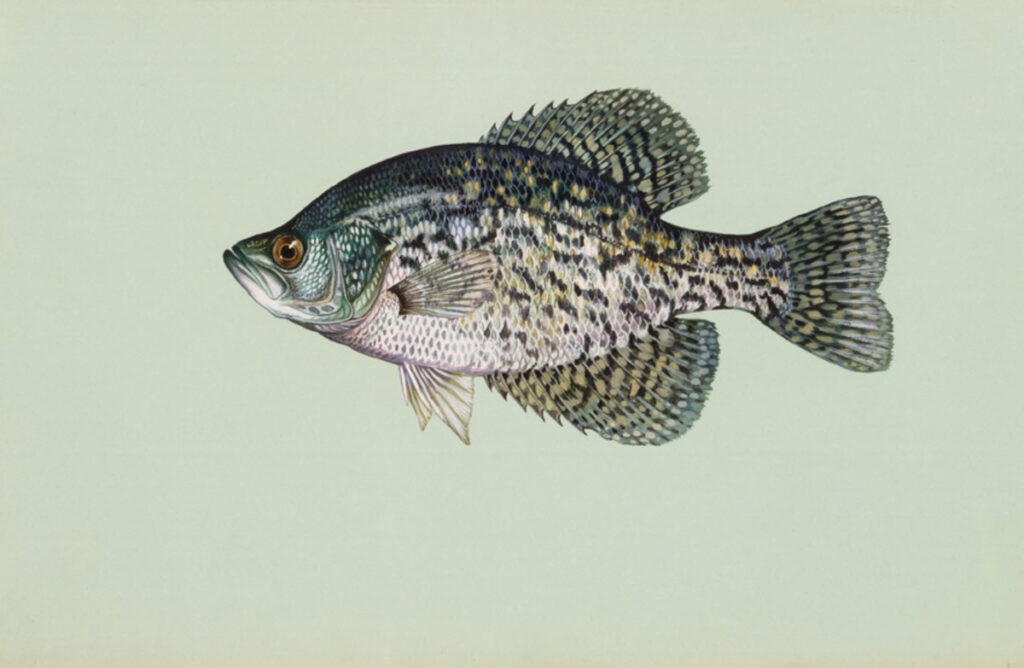
The black crappie is one of two crappies in North America, and almost everything useful about it comes down to how it differs from the other one. It is a deep-bodied, laterally compressed sunfish built for open water rather than the bottom, with a large, thin-walled mouth, a long anal fin nearly as big as the dorsal, and a body pattern of dark speckles and blotches scattered without order across a silver-green ground. It is the crappie of clean water, and where a river runs clear it usually outnumbers its relative.
The two reliable separations
Colour is not one of them. Both crappies darken and pale with mood, season and substrate, and a spawning male black crappie can go almost uniformly dark, while a stressed white crappie in a livewell can lose its markings entirely. Two characters hold up.
- Dorsal spine count. The black crappie carries 7 or 8 spines in the dorsal fin; the white crappie usually has 6, sometimes 5. Ohio’s Division of Wildlife puts it the same way — “seven or eight dorsal spines” against the white crappie’s five or six — and Montana’s field guide repeats it. The spines are the stiff rays at the front of the fin; count them by running a thumb forward along the fin base.
- Pattern. Black crappie markings are irregular speckles and blotches; white crappie markings are 5 to 10 regularly arranged dark vertical bars. Order versus disorder is the distinction, not shade.
A third character helps when the fish is in hand: the black crappie’s dorsal fin sits further forward on the back, and its body is deeper for its length. The distance from the eye to the front of the dorsal fin is short in a black crappie and noticeably longer in a white.
Where it lives, and what it wants from a river
Black crappie occupy standing and slow water: natural lakes, oxbows, reservoirs, and the sloughs, chutes and backwater arms of large rivers. In Missouri the species is most common in large Ozark reservoirs, the upper Mississippi navigation pools and the Bootheel’s natural lakes — three habitat types that share slack water and structure. On a river, that means the fish are not in the thread of the current. They are in the eddy behind a wing dam, in the drowned timber of a flooded chute, on the deep edge of a weedbed in a navigation pool, or stacked on a bridge piling in a backwater.
Cover matters as much as depth. The U.S. Fish and Wildlife Service’s habitat model for the species, built from the published literature in 1982, sets optimal riverine conditions at more than 25 percent vegetative cover, with peak suitability between 30 and 40 percent, and notes that abundant cover, particularly aquatic vegetation, is necessary for both growth and reproduction. Montana’s guide describes the same preference in plainer terms: stumps, debris piles and other cover in relatively large clear streams with sandy to mucky bottoms.
Water clarity is the dividing line
The black crappie is the clear-water species, and this is the single most useful thing to know about where it will and will not be abundant. Missouri states flatly that it is less tolerant of turbid conditions and siltation than the white crappie. Ohio agrees. The habitat model quantifies it: suitability peaks at about 10 JTU, holds below 50 JTU, and declines steadily above 75 JTU.
The nuance worth stating plainly is that both crappies grow best in clear water. The Fish and Wildlife Service model for white crappie also puts best growth below 50 JTU. The difference between the species is not preference but tolerance — the white crappie persists and reproduces in muddy water that the black crappie cannot hold in, which is why the two often trade dominance along a single river system as clarity changes from headwater to reservoir to lower main stem. In a turbid prairie river the black crappie may be present only in the clearest tributary mouths and backwaters.
Temperature
Water temperature drives the black crappie’s year more than any other single variable, and because it is a shallow-water spring spawner the transitions are sharp. The published thermal picture, assembled in the Fish and Wildlife Service habitat model, runs roughly as follows.
- Growth optimum: 72–77°F for juveniles. No growth occurs below about 52°F or above about 86°F.
- Summer occupancy: in 90 percent of streams where adults were found across the Mississippi valley and the Atlantic coast, mean weekly July–August temperatures were 73–90°F, averaging about 79°F.
- Thermal preference: 81–84°F recorded in a heated outfall, which shows the fish will select water warmer than the temperature at which it grows best.
- Fry: first appear at about 59°F; larvae were taken in the open water of Wisconsin lakes at 64–68°F.
The practical reading of that spread is that a live river temperature of 75°F tells you the fish are in their growth window; a reading of 88°F tells you they are still there but metabolically pinned, holding deeper or in shaded cover and feeding in short windows. A reading below 52°F means growth has effectively stopped, though the fish still feed and are often easiest to locate, concentrated in deeper wintering holes.
Spawning
Spawning runs from roughly mid-April into early June across the mid-latitudes, beginning once water temperatures exceed about 56°F. Montana records spawning in May and June at 58–64°F, with eggs hatching in three to five days and fish maturing at two to three years. The habitat model gives a wider observed range of 55–70°F with 64–68°F most favourable, and puts optimal embryo suitability at 64–68°F.
Males clear nests, usually in protected coves and pockets out of the current. Substrate is the constraint that separates black crappie spawning habitat from white crappie spawning habitat: Missouri notes the species requires silt-free substrates. In a river that has just dropped out of a spring flood, the silt-free ground is on gravel bars, root wads and hard clay edges rather than in the soft backs of sloughs, and this is a large part of why black crappie recruitment is erratic in silt-loaded systems.
Feeding and growth
Black crappie are open-water pursuit feeders that shift diet with size. Young fish take planktonic crustaceans and insect larvae; adults move to small fish, mainly minnows and young shad, plus aquatic insects and small crustaceans. In river systems with gizzard shad, a strong shad year class generally translates into fast crappie growth and a poor one into a year of thin fish.
Growth is not fast in absolute terms. Missouri gives a typical adult length of 9 to 10 inches, seldom above 14, and a maximum weight around 4 pounds; Ohio reports 5 to 12 inches and about a pound as typical, with exceptional fish exceeding 18 inches and 3 pounds. Longevity is modest — usually about 4 years, occasionally 8 or more. A 14-inch river black crappie is therefore an old fish from a productive system, not a common one.
Status
The black crappie carries a NatureServe global rank of G5, secure, reflecting an enormous range that has been expanded further by more than a century of stocking. Local abundance is another matter and swings hard with year-class strength, which in turn tracks spring water levels, clarity and temperature stability during the few weeks of spawning and fry survival. On regulated rivers, a spring drawdown or a silt-laden flood pulse timed against the spawn can flatten a year class outright.
The angling picture
Black crappie behaviour, not tackle, explains most of what anglers observe. The fish schools, suspends, and orients upward — the upturned mouth and eye position are those of a predator that eats things above it, which is why baits presented level with or slightly above a school outproduce baits dragged beneath it. The thin, membranous mouth that earns the name “papermouth” is a consequence of the same design: a large, protrusible, lightly built suction feeder built for engulfing small soft prey, not for holding a hook against pressure.
Seasonal movement on a river follows the temperature curve. Fish stage in deeper slack water through winter, move shallow into cover on the pre-spawn warming, disperse into open backwaters and suspend over structure through summer, and reconcentrate as autumn cools the water back through the low 60s. On rivers where black and white crappie occur together, the mix in the catch is a clarity signal as much as anything else — a run of black crappie usually means the water is clean, and a shift toward barred fish usually means it is not.
Where to catch it
355 waterways on GuidedFloats list black crappie, across 44 states. Each page carries live gauge readings, access notes, and the guides who fish it.
Alabama 13
- Alabama River below Millers Ferry
- Bayou Sara
- Black Warrior River below Bankhead Lock and Dam
- Black Warrior River below Selden Dam
- Choctawhatchee River308 cfs
- Conecuh River1,430 cfs
- Conecuh River below Point A Dam589 cfs
- Fish River58 cfs
- Lake Tuscaloosa
- Mobile River-4,400 cfs
- Tallapoosa River936 cfs
- Tensaw River-1,360 cfs
- Tombigbee River below Coffeeville Lock and Dam1,870 cfs
Arizona 3
Arkansas 12
- Bayou Bartholomew1 cfs
- Bayou Deview
- Bayou Macon13 cfs
- Bayou Meto
- Bear Bayou
- Beaver Lake
- Bull Shoals Lake
- Deep Bayou
- Illinois Bayou4 cfs
- Lake Catherine
- Lake Hamilton
- Saline River13 cfs
Colorado 3
Connecticut 1
- Quinebaug River887 cfs
Delaware 5
- Christina River-7,830 cfs
- Garrisons Lake
- Hearns Pond
- Marshyhope Creek13 cfs
- St Jones River11 cfs
Florida 12
- Lake Minnehaha
- Lake Rosalie
- Lake Seminole
- Lake Talquin
- Lake Trafford
- Lake Weohyakapka
- Myakka River
- Ochlockonee River1,310 cfs
- Peace River1,160 cfs
- St. Johns River3,700 cfs
- Wakulla River696 cfs
- Withlacoochee River431 cfs
Georgia 11
- Altamaha River3,740 cfs
- Carters Lake
- Kinchafoonee Creek137 cfs
- Lake Allatoona
- Lake Eufaula
- Lake Lanier
- Middle Oconee River105 cfs
- Ogeechee River24 cfs
- Satilla River2,400 cfs
- Spring Creek276 cfs
- West Point Lake
Hawaii 2
Idaho 3
Illinois 11
- Apple River107 cfs
- Big Muddy River47 cfs
- Cache River1 cfs
- Channel Lake
- Fox Lake
- Kaskaskia River165 cfs
- Kishwaukee River804 cfs
- Little Wabash River77 cfs
- Mackinaw River100 cfs
- Pecatonica River1,180 cfs
- Rock River4,860 cfs
Indiana 12
- Big Raccoon Creek104 cfs
- Brookville Lake
- Cecil M. Harden Lake
- Eagle Creek14 cfs
- Hamilton Lake
- Lake Maxinkuckee
- Mississinewa Lake
- Monroe Lake
- Patoka Lake
- Pike Lake
- Salamonie Lake
- Sylvan Lake
Iowa 9
- Big Bear Creek212 cfs
- Black Hawk Lake
- Clear Lake
- Maquoketa River2,410 cfs
- Rathbun Lake
- Spirit Lake
- Spring Creek
- Storm Lake
- West Okoboji Lake
Kansas 10
- Clinton Lake
- Hillsdale Lake
- Horsethief Reservoir
- Kanopolis Lake
- Milford Lake
- Neosho River3,550 cfs
- Perry Lake
- Pomona Lake
- Tuttle Creek Lake
- Wilson Lake
Kentucky 7
- Barren River Lake
- Bayou de Chien19 cfs
- Cave Run Lake
- Green River Lake
- Nolin River Lake
- Rough River Lake
- Taylorsville Lake
Louisiana 67
- Abita River
- Alligator Bayou
- Amite River321 cfs
- Atchafalaya River44,900 cfs
- Bayou Anacoco31 cfs
- Bayou Bartholomew5 cfs
- Bayou Bonne Idee
- Bayou Cocodrie62 cfs
- Bayou Conway
- Bayou Courtableau-5 cfs
- Bayou D'Arbonne
- Bayou D'Arbonne
- Bayou Darby
- Bayou de Loutre
- Bayou Des Cannes1 cfs
- Bayou Des Glaises11 cfs
- Bayou DeSiard
- Bayou Dorcheat
- Bayou Fountain
- Bayou Francois
- Bayou Fusilier
- Bayou Grand Cane
- Bayou Grosse Tete
- Bayou Lacassine
- Bayou Lafourche388 cfs
- Bayou Liberty
- Bayou Macon
- Bayou Mallet
- Bayou Milhomme
- Bayou Nezpique9 cfs
- Bayou Pierre160 cfs
- Bayou Plaquemine Brule
- Bayou Queue de Tortue
- Bayou Rapides
- Bayou San Patricio
- Bayou Teche
- Bayou Toro1 cfs
- Big Colewa Bayou
- Black Bayou
- Black Lake Bayou
- Bodcau Bayou314 cfs
- Bogue Chitto River613 cfs
- Bushley Bayou
- Chauvin Bayou
- Chemin-A-Haut Bayou
- Choctaw Bayou
- Cross Bayou
- Cypress Bayou4 cfs
- Flagon Bayou
- Gilmer Bayou
- Henderson Bayou
- Lake Bistineau
- Lake Claiborne
- Lake D'Arbonne
- Little Corney Bayou
- Loggy Bayou
- Paw Paw Bayou
- Red Chute Bayou246 cfs
- Saline Bayou18 cfs
- Shettleworth Bayou
- Tangipahoa River361 cfs
- Tchefuncte River58 cfs
- Toledo Bend Reservoir
- Twelvemile Bayou
- White Bayou
- Willow Chute Bayou
- Youngs Bayou
Maryland 2
Massachusetts 2
- Charles River175 cfs
- Upper Mystic Lake
Michigan 8
- Austin Lake
- Cisco Lake
- Houghton Lake
- Intermediate Lake
- Lake Gogebic
- Lake St Helen
- Thornapple River205 cfs
- Van Etten Lake
Minnesota 11
- Cannon River541 cfs
- Crane Lake
- Lake Minnetonka
- Lake of the Woods
- Lake Traverse
- Leech Lake
- Lower Red Lake
- Mille Lacs Lake
- Minnehaha Creek below Grays Bay Dam
- Orwell Lake
- Upper Red Lake
Mississippi 11
- Bayou Pierre
- Big Black River229 cfs
- Harris Bayou
- Luxapallila Creek88 cfs
- Pearl River909 cfs
- Porter Bayou12 cfs
- Richies Bayou
- Ross Barnett Reservoir
- Steele Bayou
- Strong River43 cfs
- Tombigbee River230 cfs
Missouri 3
- Spring Creek8 cfs
- Spring River74 cfs
- Table Rock Lake
Nebraska 4
- Big Blue River973 cfs
- Harlan County Lake
- Sappa Creek
- Wahoo Creek140 cfs
Nevada 5
New Jersey 1
- Passaic River1,050 cfs
New Mexico 6
New York 8
- Chautauqua Lake
- Conesus Lake
- Great Sacandaga Lake
- Lake George
- Mohawk River140 cfs
- Oswegatchie River892 cfs
- Owasco Lake
- Saratoga Lake
North Carolina 8
- Catawba River2,910 cfs
- Currituck Sound
- Deep River56 cfs
- Lumber River105 cfs
- Neuse River506 cfs
- Pee Dee River603 cfs
- Tar River3 cfs
- Yadkin River1,900 cfs
North Dakota 15
- Apple Creek
- Baldhill Creek45 cfs
- Devils Lake
- Dry Lake
- Eastern Stump Lake
- Homme Reservoir
- James River263 cfs
- Lake Ashtabula
- Lake Darling
- Morrison Lake
- Pipestem Creek9 cfs
- Sheyenne River251 cfs
- Sheyenne River below Devils Lake Outlet5 cfs
- Short Creek Dam
- White Earth Lake
Ohio 10
- Atwood Lake
- Berlin Lake
- Caesar Creek Lake
- Indian Lake
- Kokosing River47 cfs
- Mahoning River458 cfs
- Mosquito Creek below Mosquito Creek Dam3 cfs
- Mosquito Creek Lake
- Scioto River2,160 cfs
- Tuscarawas River
Oklahoma 11
- Big Cabin Creek2 cfs
- Canton Lake
- Fort Cobb Reservoir
- Grand Lake o' the Cherokees
- Lake Eucha
- Lake Hefner
- Lake Hudson
- Lake Lawtonka
- Lake Thunderbird
- McGee Creek Reservoir
- North Fork Red River below Altus Dam1 cfs
Oregon 3
Pennsylvania 5
Rhode Island 3
- Blackstone River502 cfs
- Pawtuxet River240 cfs
- Woonasquatucket River39 cfs
South Carolina 12
- Lake Hartwell
- Lake Marion
- Lake Moultrie
- Lake Murray
- Lake Thurmond
- Lake William C. Bowen
- Middle Tyger River21 cfs
- Monticello Reservoir
- Neal Shoals Reservoir
- Ninetynine Islands Reservoir
- Parr Shoals Reservoir
- Wateree River Tailrace2,720 cfs
South Dakota 4
Tennessee 4
- French Broad River1,270 cfs
- Hatchie River224 cfs
- Reelfoot Lake
- Running Reelfoot Bayou
Texas 19
- Attoyac Bayou
- Bairds Bayou
- Bayou Lanana1 cfs
- Big Cypress Bayou20 cfs
- Black Cypress Bayou
- Housen Bayou
- Lake Charlotte
- Lake Conroe
- Lake Fork Reservoir
- Little Cypress Bayou
- Luce Bayou4 cfs
- Palo Gaucho Bayou2 cfs
- Pine Island Bayou2 cfs
- Sabine River412 cfs
- Sam Rayburn Reservoir
- Village Creek96 cfs
- West Fork Double Bayou-112 cfs
- West Fork San Jacinto River
- Winters Bayou
Utah 2
- Colorado River (Utah)3,040 cfs
- Santa Clara River below Winsor Dam1 cfs
Vermont 2
Virginia 1
- Pamunkey River216 cfs
Washington 2
West Virginia 1
Wisconsin 11
References
- Black Crappie — Field Guide — Missouri Department of Conservation
- White Crappie — Field Guide — Missouri Department of Conservation
- Black Crappie — Ohio Department of Natural Resources, Division of Wildlife
- White Crappie — Ohio Department of Natural Resources, Division of Wildlife
- Black Crappie (Pomoxis nigromaculatus) — Montana Field Guide — Montana Natural Heritage Program and Montana Fish, Wildlife & Parks
- White Crappie (Pomoxis annularis) — Montana Field Guide — Montana Natural Heritage Program and Montana Fish, Wildlife & Parks
- Habitat suitability index models: Black crappie (FWS/OBS-82/10.6) — U.S. Geological Survey Publications Warehouse (originally U.S. Fish and Wildlife Service)
- Habitat Suitability Index Models: Black Crappie — full text — U.S. Fish and Wildlife Service, Biological Services Program (1982)
- Habitat suitability index models: White crappie (FWS/OBS-82/10.7) — U.S. Geological Survey Publications Warehouse (originally U.S. Fish and Wildlife Service)
- Habitat Suitability Index Models: White Crappie — full text — U.S. Fish and Wildlife Service, Biological Services Program (1982)
- IGFA World Records — International Game Fish Association