Bluegill
Lepomis macrochirus
The most widely introduced sunfish on earth, native to the eastern and central US and now recorded from all fifty states — and a river fish wherever low-gradient water gives it slack current.
Identification
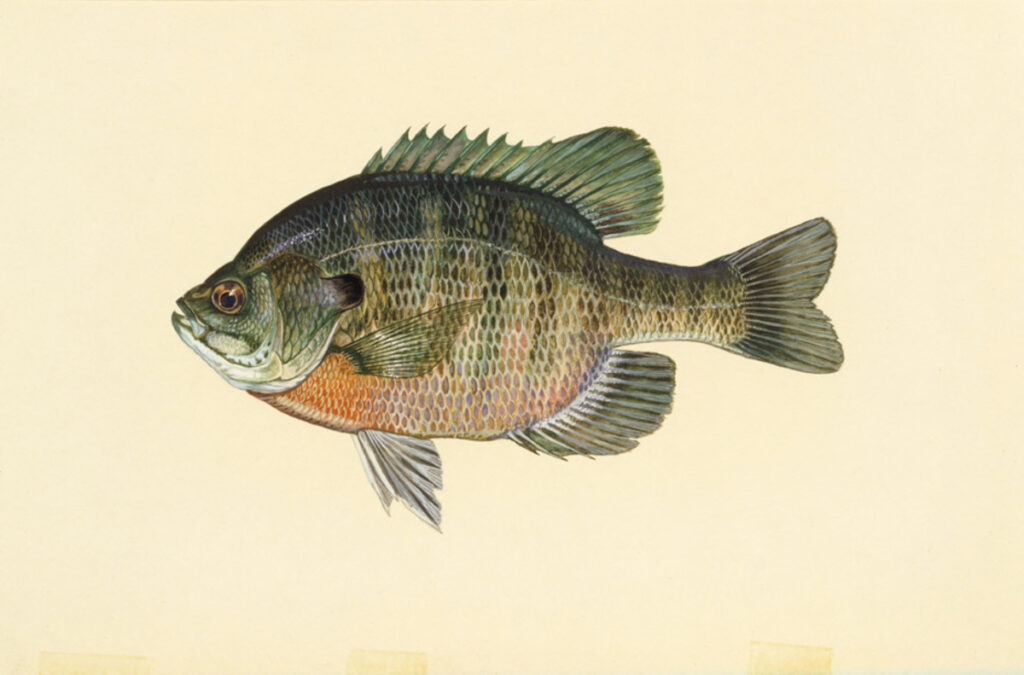
Bluegill are the fish most Americans picture when they hear “sunfish”: deep-bodied, laterally compressed, with a strikingly small mouth that separates them immediately from green sunfish, warmouth and the rock basses. The Missouri Department of Conservation describes them as dark olive-green over the back and sides, with yellow or reddish orange on the breast and belly and blue on the chin and lower gill cover — the source of the name.
The two field marks that settle identification are the black ear flap, moderately prolonged and without a pale margin or a coloured spot, and a dark blotch at the rear base of the soft dorsal fin. Compare that to redear, whose ear flap carries a whitish border and a prominent orange or red spot, and to longear, whose flap is long, black and typically edged in white. The pectoral fin is long and pointed, which is where macrochirus — “large hand” — comes from.
Breeding males are far darker and more intensely coloured than females, with a deep coppery-orange breast, and populations differ enough in colour that regional strain names like coppernose persist in the pond-stocking trade.
Range and distribution
The USGS Nonindigenous Aquatic Species database gives the native range as the St. Lawrence–Great Lakes and Mississippi River basins from Quebec and New York to Minnesota and south to the Gulf, plus Atlantic and Gulf Slope drainages from the Cape Fear River to the Rio Grande, and into northern Mexico.
The introduced range is the story. USGS documents bluegill from every US state and Puerto Rico, with the earliest recorded occurrence dating to 1700 in Massachusetts and records continuing to 2024. The means of introduction is given simply as intentional stocking for sportfishing, and the status as established in most locations. Bluegill is almost certainly the most widely introduced sunfish in the world, and the reason is straightforward: it is the standard forage fish stocked with largemouth bass in ponds, and it travels wherever that pairing goes. MDC notes bluegill are stocked in large numbers throughout Missouri primarily as forage for largemouth bass.
That success has costs outside the native range. USGS records that in California, bluegill compete aggressively with the native Sacramento perch, displacing it from spawning and feeding areas, and that introduced predatory centrarchids as a group are implicated in the decline of native ranid frogs in California, of California tiger salamander populations, and of the Chiricahua leopard frog in southeastern Arizona.
Bluegill in rivers
Bluegill are usually discussed as a pond and reservoir fish, and in a river context that framing is misleading. MDC’s Missouri account has them statewide, in everything from farm ponds to large reservoirs and nearly any stream capable of supporting aquatic life, with a preference for the deeper pools and backwaters of low-gradient streams.
The USFWS habitat suitability model for bluegill puts numbers on the flow preference that explain the distribution precisely. Optimal adult current velocity is under 10 cm/second, with tolerance to about 45 cm/second; optimal stream gradient is 0.5 m/km or less. That is a fish adapted to slack water. In a high-gradient Ozark float stream, bluegill are confined to eddies, backwaters and the tails of long pools, and longear sunfish take over the faster habitat. In a low-gradient prairie or coastal-plain river, bluegill can be the dominant sunfish through the whole channel.
The same model gives optimal turbidity below 50 ppm suspended solids, optimal pH of 6.5–8.5, and optimal dissolved oxygen above 5.0 mg/L — a broad envelope, which is part of why the species travels so well.
Water temperature
Bluegill is one of the best-studied freshwater fish in North America, and the thermal figures are correspondingly solid. From the USFWS habitat suitability report:
- Adults: optimal growth occurs near 27°C (81°F); no growth occurs below 10°C (50°F) or above 30°C (86°F).
- Juveniles: highest specific growth rate at 30°C (86°F), with a growth range of 22–34°C (72–93°F).
- Fry: optimal 25–32°C (77–90°F); fry do not survive below 11°C (52°F) or above 34°C (93°F).
- Embryos: optimal development at 22–27°C (72–81°F), with development occurring from 22–34°C.
- Upper incipient lethal temperature: 35°C (95°F).
The practical band for a live river gauge is roughly 75–86°F. Note the asymmetry: bluegill tolerate genuinely hot water far better than most river game fish, which is why they persist in summer-stressed reaches where smallmouth bass and rock bass thin out. The floor matters more than the ceiling — below 50°F, bluegill stop growing and largely stop feeding.
Life history
Bluegill are colonial nest spawners and prolific ones. MDC gives a Missouri spawning season of late May through August, with males building nests in shallow water roughly 1 to 2 feet deep over gravel and defending them. USFWS gives a spawning temperature range of 17–31°C (63–88°F) with peak activity at 24–27°C (75–81°F), and multiple spawning waves through the season are normal.
Growth in Missouri is modest — MDC has fish reaching about 6 inches by ages 3 to 4, and a maximum of around 9.5 inches and 12 ounces. Bluegill are famously prone to stunting: in waters where predation is low, they overpopulate and the whole cohort stalls at 3 to 4 inches. That dynamic is why they are stocked as bass forage in the first place, and why bluegill size structure is one of the standard diagnostics fisheries biologists use to read the health of a pond or reservoir.
Hybridization
Bluegill hybridize readily, and this is a genuine complication for anyone trying to identify sunfish in the field. USGS records that bluegill hybridizes with green sunfish, redear sunfish, redbreast sunfish and warmouth. Hybrids are common where nesting colonies of two species overlap, particularly in disturbed or introduced situations, and they are often intermediate enough in ear-flap shape, mouth size and colour to defeat a field key.
The bluegill × green sunfish cross is the one most often produced deliberately, because it grows quickly and is largely male-biased; it is stocked widely in ponds and turns up in rivers below them. In a mixed sunfish river, a fish that will not key cleanly to any species is more likely to be a hybrid than a range extension.
Stocking has also blurred the picture within the species. USGS notes that because introduced California bluegill were typically small — possibly due to a limited genetic founding population — the state began introducing Florida-strain bluegill in an effort to obtain a larger, faster-growing fish. Similar strain transfers have occurred across the South.
Diet
Bluegill are visual, mid-water feeders rather than bottom-grubbers. MDC describes them as feeding primarily by sight, at all levels of the water column, on moving prey. Juveniles take small crustaceans — cladocerans and copepods; adults take mostly insects, plus small fish, crayfish and snails.
The small mouth is the constraint that shapes everything. A bluegill cannot take the prey sizes a rock bass or a warmouth can, so it specializes downward, on abundant small invertebrates, and pays for that with sheer numbers. In river backwaters that means drifting mayfly and midge larvae, terrestrial insects off the surface film, and zooplankton in slack water.
Angling
Bluegill are the most heavily fished panfish in North America and the fish through which most American anglers begin. In a river setting, they are a fish of the slack water: eddies behind logjams, backwater sloughs, the downstream ends of long pools, and the flooded margins of low-gradient reaches.
They are catchable through the entire warm season, but the concentrations that make them memorable happen during the colonial spawn from late May onward, when dozens of nests may occupy a single shallow gravel flat and fish defend them aggressively. MDC’s note that bluegill are most responsive to moving prey seen from below explains why they respond to small surface and near-surface presentations as reliably as they do to bait on the bottom.
As a table fish, bluegill are the standard against which other panfish are judged — a small but firm, clean white fillet, best from cool, clear water.
Conservation
Within its native range, bluegill is secure, abundant and under no conservation pressure. It is not ranked as at-risk by any authority.
The conservation issue attached to bluegill runs the other way. As a stocked species it has been moved so comprehensively that it is now recorded from all 50 states, and in western waters it is a documented competitor with native fishes and a contributor, alongside other introduced centrarchids, to amphibian declines. In river systems the practical consequence is that bluegill presence in a stream well outside the native range should be read as a stocking signature, usually a pond escape, rather than as a natural range.
Where to catch it
475 waterways on GuidedFloats list bluegill, across 43 states. Each page carries live gauge readings, access notes, and the guides who fish it.
Alabama 17
- Alabama River below Millers Ferry
- Bayou Sara
- Black Warrior River below Bankhead Lock and Dam
- Black Warrior River below Selden Dam
- Cahaba River234 cfs
- Choccolocco Creek158 cfs
- Choctawhatchee River305 cfs
- Conecuh River1,490 cfs
- Conecuh River below Point A Dam564 cfs
- Fish River56 cfs
- Hatchet Creek62 cfs
- Lake Tuscaloosa
- Locust Fork51 cfs
- Mobile River-3,190 cfs
- Sipsey Fork8 cfs
- Tallapoosa River1,260 cfs
- Tensaw River-781 cfs
Arizona 6
- Bartlett Reservoir
- Bill Williams River below Alamo Dam13 cfs
- Del Rio Springs1 cfs
- Lake Mohave
- Salt River below Stewart Mountain Dam
- Verde River1,020 cfs
Arkansas 19
- Bayou Bartholomew1 cfs
- Bayou Deview
- Bayou Macon13 cfs
- Bayou Meto
- Bear Bayou
- Beaver Lake
- Buffalo River107 cfs
- Bull Shoals Lake
- Caddo River24 cfs
- Deep Bayou
- Frog Bayou
- Illinois Bayou4 cfs
- Kings River55 cfs
- Lake Catherine
- Lake Hamilton
- Osage Creek26 cfs
- Ouachita River10 cfs
- Saline River13 cfs
- Spring River299 cfs
California 7
- Cosumnes River60 cfs
- Kern River
- Nacimiento River62 cfs
- Piru Creek401 cfs
- Salinas River
- Santa Ynez River
- Stanislaus River773 cfs
Colorado 1
Delaware 7
- Brandywine Creek268 cfs
- Christina River-8,500 cfs
- Garrisons Lake
- Hearns Pond
- Marshyhope Creek13 cfs
- Red Clay Creek38 cfs
- St Jones River11 cfs
Florida 16
- Chipola River883 cfs
- Hidden River8 cfs
- Lake Minnehaha
- Lake Rosalie
- Lake Seminole
- Lake Talquin
- Lake Trafford
- Lake Weohyakapka
- Myakka River
- Ochlockonee River1,320 cfs
- Peace River1,170 cfs
- Santa Fe River965 cfs
- St. Johns River3,680 cfs
- Suwannee River6,170 cfs
- Wakulla River696 cfs
- Withlacoochee River430 cfs
Georgia 11
- Altamaha River3,740 cfs
- Broad River196 cfs
- Carters Lake
- Flint River1,270 cfs
- Kinchafoonee Creek137 cfs
- Lake Eufaula
- Lake Lanier
- Middle Oconee River105 cfs
- Ocmulgee River1,370 cfs
- Satilla River2,420 cfs
- Spring Creek278 cfs
Hawaii 9
- Hanalei River175 cfs
- Kaukonahua Stream below Wahiawa Reservoir32 cfs
- Koolau Reservoir
- Ku Tree Reservoir
- Wahiawa Reservoir
- Wailua River2,330 cfs
- Wailuku River
- Waimea River235 cfs
- Wainiha River90 cfs
Idaho 3
Illinois 14
- Apple River98 cfs
- Big Muddy River47 cfs
- Cache River1 cfs
- Channel Lake
- Embarras River55 cfs
- Fox Lake
- Iroquois River122 cfs
- Kishwaukee River804 cfs
- Little Wabash River77 cfs
- Mackinaw River100 cfs
- Macoupin Creek14 cfs
- Pecatonica River1,180 cfs
- Spring Brook2 cfs
- Vermilion River150 cfs
Indiana 14
- Big Raccoon Creek104 cfs
- Brookville Lake
- Cecil M. Harden Lake
- Eagle Creek14 cfs
- Hamilton Lake
- Lake Maxinkuckee
- Mississinewa Lake
- Monroe Lake
- Patoka Lake
- Pike Lake
- Salamonie Lake
- Sugar Creek44 cfs
- Sylvan Lake
- Wildcat Creek139 cfs
Iowa 13
- Beaver Creek834 cfs
- Big Bear Creek212 cfs
- Black Hawk Creek787 cfs
- Black Hawk Lake
- Clear Lake
- Maquoketa River2,430 cfs
- Rathbun Lake
- Spirit Lake
- Spring Creek
- Storm Lake
- Wapsipinicon River3,330 cfs
- West Okoboji Lake
- Wolf Creek590 cfs
Kansas 9
- Cedar Bluff Reservoir
- Clinton Lake
- Hillsdale Lake
- Horsethief Reservoir
- Kanopolis Lake
- Melvern Lake
- Perry Lake
- Pomona Lake
- Stranger Creek40 cfs
Kentucky 16
- Barren River Lake
- Bayou de Chien19 cfs
- Big South Fork69 cfs
- Cave Run Lake
- Dix River29 cfs
- Elkhorn Creek128 cfs
- Green River Lake
- Levisa Fork below Fishtrap Dam
- Little Sandy River below Grayson Dam43 cfs
- Nolin River Lake
- Red River7 cfs
- Rough River Lake
- Royal Springs1 cfs
- South Elkhorn Creek4 cfs
- Taylorsville Lake
- Tygarts Creek30 cfs
Louisiana 70
- Abita River
- Alligator Bayou
- Amite River323 cfs
- Atchafalaya River27,800 cfs
- Bayou Anacoco31 cfs
- Bayou Bartholomew5 cfs
- Bayou Bonne Idee
- Bayou Cocodrie62 cfs
- Bayou Conway
- Bayou Courtableau-5 cfs
- Bayou D'Arbonne
- Bayou D'Arbonne
- Bayou Darby
- Bayou de Loutre
- Bayou Des Cannes1 cfs
- Bayou Des Glaises11 cfs
- Bayou DeSiard
- Bayou Dorcheat
- Bayou Fountain
- Bayou Francois
- Bayou Fusilier
- Bayou Grand Cane
- Bayou Grosse Tete
- Bayou Lacassine
- Bayou Lafourche391 cfs
- Bayou Liberty
- Bayou Macon
- Bayou Mallet
- Bayou Manchac
- Bayou Milhomme
- Bayou Nezpique9 cfs
- Bayou Perot
- Bayou Pierre158 cfs
- Bayou Plaquemine Brule
- Bayou Queue de Tortue
- Bayou Rapides
- Bayou San Patricio
- Bayou Teche
- Bayou Toro1 cfs
- Big Colewa Bayou
- Black Bayou
- Black Lake Bayou
- Bodcau Bayou314 cfs
- Bogue Chitto River613 cfs
- Bushley Bayou
- Chauvin Bayou
- Chemin-A-Haut Bayou
- Choctaw Bayou
- Cross Bayou
- Cypress Bayou4 cfs
- Flagon Bayou
- Gilmer Bayou
- Henderson Bayou
- Kisatchie Bayou
- Lake Bistineau
- Lake Claiborne
- Lake D'Arbonne
- Little Corney Bayou
- Loggy Bayou
- Paw Paw Bayou
- Red Chute Bayou243 cfs
- Saline Bayou18 cfs
- Shettleworth Bayou
- Tangipahoa River361 cfs
- Tchefuncte River58 cfs
- Toledo Bend Reservoir
- Twelvemile Bayou
- White Bayou
- Willow Chute Bayou
- Youngs Bayou
Maryland 9
- Big Pipe Creek37 cfs
- Licking Creek66 cfs
- Monocacy River273 cfs
- Nanticoke River
- Patuxent River28 cfs
- Tonoloway Creek23 cfs
- Town Creek21 cfs
- Tuckahoe Creek36 cfs
- Wills Creek92 cfs
Massachusetts 4
- Charles River178 cfs
- Quinebaug River80 cfs
- Upper Mystic Lake
- West River
Michigan 8
- Austin Lake
- Cisco Lake
- Houghton Lake
- Intermediate Lake
- Lake Gogebic
- Lake St Helen
- Thornapple River205 cfs
- Van Etten Lake
Minnesota 6
- Cannon River541 cfs
- Lake Minnetonka
- Lake Traverse
- Leech Lake
- Minnehaha Creek below Grays Bay Dam
- Orwell Lake
Mississippi 16
- Bayou Pierre
- Big Black River229 cfs
- Harris Bayou
- Jourdan River
- Luxapallila Creek87 cfs
- Okatoma Creek78 cfs
- Old Fort Bayou
- Pascagoula River
- Pearl River909 cfs
- Porter Bayou12 cfs
- Richies Bayou
- Ross Barnett Reservoir
- Steele Bayou
- Strong River43 cfs
- Tombigbee River230 cfs
- Wolf River (Mississippi)43 cfs
Missouri 11
- Big River133 cfs
- Bryant Creek140 cfs
- East Fork Black River below Taum Sauk Reservoir6 cfs
- Huzzah Creek59 cfs
- Little North Fork River
- North Fork Spring River8 cfs
- Pearson Creek5 cfs
- Roubidoux Creek
- Spring Creek8 cfs
- Spring River74 cfs
- Table Rock Lake
Nebraska 6
- Frenchman Creek14 cfs
- Logan Creek215 cfs
- North Loup River401 cfs
- Sappa Creek
- Spring Creek
- Wahoo Creek140 cfs
Nevada 1
New Hampshire 1
New Mexico 7
- Blue Springs6 cfs
- Bluewater Lake
- Brantley Lake
- Conchas Lake
- Lake Sumner
- Santa Rosa Lake
- Ute Reservoir
New York 6
North Carolina 10
- Catawba River2,970 cfs
- Currituck Sound
- Deep River56 cfs
- Haw River104 cfs
- Lumber River104 cfs
- Neuse River469 cfs
- Roanoke River1,530 cfs
- Tar River3 cfs
- Yadkin River1,940 cfs
- Yadkin River below W. Kerr Scott Dam921 cfs
North Dakota 11
- Apple Creek
- Baldhill Creek45 cfs
- Dry Lake
- Homme Reservoir
- Lake Ashtabula
- Lake Darling
- Morrison Lake
- Pipestem Creek9 cfs
- Sheyenne River251 cfs
- Short Creek Dam
- White Earth Lake
Ohio 13
- Atwood Lake
- Berlin Lake
- Caesar Creek Lake
- Hocking River516 cfs
- Indian Lake
- Kokosing River46 cfs
- Licking River
- Little Miami River72 cfs
- Little Muskingum River144 cfs
- Mosquito Creek below Mosquito Creek Dam3 cfs
- Mosquito Creek Lake
- Tuscarawas River
- Walhonding River
Oklahoma 14
- Big Cabin Creek2 cfs
- Flint Creek4 cfs
- Fort Cobb Reservoir
- Glover River
- Honey Creek30 cfs
- Kiamichi River2 cfs
- Lake Eucha
- Lake Hefner
- Lake Lawtonka
- Lake Thunderbird
- McGee Creek Reservoir
- Mountain Fork8 cfs
- North Fork Red River below Altus Dam1 cfs
- Sager Creek8 cfs
Pennsylvania 7
- Aquashicola Creek56 cfs
- Aughwick Creek63 cfs
- Codorus Creek16 cfs
- Glendale Lake
- Lake Arthur
- Pymatuning Reservoir
- Shohola Creek42 cfs
Rhode Island 8
- Adamsville Brook27 cfs
- Blackstone River502 cfs
- Branch River120 cfs
- Chipuxet River29 cfs
- Nipmuc River10 cfs
- Pawtuxet River243 cfs
- Peeptoad Brook1 cfs
- Woonasquatucket River39 cfs
South Carolina 16
- Broad River1,120 cfs
- Catawba River1,190 cfs
- Lake Hartwell
- Lake Marion
- Lake Moultrie
- Lake Murray
- Lake Thurmond
- Lake William C. Bowen
- Middle Tyger River21 cfs
- Monticello Reservoir
- Neal Shoals Reservoir
- Ninetynine Islands Reservoir
- North Santee River
- Pacolet River177 cfs
- Parr Shoals Reservoir
- Wateree River Tailrace2,750 cfs
South Dakota 4
Tennessee 11
- Big Limestone Creek28 cfs
- Daddys Creek15 cfs
- Elk River6 cfs
- Harpeth River
- Hatchie River224 cfs
- Nolichucky River below Nolichucky Dam901 cfs
- Obed River15 cfs
- Reelfoot Lake
- Running Reelfoot Bayou
- South Chickamauga Creek115 cfs
- Spring Creek
Texas 39
- Adams Bayou
- Attoyac Bayou
- Austin Bayou
- Bairds Bayou
- Bastrop Bayou
- Bayou Lanana1 cfs
- Big Cypress Bayou20 cfs
- Black Cypress Bayou
- Blanco River5 cfs
- Buffalo Bayou164 cfs
- Cedar Bayou2 cfs
- Chocolate Bayou14 cfs
- Cow Bayou
- Dickinson Bayou
- Frio River62 cfs
- Greens Bayou
- Highland Bayou
- Housen Bayou
- Hurricane Bayou
- Lake Charlotte
- Lake Conroe
- Lake Fork Reservoir
- Linnville Bayou
- Little Cypress Bayou
- Llano River449 cfs
- Luce Bayou4 cfs
- Medina River17 cfs
- Mustang Bayou
- Palo Gaucho Bayou2 cfs
- Pecan Bayou12 cfs
- Pine Island Bayou2 cfs
- Sam Rayburn Reservoir
- San Saba River91 cfs
- Turtle Bayou
- Village Creek96 cfs
- West Fork Double Bayou-145 cfs
- West Fork San Jacinto River
- Whiteoak Bayou19 cfs
- Winters Bayou
Utah 1
Vermont 1
Virginia 14
- Calfpasture River54 cfs
- Cowpasture River277 cfs
- Hazel River152 cfs
- James River986 cfs
- Linville Creek26 cfs
- Maury River104 cfs
- North Fork Shenandoah River297 cfs
- North River180 cfs
- Opequon Creek12 cfs
- Pamunkey River216 cfs
- Pedlar River6 cfs
- Pound River below Flannagan Dam
- Rapidan River73 cfs
- South Fork Shenandoah River353 cfs
Washington 2
West Virginia 9
- Back Creek29 cfs
- Cacapon River270 cfs
- Cheat River2,830 cfs
- Gauley River below Summersville Dam
- Howard Creek
- Opequon Creek105 cfs
- Patterson Creek70 cfs
- Tygart Lake
- Warm Springs Run3 cfs
Wisconsin 8
References
- Bluegill field guide — Missouri Department of Conservation
- Bluegill (Lepomis macrochirus) species profile — USGS Nonindigenous Aquatic Species Database
- Habitat Suitability Index Models: Bluegill (FWS/OBS-82/10.8) — citation record — U.S. Geological Survey / U.S. Fish and Wildlife Service
- Habitat Suitability Index Models: Bluegill (Stuber, Gebhart & Maughan 1982), full text — U.S. Fish and Wildlife Service
- Warmouth field guide — Missouri Department of Conservation
- Redear Sunfish field guide — Missouri Department of Conservation
- Longear Sunfish field guide — Missouri Department of Conservation
- Black River Watershed Inventory and Assessment — Missouri Department of Conservation
- Spring River (South Missouri) Watershed Inventory and Assessment — Missouri Department of Conservation
- Ecological Risk Screening Summary: Redbreast Sunfish — U.S. Fish and Wildlife Service
- IGFA World Records search — International Game Fish Association