Channel Catfish
Ictalurus punctatus
The channel catfish is essentially a swimming tongue with taste buds covering its entire body, and its spots fade with age, which is why it is so often misidentified.
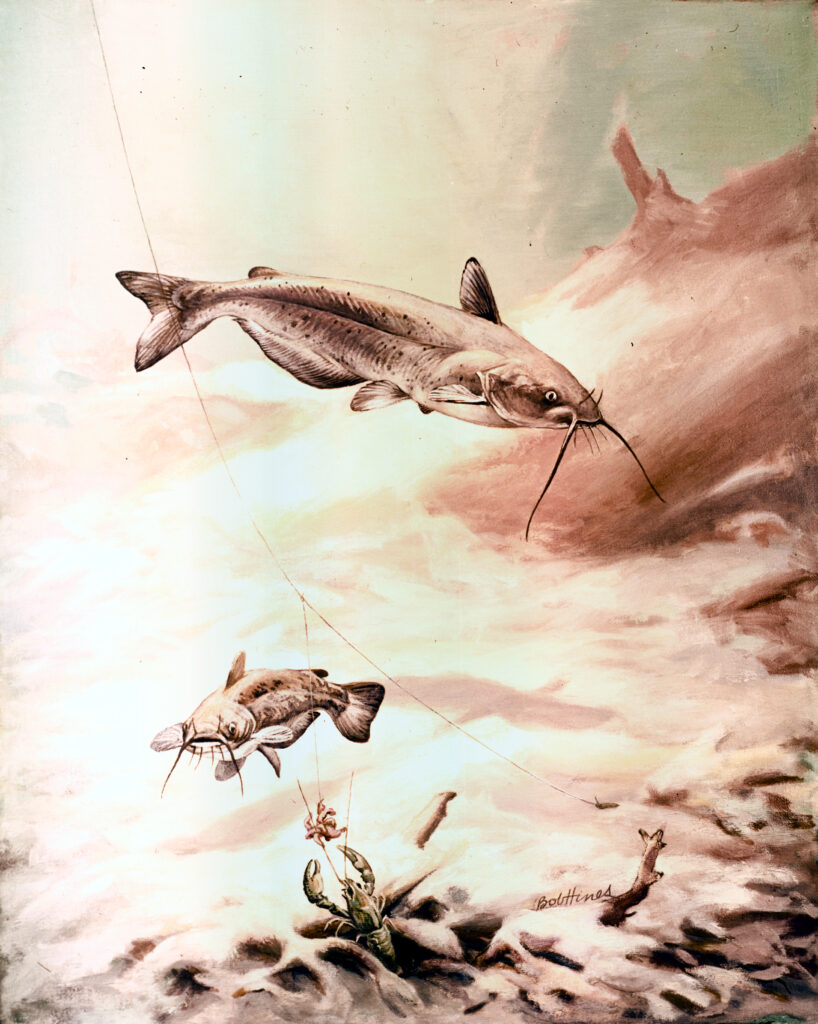
A fish that tastes with its whole body
The most remarkable thing about a channel catfish is not its size or its diet but its sensory equipment. Taste buds are not confined to the mouth. They are distributed across the barbels, the lips, the gill rakers, the fins and the entire external body surface, at densities high enough that the animal is often described in the neurophysiological literature as a swimming tongue. A catfish that brushes against a food item with its flank has, in a meaningful sense, tasted it.
The system was mapped over several decades, largely at Louisiana State University. Caprio and colleagues’ review “The taste system of the channel catfish: from biophysics to behavior” (Trends in Neurosciences 16:192–197, 1993) synthesizes the receptor biophysics, the neural coding and the resulting behavior in one place. Kanwal, Hidaka and Caprio’s recordings from facial nerve branches innervating oral and extra-oral taste buds (Brain Research, 1987) established that the extra-oral system — the taste buds on the outside of the fish — has its own dedicated neural pathway rather than being an afterthought of the mouth.
Two distinct systems are involved. The facial taste system, innervating the barbels and body surface, functions as a long-range detector and orienting mechanism: it tells the fish that food exists and in which direction. The vagal system, serving the mouth and pharynx, handles the final decision of whether to swallow. Eram and Michel documented the morphological and biochemical heterogeneity between facial and vagal taste buds in the Journal of Comparative Neurology, confirming that these are not simply the same receptor in two places. Valentincic, Wegert and Caprio further separated learned olfactory discrimination from innate taste responses to amino acids, showing that smell and taste in this animal do different jobs.
The receptors are tuned principally to amino acids, and the sensitivity is extreme — responses occur at concentrations in the nanomolar range. This is what allows a catfish to locate a food item in water with essentially zero visibility, at night, in current, by following a dissolved chemical gradient it can read across the length of its own body.
The barbels
Channel catfish carry eight barbels: four short ones under the chin, two at the corners of the mouth, and two nasal barbels. They are not passive whiskers. The barbel epithelium is densely packed with taste buds, and their fine structure has been described in detail — Grover-Johnson and Farbman’s study of taste bud fine structure in the barbel of Ictalurus punctatus (Cell and Tissue Research, 1976) and Ovalle and Shinn’s surface morphology of catfish barbel taste buds (Cell and Tissue Research, 1977) between them established the receptor architecture. Joyce and Chapman described the fine structure of the nasal barbel separately in the Journal of Morphology.
Functionally the barbels work as a mobile sampling array. A foraging catfish sweeps them across the bottom and through the water column ahead of the mouth, resolving a chemical gradient in three dimensions and closing on its source. Jelle Atema’s foundational “Structures and Functions of the Sense of Taste in the Catfish” in Brain, Behavior and Evolution — carried out on the closely related yellow bullhead — laid out the behavioral consequences of this arrangement and remains the reference point for how ictalurid feeding is organized around chemoreception rather than vision.
Hearing: the Weberian apparatus
Catfish are otophysans, which means the swimbladder is coupled to the inner ear by the Weberian apparatus — a chain of small bones derived from anterior vertebrae. The swimbladder responds to pressure changes in the water, and the ossicles transmit that motion mechanically to the ear. The effect is analogous to an eardrum: a fish that would otherwise detect only particle motion at close range instead detects sound pressure over distance and across a wide frequency band.
Lechner and Ladich quantified the relationship in “Size matters: diversity in swimbladders and Weberian ossicles affects hearing in catfishes” (Journal of Experimental Biology 211:1681–1689, 2008). Every catfish species they tested detected sound between 50 Hz and 5 kHz. Below 1 kHz, hearing thresholds varied by about 24 dB across species; above 1 kHz the spread exceeded 50 dB, and that variation tracked morphology directly — larger swimbladders and longer ossicular chains with more ossicles produced better high-frequency hearing. They concluded that reduced swimbladders in some catfishes were retained specifically for their auditory function after their hydrostatic role had diminished.
Taken together with the chemosensory system, this describes an animal built to operate without light. A channel catfish in a turbid river at midnight is not handicapped; it is in its design environment.
Identification, and why it goes wrong
Channel catfish are scaleless, with a deeply forked tail, a stout spine at the front of the dorsal and each pectoral fin, and a body that runs olive, slate or silvery-blue over a pale belly. Young and mid-sized fish carry scattered dark spots on the back and flanks — the punctatus of the scientific name.
Those spots are the source of most misidentification, because they do not persist. The Missouri Department of Conservation states plainly that the spots “are often absent… in the smallest young and in large adults.” A big channel catfish is typically unspotted and can be a uniform slate blue, which is exactly what people expect a blue catfish to look like. The spots are a diagnostic character for part of the life cycle only.
The reliable character is the anal fin, read two ways: ray count and the shape of its outer margin. Missouri gives channel catfish 24 to 29 anal rays with an outer margin “rounded outward (convex) rather than straight.” The Ohio Department of Natural Resources gives a slightly wider count, 24 to 30, with the same curved margin, and contrasts it against the blue catfish’s straight-edged fin of more than 30 rays. Missouri’s blue catfish account is more specific still: 30 to 35 rays, and an anal fin that “tapers toward the back in a flat line, like a barber’s comb.” That comparison is the most useful single sentence in catfish identification. Hold the anal fin flat and look at its edge: a curve means channel, a straight taper means blue.
Flathead catfish are not easily confused with either once seen. Missouri gives them 14 to 17 anal rays in a short rounded fin, a tail “mostly squared off, with a slight notch,” a lower jaw that “projects far beyond the upper jaw,” and mottled yellow-brown coloration. Their diet differs too: flatheads “are not scavengers and rarely eat dead or decaying material,” which separates them behaviorally from channel catfish.
Habitat in rivers
Channel catfish are a river fish first and a reservoir fish second. Missouri places them in “large, rather turbid streams with low or moderate gradients,” with adults holding deeper water or tight to “submerged logs and other cover” and young fish using the shallows. Ohio describes a preference for “deep water, clean gravel or boulder substrates, and low to moderate current.” The Virginia Department of Wildlife Resources adds that they are “most associated with pools and runs with moderate levels of current,” in areas “with silty substrates that have overhanging cover.”
The picture that emerges is a fish that uses current but does not fight it, that relies on cover and depth by day, and that ranges into shallower and faster water at night to feed. Turbidity is not a problem for them and may be an advantage, since it disadvantages the sight-feeding predators they compete with while leaving their own chemosensory system fully functional.
Water temperature
Channel catfish are warm-water fish with the highest thermal optimum of any widely distributed American river gamefish. Feeding slows markedly as water drops below about 50 °F, and winter fish concentrate in deep holes and become difficult to move. Activity climbs steeply through spring, and the fish remain active through the warmest part of summer, when trout and even smallmouth are thermally stressed.
The best-documented thermal threshold is spawning. Ohio reports that reproduction begins “when water temperatures reach 70°F.” Missouri places it later and warmer — “from about the last week of May, when water temperatures reach 75 F” — and running through mid-July. These are not contradictory so much as regional and methodological: the honest summary is that spawning begins somewhere in the low-to-mid 70s and that the exact number varies by latitude and by how an agency defines onset. Virginia simply gives the calendar window, “between April and June in Virginia.”
For a river with a live temperature gauge, the useful signal is the spring climb. Water moving through the sixties into the seventies marks the transition from winter dormancy through pre-spawn feeding into the spawn itself, and it is the single most informative number available for predicting where and whether channel catfish are active.
Spawning and parental care
Channel catfish are cavity nesters. Males select and clean an enclosed site — an undercut bank, a hollow log, a crevice among rocks, a submerged drum or box — and the pair spawns inside it. Ohio reports females depositing “a gelatinous mass containing between 8,000 and 15,000 eggs,” with the nest and young guarded afterward. Missouri notes that eggs “hatch in about a week”; Virginia gives hatching at 5 to 10 days after fertilization, with the male fanning and cleaning the egg mass throughout.
Male parental care continues past hatching, with the fry held in a dense school in the nest cavity for several days before dispersing. The requirement for enclosed nest sites is a real constraint in rivers: reaches stripped of large wood and undercut banks lose reproductive capacity even where water quality and temperature are entirely suitable.
Diet and growth
Channel catfish are genuine omnivores. Missouri lists “fish, insects, crayfish, mollusks, and plant material,” and notes an ontogenetic shift — fish under four inches feed “almost entirely on small insects” before broadening. Ohio’s list adds fruits and berries alongside insect larvae, crayfish, mollusks and fish “dead or alive.” Virginia describes them as “omnivorous feeders, consuming fish, crustaceans, amphibians, aquatic plants, and small mammals when opportunity presents itself.”
The willingness to take carrion is real and is the basis of a whole tradition of angling, but it is frequently overstated. A channel catfish is an effective predator on live fish, and larger individuals in rivers take a substantial proportion of live prey. The scavenging reputation says more about how they are commonly fished than about what they mostly eat.
Growth is unhurried and longevity is high. Virginia reports mature fish averaging around 20 inches, with large specimens exceeding 30 inches, and a lifespan of up to 30 years. Missouri gives a common range of 12 to 32 inches and one to fifteen pounds, with occasional Missouri fish reaching 45 pounds. Ohio’s typical fish is 15 to 25 inches and 2 to 10 pounds. A very large channel catfish is therefore an old fish, and river populations that produce them are populations where fish survive many years.
Angling as natural history
The habits of channel catfish anglers are, almost without exception, direct consequences of the sensory biology. Fishing happens at night because the fish forage at night and are equipped to do so. Baits are chosen for dissolved chemical signal rather than visual appeal because the fish locates food by tasting a gradient across its entire body surface. Presentations sit on or near the bottom in current seams below cover because that is where the fish holds and where scent plumes travel. Turbid, rising water after rain concentrates fish rather than scattering them, because reduced visibility costs a channel catfish nothing.
The one thing that consistently misleads people is identification. A large, unspotted, slate-colored channel catfish looks exactly like what most anglers picture as a blue catfish, and the spots that would have settled it at fifteen inches are gone by thirty. The anal fin resolves it every time: count the rays, and look at whether the outer edge curves or runs straight.
Where to catch it
612 waterways on GuidedFloats list channel catfish, across 47 states. Each page carries live gauge readings, access notes, and the guides who fish it.
Alabama 19
- Alabama River below Millers Ferry
- Bayou Sara
- Black Warrior River below Bankhead Lock and Dam
- Black Warrior River below Selden Dam
- Cahaba River234 cfs
- Choccolocco Creek165 cfs
- Choctawhatchee River321 cfs
- Conecuh River2,200 cfs
- Conecuh River below Point A Dam1,240 cfs
- Coosa River1,910 cfs
- Fish River56 cfs
- Hatchet Creek62 cfs
- Lake Tuscaloosa
- Locust Fork54 cfs
- Mobile River12,400 cfs
- Sipsey Fork8 cfs
- Tallapoosa River533 cfs
- Tensaw River8,260 cfs
- Tombigbee River below Coffeeville Lock and Dam1,680 cfs
Arizona 10
- Bartlett Reservoir
- Bill Williams River below Alamo Dam13 cfs
- Black River167 cfs
- Del Rio Springs1 cfs
- East Verde River77 cfs
- Lake Mohave
- Oak Creek59 cfs
- Salt River511 cfs
- Salt River below Stewart Mountain Dam42 cfs
- Verde River841 cfs
Arkansas 20
- Bayou Bartholomew1 cfs
- Bayou Deview
- Bayou Macon13 cfs
- Bayou Meto
- Bear Bayou
- Beaver Lake
- Buffalo River115 cfs
- Bull Shoals Lake
- Caddo River23 cfs
- Deep Bayou
- Frog Bayou
- Illinois Bayou4 cfs
- Kings River68 cfs
- Lake Catherine
- Lake Hamilton
- Mammoth Spring
- Osage Creek29 cfs
- Ouachita River11 cfs
- Saline River13 cfs
- South Fork Spring River4 cfs
California 12
- Cosumnes River60 cfs
- Kern River
- Nacimiento River62 cfs
- Piru Creek402 cfs
- Pit River26 cfs
- Putah Creek141 cfs
- Russian River156 cfs
- Salinas River
- San Joaquin River392 cfs
- Santa Ynez River
- Stanislaus River846 cfs
- Tuolumne River1,170 cfs
Colorado 3
Connecticut 5
Delaware 9
- Appoquinimink River
- Broadkill River
- Christina River-4,440 cfs
- Garrisons Lake
- Hearns Pond
- Marshyhope Creek13 cfs
- Murderkill River
- St Jones River46 cfs
- White Clay Creek54 cfs
Florida 13
- Chipola River906 cfs
- Lake Minnehaha
- Lake Rosalie
- Lake Seminole
- Lake Talquin
- Lake Trafford
- Lake Weohyakapka
- Ochlockonee River1,400 cfs
- Peace River1,210 cfs
- Santa Fe River973 cfs
- St. Johns River3,590 cfs
- Suwannee River6,090 cfs
- Withlacoochee River419 cfs
Georgia 15
- Altamaha River3,760 cfs
- Broad River193 cfs
- Carters Lake
- Etowah River190 cfs
- Flint River414 cfs
- Kinchafoonee Creek141 cfs
- Lake Allatoona
- Lake Eufaula
- Lake Lanier
- Middle Oconee River102 cfs
- Ocmulgee River1,500 cfs
- Ogeechee River26 cfs
- Satilla River2,570 cfs
- Spring Creek302 cfs
- West Point Lake
Hawaii 8
- Hanalei River227 cfs
- Kaukonahua Stream below Wahiawa Reservoir32 cfs
- Koolau Reservoir
- Ku Tree Reservoir
- Wahiawa Reservoir
- Wailua River2,330 cfs
- Wailuku River
- Waimea River506 cfs
Idaho 4
Illinois 20
- Apple River102 cfs
- Big Muddy River45 cfs
- Cache River1 cfs
- Channel Lake
- Embarras River55 cfs
- Fox Lake
- Fox River1,500 cfs
- Illinois River (Illinois)15,300 cfs
- Iroquois River125 cfs
- Kankakee River1,610 cfs
- Kaskaskia River170 cfs
- Kishwaukee River832 cfs
- Little Wabash River76 cfs
- Mackinaw River104 cfs
- Macoupin Creek15 cfs
- Pecatonica River1,180 cfs
- Rock River4,980 cfs
- Spring Brook2 cfs
- Vermilion River168 cfs
- Wabash River9,570 cfs
Indiana 20
- Big Raccoon Creek104 cfs
- Blue River14 cfs
- Brookville Lake
- Cecil M. Harden Lake
- Eagle Creek10 cfs
- East Fork White River
- Flatrock River47 cfs
- Hamilton Lake
- Lake Maxinkuckee
- Mississinewa Lake
- Mississinewa River22 cfs
- Monroe Lake
- Patoka Lake
- Pike Lake
- Salamonie Lake
- Sugar Creek44 cfs
- Sylvan Lake
- Tippecanoe River519 cfs
- White River (Indiana)1,050 cfs
- Wildcat Creek137 cfs
Iowa 18
- Beaver Creek894 cfs
- Big Bear Creek217 cfs
- Black Hawk Creek832 cfs
- Black Hawk Lake
- Cedar River9,550 cfs
- Clear Lake
- Iowa River4,540 cfs
- Maquoketa River2,440 cfs
- Rathbun Lake
- Spirit Lake
- Spring Creek
- Storm Lake
- Turkey River2,730 cfs
- Upper Iowa River725 cfs
- Wapsipinicon River3,280 cfs
- West Okoboji Lake
- Wolf Creek621 cfs
- Yellow River215 cfs
Kansas 20
- Cedar Bluff Reservoir
- Cheney Reservoir
- Clinton Lake
- Cottonwood River96 cfs
- Fall River18 cfs
- Hillsdale Lake
- Horsethief Reservoir
- Kanopolis Lake
- Kansas River15,100 cfs
- Marais des Cygnes River48 cfs
- Melvern Lake
- Milford Lake
- Neosho River3,040 cfs
- Perry Lake
- Pomona Lake
- Stranger Creek41 cfs
- Tuttle Creek Lake
- Verdigris River70 cfs
- Walnut River195 cfs
- Wilson Lake
Kentucky 18
- Barren River Lake
- Bayou de Chien20 cfs
- Big South Fork73 cfs
- Cave Run Lake
- Dix River31 cfs
- Green River (Kentucky)447 cfs
- Green River Lake
- Kentucky River961 cfs
- Levisa Fork below Fishtrap Dam
- Little Sandy River below Grayson Dam43 cfs
- Nolin River Lake
- Red River7 cfs
- Rockcastle River72 cfs
- Rough River Lake
- Royal Springs1 cfs
- South Elkhorn Creek4 cfs
- Taylorsville Lake
- Tygarts Creek35 cfs
Louisiana 71
- Abita River
- Alligator Bayou
- Amite River314 cfs
- Atchafalaya River93,200 cfs
- Bayou Anacoco38 cfs
- Bayou Bartholomew5 cfs
- Bayou Bonne Idee
- Bayou Cocodrie62 cfs
- Bayou Conway
- Bayou Courtableau21 cfs
- Bayou D'Arbonne
- Bayou D'Arbonne
- Bayou Darby
- Bayou de Loutre
- Bayou Des Cannes1 cfs
- Bayou Des Glaises11 cfs
- Bayou DeSiard
- Bayou Dorcheat
- Bayou Dupre
- Bayou Fountain
- Bayou Francois
- Bayou Fusilier
- Bayou Grand Cane
- Bayou Grosse Tete
- Bayou Lacassine
- Bayou Lafourche371 cfs
- Bayou Liberty
- Bayou Macon
- Bayou Mallet
- Bayou Manchac
- Bayou Milhomme
- Bayou Nezpique9 cfs
- Bayou Perot
- Bayou Pierre156 cfs
- Bayou Plaquemine Brule
- Bayou Queue de Tortue
- Bayou Rapides
- Bayou San Patricio
- Bayou Teche
- Bayou Toro1 cfs
- Big Colewa Bayou
- Black Bayou
- Black Lake Bayou
- Bodcau Bayou324 cfs
- Bogue Chitto River607 cfs
- Bushley Bayou
- Chauvin Bayou
- Chemin-A-Haut Bayou
- Choctaw Bayou
- Cross Bayou
- Cypress Bayou4 cfs
- Flagon Bayou
- Gilmer Bayou
- Henderson Bayou
- Kisatchie Bayou
- Lake Bistineau
- Lake Claiborne
- Lake D'Arbonne
- Little Corney Bayou
- Loggy Bayou
- Paw Paw Bayou
- Red Chute Bayou237 cfs
- Saline Bayou18 cfs
- Shettleworth Bayou
- Tangipahoa River355 cfs
- Tchefuncte River58 cfs
- Toledo Bend Reservoir
- Twelvemile Bayou
- White Bayou
- Willow Chute Bayou
- Youngs Bayou
Maryland 12
- Antietam Creek110 cfs
- Conococheague Creek237 cfs
- Deer Creek47 cfs
- Licking Creek67 cfs
- Monocacy River304 cfs
- Nanticoke River
- Patuxent River28 cfs
- Potomac River5,250 cfs
- Tonoloway Creek25 cfs
- Town Creek21 cfs
- Tuckahoe Creek43 cfs
- Wills Creek98 cfs
Massachusetts 2
- Connecticut River7,210 cfs
- Merrimack River2,870 cfs
Michigan 3
- Austin Lake
- Grand River90 cfs
- Thornapple River208 cfs
Minnesota 7
- Cannon River539 cfs
- Kettle River89 cfs
- Lake Traverse
- Mississippi River6,000 cfs
- Orwell Lake
- Root River983 cfs
- St. Croix River3,500 cfs
Mississippi 16
- Bayou Pierre
- Big Black River229 cfs
- Harris Bayou
- Jourdan River
- Luxapallila Creek88 cfs
- Okatoma Creek78 cfs
- Old Fort Bayou
- Pascagoula River
- Pearl River885 cfs
- Porter Bayou12 cfs
- Richies Bayou
- Ross Barnett Reservoir
- Steele Bayou
- Strong River43 cfs
- Tombigbee River236 cfs
- Wolf River (Mississippi)43 cfs
Missouri 17
- Big Piney River125 cfs
- Big River135 cfs
- Big Spring272 cfs
- Black River174 cfs
- Bryant Creek140 cfs
- East Fork Black River below Taum Sauk Reservoir6 cfs
- Elk River
- Gasconade River479 cfs
- Greer Spring197 cfs
- Huzzah Creek62 cfs
- Little North Fork River
- Niangua River26 cfs
- North Fork Spring River3 cfs
- Roubidoux Creek
- Spring Creek8 cfs
- Spring River78 cfs
- Table Rock Lake
Nebraska 19
- Bazile Creek43 cfs
- Big Blue River1,020 cfs
- Bow Creek37 cfs
- Cedar River262 cfs
- Dismal River255 cfs
- Elkhorn River1,210 cfs
- Frenchman Creek13 cfs
- Harlan County Lake
- Lodgepole Creek1 cfs
- Logan Creek205 cfs
- Loup River287 cfs
- Middle Loup River1,200 cfs
- Niobrara River543 cfs
- North Loup River391 cfs
- Platte River5,750 cfs
- Ponca Creek8 cfs
- Sappa Creek
- Spring Creek
- Wahoo Creek138 cfs
Nevada 7
- Humboldt River21 cfs
- Lahontan Reservoir
- Little Washoe Lake
- Rye Patch Reservoir
- South Fork Reservoir
- Topaz Lake
- Weber Reservoir
New Hampshire 1
New Jersey 7
- Cohansey River
- Delaware River5,490 cfs
- Hackensack River
- Maurice River
- Newark Bay
- Passaic River1,110 cfs
- Raritan River359 cfs
New Mexico 10
- Blue Springs6 cfs
- Bluewater Lake
- Brantley Lake
- Conchas Lake
- Gila River144 cfs
- Lake Sumner
- Rio Chama below Abiquiu Dam182 cfs
- Rio Grande below Elephant Butte Dam
- Santa Rosa Lake
- Ute Reservoir
New York 4
- Genesee River919 cfs
- Mohawk River140 cfs
- Saranac River1,330 cfs
- Saratoga Lake
North Carolina 13
- Catawba River2,940 cfs
- Currituck Sound
- Deep River71 cfs
- French Broad River1,050 cfs
- Haw River69 cfs
- Lumber River101 cfs
- Neuse River226 cfs
- Pamlico River
- Pee Dee River8,530 cfs
- Roanoke River1,510 cfs
- Tar River4 cfs
- Yadkin River2,180 cfs
- Yadkin River below W. Kerr Scott Dam940 cfs
North Dakota 15
- Apple Creek
- Baldhill Creek48 cfs
- Dry Lake
- Homme Reservoir
- James River275 cfs
- Lake Ashtabula
- Lake Darling
- Little Missouri River14 cfs
- Missouri River (North Dakota)13,000 cfs
- Pipestem Creek9 cfs
- Red River of the North2,330 cfs
- Sheyenne River254 cfs
- Sheyenne River below Baldhill Dam161 cfs
- Sheyenne River below Devils Lake Outlet4 cfs
- Tobacco Garden Creek3 cfs
Ohio 20
- Atwood Lake
- Berlin Lake
- Caesar Creek Lake
- Cuyahoga River368 cfs
- Great Miami River1,840 cfs
- Hocking River546 cfs
- Indian Lake
- Kokosing River48 cfs
- Licking River
- Little Miami River72 cfs
- Little Muskingum River159 cfs
- Mahoning River465 cfs
- Maumee River1,100 cfs
- Mosquito Creek below Mosquito Creek Dam3 cfs
- Mosquito Creek Lake
- Muskingum River2,580 cfs
- Sandusky River66 cfs
- Scioto River2,340 cfs
- Tuscarawas River
- Walhonding River
Oklahoma 20
- Big Cabin Creek3 cfs
- Blue River43 cfs
- Canton Lake
- Flint Creek4 cfs
- Fort Cobb Reservoir
- Glover River
- Grand Lake o' the Cherokees
- Honey Creek33 cfs
- Illinois River394 cfs
- Kiamichi River2 cfs
- Lake Eucha
- Lake Hefner
- Lake Hudson
- Lake Lawtonka
- Lake Thunderbird
- Lower Mountain Fork River158 cfs
- McGee Creek Reservoir
- Mountain Fork8 cfs
- North Fork Red River below Altus Dam1 cfs
- Sager Creek8 cfs
Oregon 3
- John Day River190 cfs
- Owyhee River31 cfs
- Willamette River6,700 cfs
Pennsylvania 11
- Allegheny Reservoir
- Allegheny River below Kinzua Dam2,310 cfs
- Aquashicola Creek57 cfs
- Aughwick Creek65 cfs
- Clarion River508 cfs
- Codorus Creek9 cfs
- Glendale Lake
- Lake Arthur
- Pymatuning Reservoir
- Raystown Lake
- Susquehanna River16,600 cfs
Rhode Island 1
- Blackstone River506 cfs
South Carolina 21
- Ashley River
- Broad River1,880 cfs
- Catawba River4,450 cfs
- Congaree River4,000 cfs
- Lake Hartwell
- Lake Marion
- Lake Moultrie
- Lake Murray
- Lake Thurmond
- Lake William C. Bowen
- Little Back River
- Middle Tyger River23 cfs
- Monticello Reservoir
- Neal Shoals Reservoir
- Ninetynine Islands Reservoir
- North Santee River
- Pacolet River183 cfs
- Parr Shoals Reservoir
- Saluda River2,460 cfs
- South Santee River
- Wateree River Tailrace5,250 cfs
South Dakota 8
- Belle Fourche Reservoir
- Belle Fourche River12 cfs
- Cheyenne River80 cfs
- Fall River25 cfs
- Lake Kampeska
- Lake Oahe
- Missouri River (South Dakota)
- White River97 cfs
Tennessee 17
- Big Limestone Creek28 cfs
- Buffalo River (Tennessee)305 cfs
- Clear Creek6 cfs
- Clinch River714 cfs
- Daddys Creek17 cfs
- Duck River376 cfs
- Elk River6 cfs
- French Broad River1,360 cfs
- Harpeth River
- Hatchie River224 cfs
- Nolichucky River964 cfs
- Nolichucky River below Nolichucky Dam959 cfs
- Obed River14 cfs
- Reelfoot Lake
- Running Reelfoot Bayou
- South Chickamauga Creek117 cfs
- Spring Creek
Texas 48
- Adams Bayou
- Attoyac Bayou
- Austin Bayou
- Bairds Bayou
- Bastrop Bayou
- Bayou Lanana1 cfs
- Big Cypress Bayou20 cfs
- Black Cypress Bayou
- Blanco River5 cfs
- Buffalo Bayou182 cfs
- Cedar Bayou2 cfs
- Chocolate Bayou14 cfs
- Cow Bayou
- Devils River
- Dickinson Bayou
- Frio River62 cfs
- Greens Bayou
- Highland Bayou
- Housen Bayou
- Hurricane Bayou
- Lake Charlotte
- Lake Conroe
- Lake Fork Reservoir
- Lake Livingston
- Lake Travis
- Linnville Bayou
- Little Cypress Bayou
- Llano River495 cfs
- Luce Bayou3 cfs
- Medina River16 cfs
- Mustang Bayou
- Neches River172 cfs
- Nueces River75 cfs
- O.H. Ivie Reservoir
- Palo Gaucho Bayou2 cfs
- Pecan Bayou18 cfs
- Pedernales River7 cfs
- Pine Island Bayou2 cfs
- Sabine River405 cfs
- Sam Rayburn Reservoir
- San Marcos River84 cfs
- San Saba River89 cfs
- Turtle Bayou
- Village Creek99 cfs
- West Fork Double Bayou184 cfs
- West Fork San Jacinto River
- Whiteoak Bayou16 cfs
- Winters Bayou
Utah 2
- Colorado River (Utah)3,080 cfs
- Santa Clara River below Winsor Dam1 cfs
Vermont 2
- Missisquoi River969 cfs
- Winooski River1,020 cfs
Virginia 20
- Calfpasture River59 cfs
- Cedar Creek33 cfs
- Clinch River453 cfs
- Cowpasture River308 cfs
- Dan River695 cfs
- Hazel River157 cfs
- James River1,040 cfs
- Linville Creek27 cfs
- Mattaponi River232 cfs
- Maury River110 cfs
- New River2,500 cfs
- North Fork Shenandoah River301 cfs
- North River189 cfs
- Opequon Creek12 cfs
- Pamunkey River229 cfs
- Pound River below Flannagan Dam
- Rapidan River80 cfs
- Rappahannock River790 cfs
- Shenandoah River845 cfs
- South Fork Shenandoah River357 cfs
Washington 1
West Virginia 12
- Back Creek32 cfs
- Cacapon River286 cfs
- Cheat River3,290 cfs
- Elk River (West Virginia)3,500 cfs
- Gauley River below Summersville Dam
- Greenbrier River1,520 cfs
- Opequon Creek110 cfs
- Patterson Creek78 cfs
- South Branch Potomac River1,530 cfs
- Tygart Lake
- Tygart Valley River606 cfs
- West Fork River below Stonewall Jackson Dam375 cfs
Wisconsin 7
- Chippewa River1,480 cfs
- Eau Galle River16 cfs
- Fox River (Wisconsin)1,160 cfs
- Lake Koshkonong
- Lake Waubesa
- Lake Winnebago
- Wisconsin River5,390 cfs
Wyoming 1
References
- Channel Catfish — Field Guide — Missouri Department of Conservation
- Blue Catfish — Field Guide — Missouri Department of Conservation
- Flathead Catfish — Field Guide — Missouri Department of Conservation
- Channel Catfish — Discover and Learn: Fish — Ohio Department of Natural Resources
- Channel Catfish (Ictalurus punctatus) species profile — Virginia Department of Wildlife Resources
- The taste system of the channel catfish: from biophysics to behavior (Caprio et al., Trends in Neurosciences 16:192–197, 1993) — Trends in Neurosciences
- Structures and Functions of the Sense of Taste in the Catfish (Atema, Brain, Behavior and Evolution) — Brain, Behavior and Evolution
- Taste responses to amino acids from facial nerve branches innervating oral and extra-oral taste buds in the channel catfish (Kanwal, Hidaka & Caprio, Brain Research, 1987) — Brain Research
- Morphological and biochemical heterogeneity in facial and vagal nerve innervated taste buds of the channel catfish (Eram & Michel, Journal of Comparative Neurology, 2005) — Journal of Comparative Neurology
- Fine structure of taste buds in the barbel of the catfish, Ictalurus punctatus (Grover-Johnson & Farbman, Cell and Tissue Research, 1976) — Cell and Tissue Research
- Surface morphology of taste buds in catfish barbels (Ovalle & Shinn, Cell and Tissue Research, 1977) — Cell and Tissue Research
- Fine structure of the nasal barbel of the channel catfish, Ictalurus punctatus (Joyce & Chapman, Journal of Morphology, 1978) — Journal of Morphology
- Learned olfactory discrimination versus innate taste responses to amino acids in channel catfish (Valentincic, Wegert & Caprio, Physiology & Behavior, 1994) — Physiology & Behavior
- Size matters: diversity in swimbladders and Weberian ossicles affects hearing in catfishes (Lechner & Ladich, Journal of Experimental Biology 211:1681–1689, 2008) — Journal of Experimental Biology
- IGFA World Records database — International Game Fish Association