Brown Trout
Salmo trutta
A European fish that arrived in crates in the 1880s, brown trout now hold the warm lower ends of American trout rivers — and are removed from three national parks.
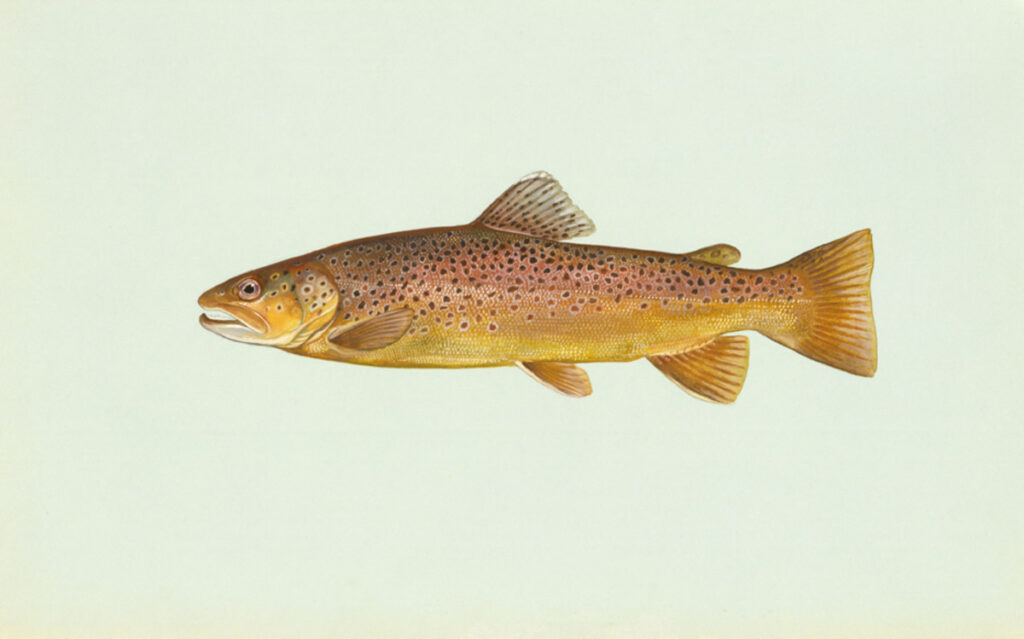
Recognizing the fish
Brown trout are heavy-shouldered, blunt-headed trout with a squared or barely notched tail and a body ground color that runs from buttery yellow-gold through olive to near-bronze. The defining mark is the spotting: dark spots on the back and flanks are mixed with rusty red or orange spots, and many of those spots sit inside pale halos. Spotting stops at the lateral line region in many fish and rarely extends onto the tail, which separates them cleanly from rainbow trout, whose tails are heavily peppered.
Coloration is plastic. Fish from tannic freestone rivers run dark and heavily marked; fish from limestone spring creeks are pale and silvery; sea-run and lake-run fish are chrome with faint X-shaped marks and lose the red spotting almost entirely. Large males develop a pronounced kype in autumn. Because the same species can look this different from one river to the next, the reliable characters are structural: the deep caudal peduncle, the small adipose fin often edged in orange, and the halo-ringed spots.
How brown trout got to North America
Brown trout are not native to any part of the Western Hemisphere. Their arrival is one of the best-documented introductions in American fisheries history, and also one of the most garbled in retelling.
The first eggs came from Germany in 1883, secured through Fred Mather of the US Fish Commission and distributed from the Commission’s hatchery at Cold Spring Harbor, New York. The US Geological Survey’s Nonindigenous Aquatic Species program records that “the Brown Trout was first imported to the United States in 1883 from Germany and stocked in the Pere Marquette River, Michigan, by the U.S. Fish Commission.” The resulting fry went into the water in 1884, into a tributary of Michigan’s Pere Marquette. Sources differ on which date to call the introduction: agencies that date it by the egg shipment say 1883, and the Michigan Department of Natural Resources follows that convention, stating that brown trout “were introduced to Michigan in 1883 — one of the first states to import them into North America.” Accounts that date it by the first fish in the river say 1884. Both are defensible; they are measuring different events.
The German shipment is conventionally associated with Lucius von Behr, then president of the German Fisheries Society, and “von Behr trout” survives as a strain name for the Continental stock. The elaborate version of that story — a named steamship, a named crossing, a dramatic rescue of the eggs — could not be traced to any primary source. Treat von Behr as a strain name and a plausible attribution of the donor, not as a documented voyage narrative.
The Loch Leven strain arrived later, and separately
The second founding stock is where most published accounts go wrong. Loch Leven trout — the Scottish lake strain, historically treated as a distinct form and still used as a strain designation in American hatcheries — did not come over with the German eggs in 1883. They came a year later, from a different country, through a different hatchery.
The eggs were taken at the Howietoun hatchery near Stirling, Scotland, on 12 November 1884, and reached Cold Spring Harbor on 2 January 1885. The record is Charles W. Smiley’s article “Loch Leven Trout introduced in the United States,” at page 28 of volume 7 of the Bulletin of the United States Fish Commission (1887). Online summaries that fold Loch Leven into the 1883 German shipment, or that give 1883 as the Loch Leven date, are repeating an error. The two strains were imported separately, roughly fourteen months apart, and were interbred in American hatcheries soon afterward. Modern US brown trout populations are mixtures; the strain names attached to hatchery lots describe ancestry loosely at best.
Where they live now
Brown trout are established in cold and cool rivers across the northern tier of the country, throughout the Appalachians and the Ozarks, across the Rockies and the interior West, and in Great Lakes tributaries where lake-run fish move up to spawn. The US Fish and Wildlife Service maintains a species profile for them despite their non-native status, reflecting how thoroughly embedded they are in American fisheries management.
Their distribution in any given watershed tends to be the mirror image of the native char. Where brook trout occupy the cold headwaters, brown trout own the middle and lower river. In the West, brown trout hold the mainstem while cutthroat retreat upstream. Wisconsin’s classification of trout water — Class 1 streams with self-sustaining wild reproduction, Class 2 with partial reproduction, Class 3 marginal — maps closely onto where brown trout reproduce naturally versus where they persist only through stocking.
Water temperature
Temperature is the single most useful number for predicting brown trout behavior in a river. Growth and active feeding concentrate between roughly 54 and 66 °F. Below about 40 °F metabolism slows and fish hold low and feed sparingly. Above about 68 °F, oxygen demand climbs while dissolved oxygen falls, and fish begin to seek out cold seeps, spring inflows and tributary mouths.
The most defensible upper limits come from field data rather than laboratory tanks. Wehrly, Wang and Mitro’s field-based estimates of thermal tolerance for trout in Michigan and Wisconsin streams found no difference between brook and brown trout in upper thermal tolerance, and placed the seven-day limits at a maximum daily mean of 23.3 °C (73.9 °F) and a maximum daily maximum of 25.4 °C (77.7 °F). Critically, those limits are duration-dependent: tolerance falls steeply between one and fourteen days of exposure, then declines more gradually over longer periods. A river that touches 75 °F for two hours on one afternoon is a different proposition from a river that averages 73 °F for a week.
Relative to other salmonids, brown trout are the warm-water specialists of the group. Michigan’s fisheries agency attributes their spread through that state’s rivers to being “more tolerant of warmer water temperatures than other trout species.” On rivers where a live temperature reading is available, the practical threshold to watch is the daily maximum crossing into the low 70s and, more importantly, whether it stays there overnight.
Eyes built for low light
The best-supported explanation for brown trout behavior is optical. Rader, Belish, Young and Rothlisberger compared dark-adapted vision across four trout species in “The scotopic visual sensitivity of four species of trout: a comparative study” (Western North American Naturalist 67:524–537, 2007, with US Forest Service involvement). Brown trout and brook trout could resolve prey at roughly twice the low-light sensitivity of rainbow and cutthroat trout — that is, they can still see and feed at light levels where the other two species effectively cannot.
This single result carries an unusual amount of explanatory weight. It accounts for the strongly nocturnal and crepuscular feeding of larger brown trout, and for the observation that the biggest fish in a river are often functionally invisible during daylight. It also supplies a mechanism for competitive displacement. If two species share a river and one of them can forage through the night while the other cannot, the difference compounds across a season. The authors proposed exactly this as a mechanism by which brown trout exclude native cutthroat trout, and it complements the field record: USGS notes that brown trout “have commonly replaced Cutthroat Trout (O. clarkii) in large rivers,” that “adult Brown Trout displaced adult native Brook Trout from the best habitats in a Michigan stream,” and that predicted brook trout occurrence is lower where brown trout are present.
Feeding and growth
Juvenile brown trout eat drifting invertebrates — mayfly, caddis and midge larvae, terrestrials that fall in from the bank. Somewhere past roughly 12 to 14 inches, the diet shifts. Large brown trout in rivers become substantially piscivorous, taking sculpin, dace, juvenile trout and crayfish, and this shift is what produces the disproportionately large individuals that rivers with good forage bases yield. The switch is also why brown trout populations often show a bimodal size structure: many small drift-feeders and a few very large predators, with comparatively few fish in between.
Growth rate tracks temperature and food. Fish in cold, infertile freestone headwaters may take five years to reach 12 inches. Fish in fertile tailwaters, where a bottom-release dam holds summer temperatures in the fifties and sixties and delivers a constant invertebrate supply, can exceed 20 inches in three or four years. The same species produces both outcomes; the river does the work.
Spawning
Brown trout spawn in autumn, in contrast to spring-spawning rainbow trout. Timing runs from September at high latitude and elevation through December in southern and low-elevation rivers, with the trigger being falling water temperature through roughly the mid-40s to low 50s °F, often reinforced by shortening day length and autumn flow increases. In Michigan, the state agency reports spawning “in tributary streams in September and October,” in “shallow, gravelly or rocky areas.”
Females cut redds in clean gravel at the tails of pools and in riffle margins, preferring places with downwelling flow through the substrate that will keep eggs oxygenated. Eggs incubate through winter and hatch in late winter or early spring, with alevins remaining in the gravel until yolk absorption. Fine sediment is the dominant threat to this life stage — silt infilling the gravel suffocates eggs before they hatch — which is why land use in the upper watershed shows up in trout numbers two years later.
Whirling disease
Whirling disease is caused by Myxobolus cerebralis, a parasite that invades head and spinal cartilage in young trout, producing skeletal deformity, erratic swimming and, in heavy infections, high mortality. The USGS Fish Health Program notes it is “thought to have been introduced from Europe,” was first detected in the US in 1958, and now occurs in more than twenty states.
Brown trout are comparatively resistant to it, and the reason is evolutionary: the parasite originated in Europe, where brown trout are native and where the two have a long shared history. Rainbow trout, cutthroat trout and bull trout — all New World species with no such history — are far more vulnerable, and rainbow trout collapses in Rocky Mountain rivers during the 1990s were the disease’s most visible effect. The accurate framing is resistance rather than “reservoir host”: brown trout are infected and can carry the parasite, but they mount a far more effective response to it than the native species they share water with. The comparative work is summarized in Hedrick and colleagues’ comparative susceptibility study of rainbow and brown trout in Diseases of Aquatic Organisms.
Prized fishery and removal target at the same time
Brown trout occupy an awkward position in American river management. They support some of the most valued river fisheries in the country and they are simultaneously the target of removal programs in national parks charged with restoring native fish.
In Grand Canyon National Park, the Native Fish Ecology and Conservation program removes “invasive trout and other invasive fishes in an effort to minimize threats of predation and restore native fishes and habitat in larger perennial tributaries,” in a river system whose humpback chub population is the largest remaining anywhere. In Great Smoky Mountains National Park, non-native trout have displaced native brook trout from a large share of their historical range, and restoration work there is built around reclaiming headwater reaches. In Yellowstone, the park’s westslope cutthroat program records that “nonnative brook and brown trout” contributed to native cutthroat decline by the 1930s, and describes removals in East Fork Specimen Creek and the upper Gibbon River ahead of restocking with genetically pure cutthroat. The park’s broader fisheries mission is explicitly framed around preserving native species. Removal methods and effects have been studied directly, including work on how brown trout removal affects survival and movement of remaining fish.
None of this is a contradiction so much as a matter of scale. On a tailwater built by a dam, where the native assemblage is already gone, brown trout are the fishery. On a headwater tributary that still holds a genetically intact native population, they are the problem. Both statements are true of the same species in the same state.
Habitat and behavior in rivers
Brown trout are structure-oriented in a way that other trout are not. They sit tight to undercut banks, log jams, boulder shadows and the deep slots along outside bends, and they defend those positions. Larger fish claim the best lies — the ones with the most food delivered for the least effort — and hold them across seasons. The pattern is consistent enough that a river’s productive water can be read from its structure alone.
Their nocturnal habit shapes everything downstream of it. Large brown trout move out of deep cover after dusk to hunt shallow flats and tailouts, and return before full light. The visual sensitivity data explains why this works for them and not for the rainbow trout in the same pool. In midsummer, thermal refuge overrides everything: fish concentrate at spring seeps, cold tributary confluences and dam release plumes, and abandon the reaches between them. A live water temperature reading, and the location of the nearest cold input, describe brown trout distribution in a July river better than any other pair of variables.
Where to catch it
419 waterways on GuidedFloats list brown trout, across 40 states. Each page carries live gauge readings, access notes, and the guides who fish it.
Arizona 13
- Black River167 cfs
- Blue Ridge Reservoir
- Bright Angel Creek19 cfs
- Chevelon Creek55 cfs
- Colorado River (Lees Ferry)7,940 cfs
- Del Rio Springs1 cfs
- East Verde River77 cfs
- Oak Creek59 cfs
- Show Low Creek
- Tonto Creek73 cfs
- West Clear Creek49 cfs
- West Fork Oak Creek3 cfs
- Wet Beaver Creek9 cfs
Arkansas 5
- Little Red River226 cfs
- Mammoth Spring
- Spring River
- Spring River299 cfs
- White River1,720 cfs
California 12
- Hat Creek120 cfs
- Kern River
- Little Truckee River below Boca Dam205 cfs
- Merced River14 cfs
- Pit River26 cfs
- Prosser Creek72 cfs
- Putah Creek141 cfs
- San Joaquin River392 cfs
- Scott River10 cfs
- Shasta River123 cfs
- Trinity River369 cfs
- Upper Sacramento River211 cfs
Colorado 20
- Animas River154 cfs
- Arkansas River
- Blue River below Green Mountain Reservoir188 cfs
- Boulder Creek12 cfs
- Cache la Poudre River26 cfs
- Clear Creek57 cfs
- Colorado River667 cfs
- Dolores River312 cfs
- Eagle River7 cfs
- East River64 cfs
- Fryingpan River76 cfs
- Gunnison River213 cfs
- Purgatoire River below Trinidad Lake
- Ridgway Reservoir
- Roaring Fork River512 cfs
- South Platte River105 cfs
- Taylor Park Reservoir
- Taylor River42 cfs
- Uncompahgre River65 cfs
- Yampa River117 cfs
Connecticut 9
- Farmington River594 cfs
- Housatonic River864 cfs
- Natchaug River123 cfs
- Naugatuck River264 cfs
- Quinebaug River869 cfs
- Salmon Creek22 cfs
- Salmon River (Connecticut)86 cfs
- Saugatuck River11 cfs
- West Branch Farmington River151 cfs
Delaware 3
- Brandywine Creek276 cfs
- Red Clay Creek38 cfs
- White Clay Creek54 cfs
Georgia 6
- Chattahoochee River613 cfs
- Chattooga River182 cfs
- Etowah River190 cfs
- Soque River67 cfs
- Tallulah River54 cfs
- Toccoa River163 cfs
Idaho 13
- Anderson Ranch Reservoir
- Big Lost River102 cfs
- Big Wood River54 cfs
- C.J. Strike Reservoir
- Henrys Fork92 cfs
- Payette River803 cfs
- Priest River1,340 cfs
- Silver Creek92 cfs
- South Fork Boise River300 cfs
- South Fork Snake River3,050 cfs
- Teton River406 cfs
- Warm Springs Creek29 cfs
- Warm Springs Creek40 cfs
Iowa 5
- Bloody Run Creek25 cfs
- Turkey River2,730 cfs
- Upper Iowa River725 cfs
- Waterloo Creek
- Yellow River215 cfs
Kentucky 1
Maine 8
- Androscoggin River2,180 cfs
- Branch Brook8 cfs
- Kennebec River1,700 cfs
- Meduxnekeag River42 cfs
- Piscataquis River714 cfs
- Saco River
- Sebago Lake
- Stony Brook
Maryland 12
- Antietam Creek110 cfs
- Big Pipe Creek40 cfs
- Conococheague Creek237 cfs
- Deer Creek47 cfs
- Gunpowder Falls77 cfs
- Licking Creek67 cfs
- Patuxent River28 cfs
- Savage River74 cfs
- Tonoloway Creek25 cfs
- Town Creek21 cfs
- Wills Creek98 cfs
- Youghiogheny River (Maryland)383 cfs
Massachusetts 8
- Deerfield River932 cfs
- Millers River322 cfs
- Quashnet River13 cfs
- Quinebaug River80 cfs
- Swift River126 cfs
- Upper Mystic Lake
- West River
- Westfield River574 cfs
Michigan 9
- Au Sable River1,270 cfs
- Boardman River117 cfs
- Higgins Lake
- Jordan River184 cfs
- Manistee River1,160 cfs
- Muskegon River1,370 cfs
- Pere Marquette River608 cfs
- Presque Isle River84 cfs
- Rifle River338 cfs
Minnesota 5
- Crooked Creek
- Root River983 cfs
- Rush Creek
- South Fork Root River201 cfs
- Straight River35 cfs
Missouri 9
- Bennett Spring101 cfs
- Current River143 cfs
- Current River at Montauk59 cfs
- Greer Spring197 cfs
- Little North Fork River
- Meramec River174 cfs
- North Fork of the White River304 cfs
- Pearson Creek6 cfs
- Roaring River15 cfs
Montana 20
- Beaverhead River200 cfs
- Big Hole River471 cfs
- Big Spring Creek152 cfs
- Bighorn River1,600 cfs
- Bitterroot River840 cfs
- Blackfoot River600 cfs
- Clark Fork1,470 cfs
- Gallatin River360 cfs
- Hebgen Lake
- Jefferson River1,070 cfs
- Lake Como
- Madison River788 cfs
- Madison River below Hebgen Lake707 cfs
- Missouri River2,980 cfs
- Rock Creek270 cfs
- Ruby River53 cfs
- Smith River191 cfs
- Stillwater River414 cfs
- Warm Springs Creek58 cfs
- Yellowstone River1,620 cfs
Nebraska 6
- Dismal River255 cfs
- Lodgepole Creek1 cfs
- Long Pine Creek146 cfs
- Middle Loup River1,200 cfs
- North Loup River391 cfs
- Spring Creek
Nevada 13
- East Fork Carson River49 cfs
- East Walker River111 cfs
- Humboldt River21 cfs
- Lamoille Creek3 cfs
- Lehman Creek4 cfs
- Rye Patch Reservoir
- South Fork Reservoir
- Steptoe Creek2 cfs
- Topaz Lake
- Truckee River323 cfs
- Truckee River below Derby Dam253 cfs
- Walker River26 cfs
- Wild Horse Reservoir
New Hampshire 20
- Ammonoosuc River124 cfs
- Androscoggin River (New Hampshire)1,430 cfs
- Ashuelot River429 cfs
- Ashuelot River below Surry Mountain Dam129 cfs
- Baker River95 cfs
- Bearcamp River46 cfs
- Beaver Brook25 cfs
- Cold River31 cfs
- Connecticut River (New Hampshire)467 cfs
- Contoocook River98 cfs
- Contoocook River below Hopkinton Dam472 cfs
- Diamond River263 cfs
- East Branch Pemigewasset River169 cfs
- Nubanusit Brook below MacDowell Dam
- Peabody River74 cfs
- Pemigewasset River573 cfs
- Piscataquog River34 cfs
- Saco River406 cfs
- Upper Ammonoosuc River330 cfs
- Winnicut River41 cfs
New Jersey 4
- Musconetcong River154 cfs
- Raritan River359 cfs
- Rockaway River74 cfs
- South Branch Raritan River52 cfs
New Mexico 12
- Cimarron River2 cfs
- Costilla Creek
- Eagle Nest Lake
- Gila River146 cfs
- Pecos River116 cfs
- Rio Chama200 cfs
- Rio Chama below Abiquiu Dam182 cfs
- Rio Chama below El Vado Dam153 cfs
- Rio Grande186 cfs
- Rio Nambe11 cfs
- Rio Pueblo de Taos41 cfs
- San Juan River272 cfs
New York 20
- Ausable River688 cfs
- Battenkill318 cfs
- Beaverkill314 cfs
- Black River4,650 cfs
- Cattaraugus Creek205 cfs
- Cayuga Lake
- Esopus Creek801 cfs
- Genesee River919 cfs
- Mohawk River140 cfs
- Mongaup River123 cfs
- Neversink River180 cfs
- Oatka Creek46 cfs
- Oswegatchie River905 cfs
- Owasco Lake
- Pepacton Reservoir
- Salmon River236 cfs
- Saranac River1,330 cfs
- Schoharie Creek
- West Branch Delaware River331 cfs
- Willowemoc Creek82 cfs
North Carolina 14
- Cataloochee Creek42 cfs
- Catawba River2,970 cfs
- Cheoah River99 cfs
- Davidson River63 cfs
- French Broad River1,050 cfs
- Linville River63 cfs
- Little Tennessee River117 cfs
- Nantahala River87 cfs
- South Toe River114 cfs
- Tuckasegee River614 cfs
- Valley River66 cfs
- Watauga River106 cfs
- Wilson Creek
- Yadkin River below W. Kerr Scott Dam946 cfs
Ohio 3
- Chagrin River146 cfs
- Mad River221 cfs
- Rocky River122 cfs
Oklahoma 2
- Blue River43 cfs
- Lower Mountain Fork River158 cfs
Oregon 4
- Lake Billy Chinook
- Metolius River1,190 cfs
- Owyhee River31 cfs
- Williamson River
Pennsylvania 32
- Allegheny Reservoir
- Allegheny River below Kinzua Dam2,310 cfs
- Aquashicola Creek57 cfs
- Aughwick Creek66 cfs
- Bald Eagle Creek298 cfs
- Big Spring Run1 cfs
- Brodhead Creek71 cfs
- Buck Run17 cfs
- Clarion River513 cfs
- Codorus Creek10 cfs
- Fishing Creek75 cfs
- Jordan Creek62 cfs
- Kettle Creek43 cfs
- Kishacoquillas Creek192 cfs
- Lackawaxen River199 cfs
- Lehigh River1,250 cfs
- Lehigh River below Francis E. Walter Dam700 cfs
- Little Juniata River190 cfs
- Little Lehigh Creek5 cfs
- Loyalsock Creek266 cfs
- Monocacy Creek26 cfs
- Penns Creek298 cfs
- Pine Creek145 cfs
- Pohopoco Creek97 cfs
- Shohola Creek44 cfs
- Spring Creek80 cfs
- Spring Creek56 cfs
- Spring Creek4 cfs
- Tobyhanna Creek180 cfs
- Tulpehocken Creek203 cfs
- Yellow Breeches Creek153 cfs
- Youghiogheny River2,260 cfs
Rhode Island 11
- Beaver River28 cfs
- Blackstone River506 cfs
- Branch River109 cfs
- Chipuxet River32 cfs
- Nipmuc River12 cfs
- Pawcatuck River602 cfs
- Pawtuxet River267 cfs
- Peeptoad Brook2 cfs
- Usquepaug River98 cfs
- Wood River142 cfs
- Woonasquatucket River42 cfs
South Carolina 2
- North Saluda River6 cfs
- Saluda River2,460 cfs
South Dakota 15
- Battle Creek
- Bear Butte Creek1 cfs
- Castle Creek
- Deerfield Reservoir
- Elk Creek
- Fall River25 cfs
- French Creek1 cfs
- Grace Coolidge Creek1 cfs
- Little Spearfish Creek12 cfs
- Pactola Reservoir
- Rapid Creek25 cfs
- Rapid Creek below Pactola Dam17 cfs
- Spearfish Creek35 cfs
- Spring Creek
- Whitewood Creek5 cfs
Tennessee 4
- Big Limestone Creek28 cfs
- Little River67 cfs
- Nolichucky River below Nolichucky Dam959 cfs
- Watauga River413 cfs
Texas 1
- Guadalupe River103 cfs
Utah 16
- Ashley Creek168 cfs
- Big Brush Creek45 cfs
- Blacksmith Fork53 cfs
- Chalk Creek14 cfs
- Duchesne River108 cfs
- Green River2,300 cfs
- Lake Fork River7 cfs
- Logan River92 cfs
- North Fork Virgin River51 cfs
- Ogden River below Pineview Reservoir17 cfs
- Price River9 cfs
- Provo River164 cfs
- Santa Clara River below Winsor Dam1 cfs
- South Fork Ogden River8 cfs
- Strawberry River31 cfs
- Weber River64 cfs
Vermont 18
- Ayers Brook15 cfs
- Batten Kill
- Lake Memphremagog
- Lamoille River251 cfs
- Lewis Creek36 cfs
- Missisquoi River969 cfs
- Moose River94 cfs
- Ompompanoosuc River63 cfs
- Ottauquechee River35 cfs
- Otter Creek705 cfs
- Passumpsic River402 cfs
- Ranch Brook8 cfs
- Waterbury Reservoir
- Wells River69 cfs
- West River311 cfs
- White River (Vermont)556 cfs
- Winooski River1,020 cfs
- Wrightsville Reservoir
Virginia 12
- Bullpasture River81 cfs
- Calfpasture River59 cfs
- Cedar Creek33 cfs
- Cowpasture River308 cfs
- Jackson River200 cfs
- Linville Creek27 cfs
- North River192 cfs
- Opequon Creek12 cfs
- Passage Creek17 cfs
- Pedlar River6 cfs
- Pound River below Flannagan Dam
- Smith Creek39 cfs
Washington 1
- Spokane River1,600 cfs
West Virginia 16
- Back Creek32 cfs
- Big Sandy Creek238 cfs
- Cheat River3,290 cfs
- Cranberry River329 cfs
- Gauley River1,910 cfs
- Gauley River below Summersville Dam
- Greenbrier River1,520 cfs
- Howard Creek
- Laurel Creek115 cfs
- Patterson Creek78 cfs
- Shavers Fork215 cfs
- South Branch Potomac River1,530 cfs
- Tygart Valley River613 cfs
- Warm Springs Run3 cfs
- West Fork River below Stonewall Jackson Dam375 cfs
- Williams River482 cfs
Wisconsin 16
- Big Roche A Cri Creek24 cfs
- Black Earth Creek41 cfs
- Bois Brule River113 cfs
- Brule River526 cfs
- Chaffee Creek12 cfs
- Devils Lake
- Dorn Creek3 cfs
- Eau Galle River16 cfs
- Green Lake
- Kinnickinnic River96 cfs
- Namekagon River43 cfs
- Peshtigo River243 cfs
- Tenmile Creek48 cfs
- Tomorrow River40 cfs
- White Creek2 cfs
- Whittlesey Creek18 cfs
Wyoming 19
- Bear River
- Big Sandy Reservoir
- Boulder Creek below Boulder Lake13 cfs
- Encampment River102 cfs
- Firehole River38 cfs
- Fish Creek146 cfs
- Gibbon River72 cfs
- Green River (Wyoming)605 cfs
- Jackson Lake
- Middle Fork Powder River5 cfs
- North Brush Creek10 cfs
- North Fork Shoshone River213 cfs
- North Platte River300 cfs
- North Platte River below Whalen Diversion Dam14 cfs
- Pacific Creek52 cfs
- Salt River423 cfs
- Shoshone River680 cfs
- Snake River1,040 cfs
- Wind River440 cfs
References
- Brown Trout (Salmo trutta) — Nonindigenous Aquatic Species factsheet — U.S. Geological Survey
- Brown Trout (Salmo trutta) species profile — U.S. Fish and Wildlife Service
- Brown Trout — Michigan Species — Michigan Department of Natural Resources
- The scotopic visual sensitivity of four species of trout: a comparative study (Rader, Belish, Young & Rothlisberger, Western North American Naturalist 67:524–537, 2007) — Brigham Young University ScholarsArchive / USDA Forest Service
- Bulletin of the United States Fish Commission, Volume 7 (1887) — includes C. W. Smiley, 'Loch Leven Trout introduced in the United States', p. 28 — United States Fish Commission
- Field-Based Estimates of Thermal Tolerance Limits for Trout: Incorporating Exposure Time and Temperature Fluctuation (Wehrly, Wang & Mitro, TAFS 136:365–374, 2007) — Transactions of the American Fisheries Society
- Whirling Disease — Fish Health Program — U.S. Geological Survey
- Comparative susceptibility of rainbow trout Oncorhynchus mykiss and brown trout Salmo trutta to Myxobolus cerebralis (Hedrick et al., Diseases of Aquatic Organisms 37:173–183, 1999) — Diseases of Aquatic Organisms
- Fish — Grand Canyon National Park — National Park Service
- Fish — Great Smoky Mountains National Park — National Park Service
- Westslope Cutthroat Trout — Yellowstone National Park — National Park Service
- Fish — Yellowstone National Park — National Park Service
- Brown Trout Removal Effects on Survival and Movement (Fetherman et al., TAFS, 2015) — Transactions of the American Fisheries Society
- Wisconsin Trout Stream Classification — Wisconsin Department of Natural Resources
- Salmo trutta — IUCN Red List assessment — International Union for Conservation of Nature
- IGFA World Records database — International Game Fish Association