Largemouth Bass
Micropterus nigricans
The most widely stocked freshwater gamefish in the world, renamed Micropterus nigricans in 2023 when genetic work showed the name salmoides belonged to the Florida bass.
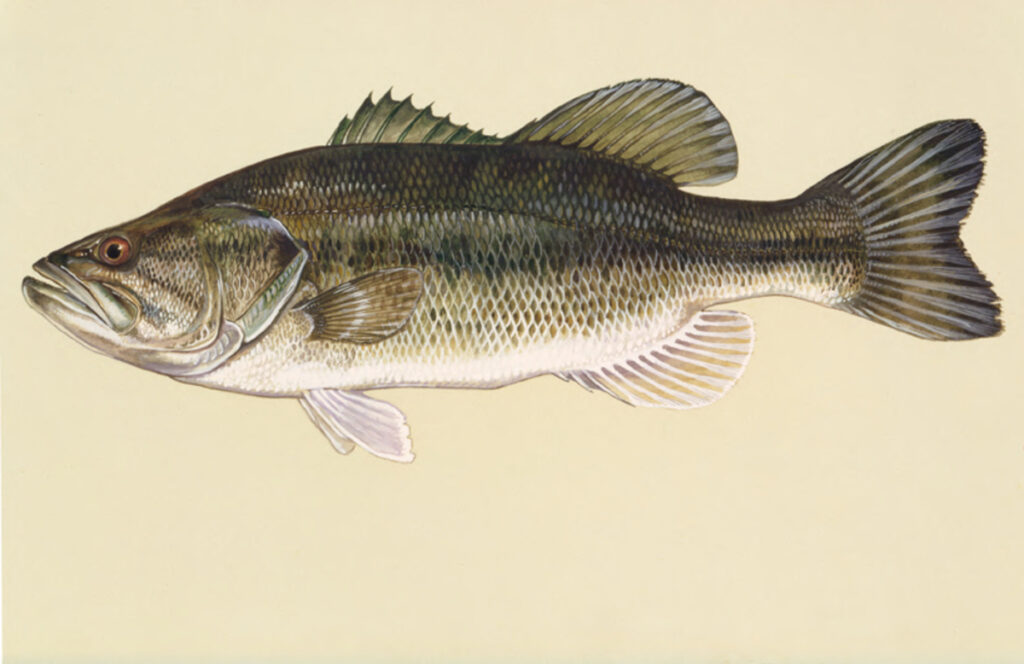
Identification
The largemouth bass is a deep-bodied, laterally compressed sunfish with a ragged dark band running the length of the midside. The band is bold in clear water and nearly invisible in stained water, and in older fish it commonly breaks into a chain of blotches rather than a continuous stripe.
Two features separate it reliably from the other black basses of North America. The first is the jaw: in adults the rear edge of the maxilla extends clearly past the back of the eye, which no other Micropterus does consistently. The second is the dorsal fin, which is nearly divided in two — a deep notch drops almost to the back between the spiny front section, which carries nine spines, and the soft-rayed rear section of twelve to thirteen rays (Texas Parks and Wildlife Department). Spotted bass, by contrast, have the two fins broadly connected and a rough patch of small teeth on the tongue that largemouth lack.
Scale counts distinguish largemouth bass from the closely related Florida bass, which is otherwise visually identical: the Florida bass carries 69–73 scales along the lateral line against 59–65 in the largemouth (Florida Museum of Natural History). Because the ranges overlap across a wide intergrade belt, and because the two interbreed freely wherever stocking has mixed them, field identification of the two is unreliable and Florida’s own wildlife agency advises anglers not to attempt it.
A recent change of scientific name
For roughly seventy-five years the largemouth bass was called Micropterus salmoides. It is not, and never was.
In 2022 Daemin Kim, Andrew Taylor and Thomas Near published a genome-scale phylogeny of the black basses in Scientific Reports, using ddRAD sequence data to delimit nineteen species of Micropterus — fourteen already described, three known but undescribed (Altamaha, Bartram’s and Choctaw basses) and two unnamed smallmouth lineages. In the course of that work they re-examined the type material behind Lacépède’s 1802 description of salmoides and concluded that it refers to the Florida bass, not to the widespread continental fish. The correct available name for the largemouth bass, Micropterus nigricans (Cuvier), was accordingly elevated from synonymy, and Micropterus floridanus became a junior synonym of salmoides (Kim, Taylor and Near 2022; PubMed record).
The American Fisheries Society adopted the change in the eighth edition of Common and Scientific Names of Fishes from the United States, Canada, and Mexico (Page et al. 2023, AFS Special Publication 37), which is the standard naming authority for North American fishes and is issued jointly with the American Society of Ichthyologists and Herpetologists. The practical result is a swap: largemouth bass is now Micropterus nigricans, and Micropterus salmoides now means Florida bass (AFS Ontario Chapter summary of the 2023 changes).
Agencies have moved at different speeds. Florida’s Fish and Wildlife Conservation Commission recognised the Florida bass as a distinct species and incorporated the new names at its February 2025 meeting (FWC, FWC news release). Maryland’s Department of Natural Resources went through a formal process to update the binomial in its own documents so that they “refer to the proper species of black bass” (Maryland DNR). NatureServe now carries separate records for M. nigricans and for M. salmoides as Florida bass. But a great many public agency pages still print the old name: as of writing, the species accounts published by Texas Parks and Wildlife, the Wisconsin DNR and the Florida Museum of Natural History all still use Micropterus salmoides for the largemouth bass. Readers should expect to meet both names for years yet.
One consequence matters for everything below: essentially the entire body of published work on largemouth bass biology — thermal tolerance, growth, spawning, diet — was produced under the name M. salmoides. In most cases those studies were working on fish now called M. nigricans, or on intergrades. The findings did not change; only the label did.
Range and distribution
The native range covers the St. Lawrence–Great Lakes and Hudson Bay (Red River) drainages, the Mississippi basin from southern Quebec and Ontario to Minnesota and south to the Gulf, and Gulf Slope drainages reaching the Rio Grande system of southern Texas and northern Mexico (NatureServe; USGS Nonindigenous Aquatic Species database). The Atlantic Coastal Plain from peninsular Florida north to North Carolina is Florida bass country, with three genetically distinct clusters recognised across Florida rivers, the Atlantic Piedmont and the Atlantic Coastal Plain (NatureServe, Florida bass).
Beyond that, the map is an artefact of a century of hatchery work. Largemouth bass have been moved into essentially every warmwater drainage on the continent and into more than fifty countries. Much of that introduced stock is of Florida-bass or intergrade origin, which is why the new taxonomy is awkward to apply outside the native range.
Habitat and water temperature
In rivers, largemouth bass are a low-velocity animal. Missouri’s fish and wildlife agency places them in “lowland lakes, artificial impoundments of all sizes, permanent pools of streams, and quiet backwaters of large rivers” — a description that separates them cleanly from smallmouth in cool clear Ozark current and from spotted bass in permanently flowing, warmer, more turbid water (Missouri Department of Conservation).
Telemetry work quantifies how strong that preference is. A three-year study of radio-tagged largemouth in the Kissimmee River, Florida, found current velocities of less than 6 cm per second at a minimum of 92.2% of bass locations in any season, with fish concentrated in smartweed, spatterdock and aquatic grass. Daily movements averaged under 100 m for more than half of all location samples. Fish held home areas where dissolved oxygen stayed above 2 ppm year-round, and abandoned them — moving more than a kilometre — when acute oxygen declines dropped water below that between June and October (Furse, Davis and Bull 1996). In a river, largemouth bass are eddy and slackwater fish, and oxygen, not current, is what usually forces them to move.
Thermally the species is warm-adapted and unusually tolerant. Nevada’s Division of Environmental Protection compiled the published literature and reports:
- Optimal growth: 25–30°C (77–86°F) for fastest growth (Coutant and DeAngelis 1983); 28.1–28.6°C (82.6–83.5°F) in Díaz et al. 2007; 27.5–30°C (81.5–86°F) in Strawn 1961.
- Preferred temperature: 27–32°C (80.6–89.6°F) for adults (Venables et al. 1978); a final preferendum of 29.0°C (84.2°F) (Neill and Magnuson 1974).
- Upper incipient lethal temperature: 32.7–36.4°C (90.9–97.5°F) at high acclimation (Hart 1952), but as low as 30.6–31°C (87.1–87.8°F) at 22°C acclimation (McCormick and Wegner 1981).
- Critical thermal maximum: 36.7°C (98°F) at 20°C acclimation up to 38.2–39.8°C (100.8–103.6°F) at 30–36°C acclimation.
Nevada DEP recommends a chronic threshold of 32°C (89.6°F) and an acute threshold of 34°C (93.2°F) for juveniles and adults (Nevada DEP thermal tolerance analysis). The acclimation dependence in that list is not a footnote — it is the main point. A largemouth that has spent August in 88°F water can survive temperatures that would kill a fish moved there from 72°F.
Early life stages are the constraint. Storms, Foltz and Wilde tested pro-larvae and post-larvae and calculated a maximum weekly average temperature of 28.1°C (82.6°F) to protect them, with 96-hour TL50 values of 32.8°C for instant exposure and 34.1°C when temperature rose gradually at 5°C per day (Storms et al. 1986). A gauge reading of 84°F in July therefore means two different things at once: comfortable for adults, above the protective ceiling for that year’s fry.
Life history
Spawning is a male enterprise. The male fans a saucer-shaped nest, usually on sand or gravel but readily on soft bottom where roots, twigs and snail shells give the eggs something to adhere to, then guards eggs and fry.
Reported temperature triggers vary, and the variation is worth stating plainly. Wisconsin reports spawning from late April to early July, beginning when water reaches 60°F, with eggs laid at 62–65°F (Wisconsin DNR). Texas gives a start near 60°F, occurring anywhere from February to May depending on latitude (TPWD). The Florida Museum states the species “generally does not spawn at temperatures much below 64°F (17.8°C),” with optimum conditions around 18.9–20.0°C. Part of that spread is latitude and part is definition — the onset of nest-building runs several degrees ahead of egg deposition — but the sources do disagree, and 60°F is best read as the point at which nesting behaviour begins rather than the point at which eggs are in the gravel.
Fecundity estimates also conflict: TPWD gives 2,000–43,000 eggs per nest, while the Florida Museum reports 2,000–145,000, a range that probably reflects the inclusion of very large Florida-strain females. Eggs hatch in five to ten days. Growth in Texas runs to 4–6 inches in the first year, 8–12 inches by age two and about 16 inches by age three. Longevity is contested: TPWD cites an average lifespan up to 16 years, whereas the Florida Museum gives maximum ages of about nine years for females and six for males. The higher figure is likely a maximum rather than an average.
Diet
Largemouth bass are gape-limited generalists and the diet tracks mouth size. Fry take zooplankton, then insect larvae; by about two inches they are eating fish and large invertebrates such as crayfish, and cannibalism is routine (TPWD). Adult stomach contents run to small fish, crayfish, mussels, snails, adult and larval insects, tadpoles and frogs (Florida Museum). In river backwaters this typically means sunfish, shad, minnows and crayfish, in proportions set by whatever the slackwater holds.
Behaviour and angling
Nearly everything characteristic about how largemouth bass behave follows from being a short-burst ambush predator with a very large mouth and a low tolerance for sustained swimming. The species does not hold in current and does not chase over distance. It waits beside an edge — a weed line, a laydown, an undercut bank, the seam where an eddy meets moving water — and takes prey in one or two body lengths. In a river this pushes the fish out of the thalweg and into backwaters, sloughs, oxbows, tributary mouths and the dead water behind wood, which is exactly the distribution the Kissimmee telemetry recorded.
Metabolic rate scales with temperature, and so does feeding frequency. Wisconsin’s summary that “few bite in the winter” is a plain-language statement of a real physiological floor: below roughly 50°F a largemouth’s daily ration collapses and feeding becomes episodic rather than daily. At the other end, fish sitting in water in the high 80s are feeding hard but are also close to their chronic thermal ceiling, and in shallow river backwaters that heat is coupled to oxygen depletion — which is why summer largemouth in rivers so often relocate abruptly rather than merely going deeper.
Spring behaviour is nest-driven and shallow; the fish are visible, territorial and site-attached. Post-spawn they disperse to cover. Because river largemouth move so little, individual backwaters function as semi-independent populations, and a slough that fishes well one year will often fish well the next for the same reason a pool holds the same smallmouth: the fish never left.
Conservation
Largemouth bass are in no danger. NatureServe has not yet assigned a global rank to Micropterus nigricans following the split, listing it as GNR, and the same applies to the Florida bass — this reflects the newness of the taxonomy rather than any concern about abundance (NatureServe). There is no federal listing.
The conservation problems attached to this species run the other way. Outside its native range it is an effective introduced predator: USGS attributes declines of native ranid frogs in California and of California tiger salamander populations partly to introduced predatory centrarchids including largemouth bass (USGS NAS). There is also a genetic dimension that the 2023 renaming has made newly visible. Decades of stocking Florida-strain fish into largemouth waters, chasing larger average size, has produced intergrade populations across much of the southern United States. Those fish are now, formally, hybrids between two recognised species, and the practice has blurred a boundary that biologists are only now able to describe properly.
Where to catch it
609 waterways on GuidedFloats list largemouth bass, across 48 states. Each page carries live gauge readings, access notes, and the guides who fish it.
Alabama 18
- Alabama River below Millers Ferry
- Bayou Sara
- Black Warrior River below Bankhead Lock and Dam
- Black Warrior River below Selden Dam
- Cahaba River234 cfs
- Choccolocco Creek165 cfs
- Choctawhatchee River321 cfs
- Conecuh River2,200 cfs
- Conecuh River below Point A Dam1,240 cfs
- Coosa River3,540 cfs
- Fish River56 cfs
- Hatchet Creek62 cfs
- Lake Tuscaloosa
- Locust Fork54 cfs
- Mobile River12,400 cfs
- Tallapoosa River533 cfs
- Tensaw River8,260 cfs
- Tombigbee River below Coffeeville Lock and Dam1,680 cfs
Arizona 9
- Bartlett Reservoir
- Bill Williams River below Alamo Dam13 cfs
- Del Rio Springs1 cfs
- East Verde River77 cfs
- Lake Mohave
- Salt River511 cfs
- Salt River below Stewart Mountain Dam42 cfs
- Show Low Creek
- Verde River841 cfs
Arkansas 18
- Bayou Bartholomew1 cfs
- Bayou Deview
- Bayou Macon13 cfs
- Bayou Meto
- Bear Bayou
- Beaver Lake
- Buffalo River115 cfs
- Bull Shoals Lake
- Caddo River23 cfs
- Deep Bayou
- Frog Bayou
- Illinois Bayou4 cfs
- Kings River68 cfs
- Lake Catherine
- Lake Hamilton
- Osage Creek29 cfs
- Ouachita River11 cfs
- Saline River13 cfs
California 15
- American River1,500 cfs
- Cosumnes River60 cfs
- Kern River
- Nacimiento River62 cfs
- Navarro River4 cfs
- Piru Creek401 cfs
- Pit River26 cfs
- Putah Creek141 cfs
- Russian River156 cfs
- Salinas River
- San Joaquin River392 cfs
- Santa Ynez River
- Stanislaus River846 cfs
- Suisun Bay
- Tuolumne River1,170 cfs
Colorado 3
Connecticut 4
- Connecticut River Estuary
- Natchaug River123 cfs
- Quinebaug River869 cfs
- Thames River
Delaware 9
- Appoquinimink River
- Brandywine Creek276 cfs
- Broadkill River
- Christina River-4,440 cfs
- Garrisons Lake
- Hearns Pond
- Marshyhope Creek13 cfs
- St Jones River46 cfs
- White Clay Creek54 cfs
Florida 20
- Aucilla River
- Chassahowitzka River277 cfs
- Chipola River906 cfs
- Hidden River8 cfs
- Hunter Spring Run63 cfs
- Lake Minnehaha
- Lake Rosalie
- Lake Seminole
- Lake Talquin
- Lake Trafford
- Lake Weohyakapka
- Loxahatchee River
- Myakka River
- Ochlockonee River1,400 cfs
- Peace River1,210 cfs
- Santa Fe River973 cfs
- St. Johns River3,590 cfs
- Suwannee River6,090 cfs
- Wakulla River770 cfs
- Withlacoochee River419 cfs
Georgia 15
- Altamaha River3,760 cfs
- Broad River193 cfs
- Carters Lake
- Etowah River190 cfs
- Flint River414 cfs
- Kinchafoonee Creek141 cfs
- Lake Allatoona
- Lake Eufaula
- Lake Lanier
- Middle Oconee River102 cfs
- Ocmulgee River1,500 cfs
- Ogeechee River26 cfs
- Satilla River2,570 cfs
- Spring Creek305 cfs
- West Point Lake
Hawaii 9
- Hanalei River227 cfs
- Kaukonahua Stream below Wahiawa Reservoir32 cfs
- Koolau Reservoir
- Ku Tree Reservoir
- Wahiawa Reservoir
- Wailua River2,330 cfs
- Wailuku River
- Waimea River506 cfs
- Wainiha River131 cfs
Idaho 5
- C.J. Strike Reservoir
- Coeur d'Alene Lake
- Coeur d'Alene River273 cfs
- Lake Pend Oreille
- Payette River803 cfs
Illinois 17
- Big Muddy River45 cfs
- Cache River1 cfs
- Channel Lake
- Embarras River55 cfs
- Fox Lake
- Fox River1,500 cfs
- Illinois River (Illinois)15,300 cfs
- Iroquois River125 cfs
- Kankakee River1,610 cfs
- Kaskaskia River170 cfs
- Little Wabash River76 cfs
- Mackinaw River104 cfs
- Macoupin Creek15 cfs
- Pecatonica River1,180 cfs
- Spring Brook2 cfs
- Vermilion River168 cfs
- Wabash River9,570 cfs
Indiana 20
- Big Raccoon Creek104 cfs
- Blue River14 cfs
- Brookville Lake
- Cecil M. Harden Lake
- Eagle Creek10 cfs
- East Fork White River
- Flatrock River47 cfs
- Hamilton Lake
- Lake Maxinkuckee
- Mississinewa Lake
- Mississinewa River22 cfs
- Monroe Lake
- Patoka Lake
- Pike Lake
- Salamonie Lake
- Sugar Creek44 cfs
- Sylvan Lake
- Tippecanoe River519 cfs
- White River (Indiana)1,050 cfs
- Wildcat Creek137 cfs
Iowa 9
- Beaver Creek906 cfs
- Black Hawk Creek839 cfs
- Black Hawk Lake
- Clear Lake
- Iowa River4,540 cfs
- Rathbun Lake
- Spirit Lake
- Storm Lake
- West Okoboji Lake
Kansas 18
- Cedar Bluff Reservoir
- Cheney Reservoir
- Clinton Lake
- Cottonwood River96 cfs
- Fall River18 cfs
- Hillsdale Lake
- Horsethief Reservoir
- Kanopolis Lake
- Marais des Cygnes River48 cfs
- Melvern Lake
- Milford Lake
- Neosho River3,040 cfs
- Perry Lake
- Pomona Lake
- Stranger Creek41 cfs
- Verdigris River70 cfs
- Walnut River199 cfs
- Wilson Lake
Kentucky 16
- Barren River Lake
- Bayou de Chien20 cfs
- Cave Run Lake
- Dix River31 cfs
- Elkhorn Creek147 cfs
- Green River (Kentucky)447 cfs
- Green River Lake
- Kentucky River972 cfs
- Levisa Fork below Fishtrap Dam
- Little Sandy River below Grayson Dam43 cfs
- Nolin River Lake
- Red River7 cfs
- Rough River Lake
- Royal Springs1 cfs
- Taylorsville Lake
- Tygarts Creek35 cfs
Louisiana 73
- Abita River
- Alligator Bayou
- Amite River314 cfs
- Atchafalaya River93,200 cfs
- Bayou Anacoco38 cfs
- Bayou Bartholomew5 cfs
- Bayou Bonne Idee
- Bayou Cocodrie62 cfs
- Bayou Conway
- Bayou Courtableau21 cfs
- Bayou D'Arbonne
- Bayou D'Arbonne
- Bayou Darby
- Bayou de Loutre
- Bayou Des Cannes1 cfs
- Bayou Des Glaises11 cfs
- Bayou DeSiard
- Bayou Dorcheat
- Bayou Dupre
- Bayou Fountain
- Bayou Francois
- Bayou Fusilier
- Bayou Grand Cane
- Bayou Grosse Tete
- Bayou Lacassine
- Bayou Lafourche371 cfs
- Bayou Liberty
- Bayou Macon
- Bayou Mallet
- Bayou Manchac
- Bayou Milhomme
- Bayou Nezpique9 cfs
- Bayou Perot
- Bayou Pierre156 cfs
- Bayou Plaquemine Brule
- Bayou Queue de Tortue
- Bayou Rapides
- Bayou San Patricio
- Bayou Teche
- Bayou Toro1 cfs
- Big Colewa Bayou
- Black Bay
- Black Bayou
- Black Lake Bayou
- Bodcau Bayou324 cfs
- Bogue Chitto River607 cfs
- Bushley Bayou
- Chauvin Bayou
- Chemin-A-Haut Bayou
- Choctaw Bayou
- Cross Bayou
- Cypress Bayou4 cfs
- Flagon Bayou
- Gilmer Bayou
- Henderson Bayou
- Kisatchie Bayou
- Lake Bistineau
- Lake Claiborne
- Lake D'Arbonne
- Little Corney Bayou
- Loggy Bayou
- Paw Paw Bayou
- Red Chute Bayou237 cfs
- Saline Bayou18 cfs
- Shettleworth Bayou
- Tangipahoa River355 cfs
- Tchefuncte River58 cfs
- Toledo Bend Reservoir
- Twelvemile Bayou
- Vermilion Bay
- White Bayou
- Willow Chute Bayou
- Youngs Bayou
Maine 2
- Branch Brook8 cfs
- Sebago Lake
Maryland 6
- Conococheague Creek237 cfs
- Monocacy River304 cfs
- Nanticoke River
- Patuxent River28 cfs
- Potomac River5,250 cfs
- Tuckahoe Creek45 cfs
Massachusetts 12
- Charles River181 cfs
- Connecticut River7,210 cfs
- Indian Head River37 cfs
- Jones River27 cfs
- Merrimack River2,870 cfs
- Millers River331 cfs
- Monatiquot River16 cfs
- Neponset River191 cfs
- Quinebaug River80 cfs
- Upper Mystic Lake
- West River
- Westfield River574 cfs
Michigan 9
- Austin Lake
- Cisco Lake
- Grand River90 cfs
- Houghton Lake
- Intermediate Lake
- Lake St Helen
- Otsego Lake
- Thornapple River208 cfs
- Van Etten Lake
Minnesota 6
- Cannon River541 cfs
- Lake Minnetonka
- Lake Traverse
- Leech Lake
- Minnehaha Creek below Grays Bay Dam
- Orwell Lake
Mississippi 16
- Bayou Pierre
- Big Black River229 cfs
- Harris Bayou
- Jourdan River
- Luxapallila Creek88 cfs
- Okatoma Creek78 cfs
- Old Fort Bayou
- Pascagoula River
- Pearl River885 cfs
- Porter Bayou12 cfs
- Richies Bayou
- Ross Barnett Reservoir
- Steele Bayou
- Strong River43 cfs
- Tombigbee River236 cfs
- Wolf River (Mississippi)43 cfs
Missouri 15
- Big Piney River125 cfs
- Big River135 cfs
- Black River174 cfs
- Bryant Creek140 cfs
- East Fork Black River below Taum Sauk Reservoir7 cfs
- Elk River
- Gasconade River479 cfs
- Huzzah Creek62 cfs
- James River152 cfs
- Little North Fork River
- Meramec River174 cfs
- North Fork Spring River3 cfs
- Spring Creek8 cfs
- Spring River78 cfs
- Table Rock Lake
Montana 1
Nebraska 14
- Bazile Creek43 cfs
- Big Blue River1,020 cfs
- Bow Creek37 cfs
- Cedar River262 cfs
- Frenchman Creek13 cfs
- Harlan County Lake
- Lodgepole Creek1 cfs
- Logan Creek205 cfs
- Middle Loup River1,200 cfs
- North Loup River391 cfs
- Ponca Creek8 cfs
- Sappa Creek
- Spring Creek
- Wahoo Creek138 cfs
Nevada 9
- Humboldt River21 cfs
- Lahontan Reservoir
- Little Washoe Lake
- Rye Patch Reservoir
- South Fork Reservoir
- Topaz Lake
- Walker River26 cfs
- Weber Reservoir
- Wild Horse Reservoir
New Hampshire 7
- Ashuelot River below Surry Mountain Dam129 cfs
- Beaver Brook25 cfs
- Contoocook River98 cfs
- Contoocook River below Hopkinton Dam472 cfs
- Nubanusit Brook below MacDowell Dam
- Piscataquog River34 cfs
- Winnicut River41 cfs
New Jersey 4
- Hackensack River
- Passaic River1,110 cfs
- Raritan River359 cfs
- Rockaway River74 cfs
New Mexico 9
- Blue Springs6 cfs
- Bluewater Lake
- Brantley Lake
- Conchas Lake
- Gila River146 cfs
- Lake Sumner
- Rio Grande below Elephant Butte Dam
- Santa Rosa Lake
- Ute Reservoir
New York 9
- Cayuga Lake
- Chautauqua Lake
- Conesus Lake
- Great Sacandaga Lake
- Lake George
- Mohawk River140 cfs
- Oswegatchie River905 cfs
- Owasco Lake
- Saratoga Lake
North Carolina 14
- Catawba River2,970 cfs
- Currituck Sound
- Deep River71 cfs
- Haw River69 cfs
- Little Tennessee River117 cfs
- Lumber River101 cfs
- Neuse River226 cfs
- Pamlico River
- Pee Dee River8,570 cfs
- Roanoke River1,510 cfs
- Tar River4 cfs
- Valley River66 cfs
- Yadkin River2,180 cfs
- Yadkin River below W. Kerr Scott Dam946 cfs
North Dakota 6
- Baldhill Creek49 cfs
- Dry Lake
- Homme Reservoir
- Lake Ashtabula
- Pipestem Creek9 cfs
- Sheyenne River below Devils Lake Outlet5 cfs
Ohio 20
- Atwood Lake
- Berlin Lake
- Caesar Creek Lake
- Cuyahoga River368 cfs
- Great Miami River1,840 cfs
- Hocking River572 cfs
- Indian Lake
- Kokosing River48 cfs
- Licking River
- Little Miami River72 cfs
- Little Muskingum River157 cfs
- Mahoning River465 cfs
- Maumee River1,110 cfs
- Mosquito Creek below Mosquito Creek Dam3 cfs
- Mosquito Creek Lake
- Muskingum River2,580 cfs
- Sandusky River66 cfs
- Scioto River2,360 cfs
- Tuscarawas River
- Walhonding River
Oklahoma 20
- Big Cabin Creek3 cfs
- Blue River43 cfs
- Canton Lake
- Flint Creek4 cfs
- Fort Cobb Reservoir
- Glover River
- Grand Lake o' the Cherokees
- Honey Creek33 cfs
- Illinois River394 cfs
- Kiamichi River2 cfs
- Lake Eucha
- Lake Hefner
- Lake Hudson
- Lake Lawtonka
- Lake Thunderbird
- Lower Mountain Fork River158 cfs
- McGee Creek Reservoir
- Mountain Fork8 cfs
- North Fork Red River below Altus Dam1 cfs
- Sager Creek8 cfs
Oregon 4
- Owyhee River31 cfs
- South Santiam River1,150 cfs
- Upper Klamath Lake
- Willamette River6,700 cfs
Pennsylvania 5
Rhode Island 12
- Adamsville Brook28 cfs
- Beaver River28 cfs
- Blackstone River506 cfs
- Branch River109 cfs
- Chipuxet River32 cfs
- Nipmuc River12 cfs
- Pawcatuck River602 cfs
- Pawtuxet River267 cfs
- Peeptoad Brook2 cfs
- Usquepaug River98 cfs
- Wood River142 cfs
- Woonasquatucket River42 cfs
South Carolina 21
- Ashley River
- Broad River1,890 cfs
- Catawba River4,460 cfs
- Congaree River4,000 cfs
- Lake Hartwell
- Lake Marion
- Lake Moultrie
- Lake Murray
- Lake Thurmond
- Lake William C. Bowen
- Little Back River
- Middle Tyger River23 cfs
- Monticello Reservoir
- Neal Shoals Reservoir
- Ninetynine Islands Reservoir
- North Santee River
- Pacolet River183 cfs
- Parr Shoals Reservoir
- Saluda River2,460 cfs
- South Santee River
- Wateree River Tailrace5,250 cfs
South Dakota 4
Tennessee 16
- Big Limestone Creek28 cfs
- Buffalo River (Tennessee)305 cfs
- Clear Creek6 cfs
- Clinch River714 cfs
- Duck River376 cfs
- Elk River6 cfs
- French Broad River1,360 cfs
- Harpeth River
- Hatchie River224 cfs
- Nolichucky River964 cfs
- Nolichucky River below Nolichucky Dam959 cfs
- Obed River14 cfs
- Reelfoot Lake
- Running Reelfoot Bayou
- South Chickamauga Creek117 cfs
- Spring Creek
Texas 51
- Adams Bayou
- Attoyac Bayou
- Austin Bayou
- Bairds Bayou
- Bastrop Bayou
- Bayou Lanana1 cfs
- Big Cypress Bayou20 cfs
- Black Cypress Bayou
- Blanco River5 cfs
- Brazos River469 cfs
- Buffalo Bayou182 cfs
- Cedar Bayou2 cfs
- Chocolate Bayou14 cfs
- Cow Bayou
- Devils River
- Dickinson Bayou
- Frio River62 cfs
- Greens Bayou
- Guadalupe River103 cfs
- Highland Bayou
- Housen Bayou
- Hurricane Bayou
- Lake Charlotte
- Lake Conroe
- Lake Fork Reservoir
- Lake Livingston
- Lake Travis
- Linnville Bayou
- Little Cypress Bayou
- Llano River495 cfs
- Luce Bayou3 cfs
- Medina River16 cfs
- Mustang Bayou
- Neches River172 cfs
- Nueces River75 cfs
- O.H. Ivie Reservoir
- Palo Gaucho Bayou2 cfs
- Pecan Bayou18 cfs
- Pedernales River7 cfs
- Pine Island Bayou2 cfs
- Sabine River405 cfs
- Sam Rayburn Reservoir
- San Marcos River84 cfs
- San Saba River84 cfs
- Trinity River1,460 cfs
- Turtle Bayou
- Village Creek99 cfs
- West Fork Double Bayou184 cfs
- West Fork San Jacinto River
- Whiteoak Bayou15 cfs
- Winters Bayou
Utah 2
- Colorado River (Utah)3,080 cfs
- Santa Clara River below Winsor Dam1 cfs
Vermont 6
- Lake Champlain
- Little Otter Creek13 cfs
- Otter Creek705 cfs
- Waterbury Reservoir
- Winooski River1,020 cfs
- Wrightsville Reservoir
Virginia 12
- Dan River695 cfs
- Hazel River157 cfs
- James River1,040 cfs
- Mattaponi River232 cfs
- New River2,500 cfs
- North Fork Shenandoah River301 cfs
- North River192 cfs
- Opequon Creek12 cfs
- Pamunkey River229 cfs
- Pound River below Flannagan Dam
- Shenandoah River845 cfs
- South Fork Shenandoah River357 cfs
Washington 3
- Lake Tapps
- Moses Lake
- Spokane River1,600 cfs
West Virginia 4
Wisconsin 12
References
- Phylogenomics and species delimitation of the economically important Black Basses (Micropterus) — Scientific Reports (Kim, Taylor and Near 2022)
- Phylogenomics and species delimitation of the economically important Black Basses (Micropterus) — PubMed record — National Library of Medicine
- Common and Scientific Names of Fishes from the United States, Canada, and Mexico, 8th edition (Special Publication 37) — American Fisheries Society
- Changes to Fish Names – 2023 — Ontario Chapter, American Fisheries Society
- Largemouth Bass — Scientific Renaming — Maryland Department of Natural Resources
- New name, same fish: Largemouth bass are now Florida bass — Florida Fish and Wildlife Conservation Commission
- FWC: Florida bass is a unique species — Florida Fish and Wildlife Conservation Commission
- Florida Bass / Largemouth Bass species profile — Florida Fish and Wildlife Conservation Commission
- Micropterus nigricans — Largemouth Bass — NatureServe Explorer
- Micropterus salmoides — Florida Bass — NatureServe Explorer
- Largemouth Bass — Species Profile, Nonindigenous Aquatic Species database — U.S. Geological Survey
- Largemouth Bass Thermal Tolerance Analysis — Juvenile and Adult, Summer — Nevada Division of Environmental Protection
- Upper Thermal Tolerance of Early Life Stages of South Carolina and Florida Largemouth Bass (Storms, Foltz and Wilde 1986) — Proceedings of the Annual Conference SEAFWA 40:57–64
- Habitat Use and Movements of Largemouth Bass Associated with Changes in Dissolved Oxygen and Hydrology in Kissimmee River, Florida (Furse, Davis and Bull 1996) — Proceedings of the Annual Conference SEAFWA 50:12–25
- Largemouth Bass species account — Texas Parks and Wildlife Department
- Largemouth bass — Fishes of Wisconsin — Wisconsin Department of Natural Resources
- Black Bass — Missouri Department of Conservation
- Largemouth Bass — Discover Fishes species profile — Florida Museum of Natural History, University of Florida
- IGFA World Records — International Game Fish Association