Smallmouth Bass
Micropterus dolomieu
A crayfish-eating river predator with hard site fidelity, a contested spawning-season biology, and a taxonomy that was rewritten in 2022.
Name and taxonomy
The currently accepted scientific name is Micropterus dolomieu. The older spelling dolomieui, which appears in a great deal of twentieth-century literature and on a great many signs, is not the accepted form. Both honor Déodat Gratet de Dolomieu, the French geologist the species was named for in 1802.
The genus was substantially rewritten in 2022. Kim, Taylor and Near’s “Phylogenomics and species delimitation of the economically important Black Basses (Micropterus)”, published in Scientific Reports (volume 12, article 9113), used genome-scale ddRAD data to delimit nineteen species of Micropterus. Two consequences matter directly for rivers.
First, the Neosho smallmouth bass of the Arkansas River drainage in Missouri, Arkansas, Oklahoma and Kansas was elevated from subspecies to full species status as Micropterus velox, the Neosho Bass. Second, the study identified two further lineages within what had been called smallmouth bass — the Ouachita Bass of the upper Ouachita River system and the Little River Bass — as distinct species that remain formally undescribed, carried in the literature as M. cf. dolomieu. In practical terms, a “smallmouth bass” caught in parts of the Ozarks and Ouachitas may not be M. dolomieu at all, and the boundaries are still being worked out.
Recognizing the fish
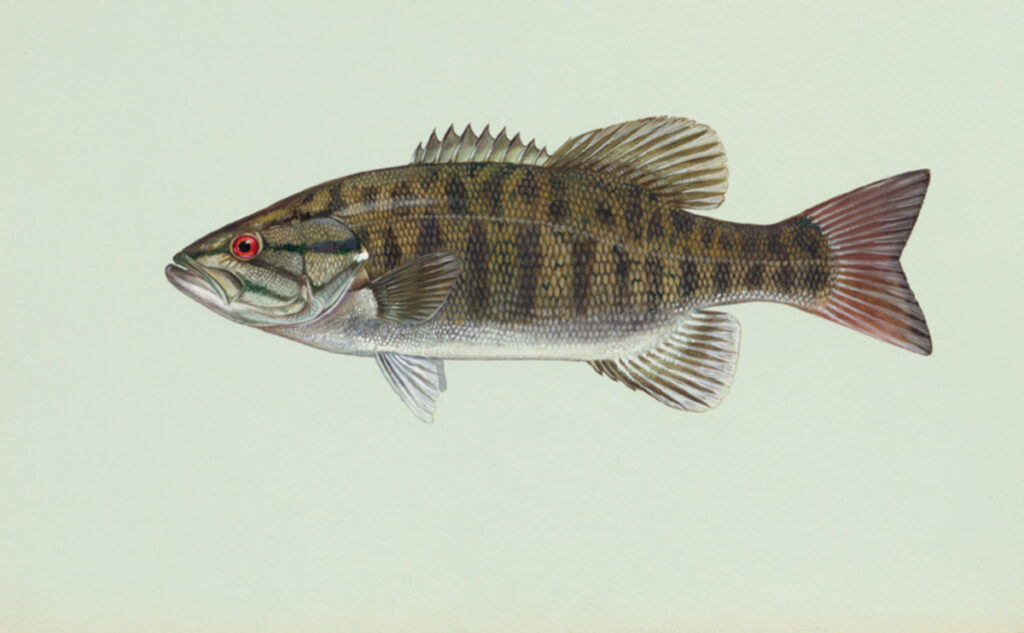
Smallmouth are elongated, laterally compressed bass with a bronze to olive-brown back, a pale belly, and a pattern of broken vertical bars along the flank rather than the horizontal stripe of a largemouth. The eye is typically red or amber. The Missouri Department of Conservation gives the two structural characters that settle any ambiguity: very small cheek scales, and connected dorsal fins — the spiny and soft portions joined rather than nearly separated. The upper jaw “extends to about the rear margin of the eye” but no further, whereas in largemouth it extends past the eye. The Pennsylvania Fish and Boat Commission describes the same characters in shorthand: brown or bronze back, pale yellow belly, “vertical, broken bars along each side of the body,” and the upper jaw stopping at the back edge of the eye.
River fish are typically darker and more heavily barred than lake fish, and fish over hard, clean rock run brighter bronze than fish over silt.
Rivers, current and structure
Smallmouth are a current-oriented species. In Ozark streams they are “the dominant species of large, predatory fish in most streams,” occupying habitats with “silt-free rock or gravel bottoms, near riffles but not in the main current.” That last phrase is the whole pattern in miniature: the fish sit in the seam beside fast water, not in it, using the current to deliver food while paying as little swimming cost as possible. Pennsylvania’s description matches — “warm streams and rivers with gravel bottoms” and “rocky areas along weed beds.”
Silt is the limiting factor across most of their range. Smallmouth need interstitial space in coarse substrate for crayfish, for hellgrammites, and for spawning gravel. Watersheds that deliver heavy fine sediment lose smallmouth even where temperature and flow remain suitable.
Water temperature
Water temperature governs the smallmouth year more tightly than any other variable. Feeding activity climbs steeply through the sixties, peaks somewhere in the seventies, and falls off below about 50 °F, when fish move to deep wintering pools and slow markedly. Published optimum ranges differ between agencies and study systems; the figure that is consistently documented is the spawning threshold, which Missouri places at water temperatures exceeding 60 °F.
Two thermal stories are worth knowing. The first is refuge. In the Missouri Ozarks, enormous karst springs buffer river temperature year-round. Ozark National Scenic Riverways describes springs that “deliver billions of gallons of clear, cold water to the Current and Jacks Fork River every week,” with Big Spring alone discharging roughly 289 million gallons a day at stable year-round temperature after a subsurface journey of up to 45 miles. Below such an inflow the river runs cold enough to concentrate fish in summer and to shift the whole thermal profile of the reach downstream.
The second is expansion. Warming water opens new river to smallmouth, sometimes with severe consequences. The US Geological Survey’s Grand Canyon Monitoring and Research Center records that in 2022, low reservoir levels meant water from Lake Powell’s warm upper layer was released downstream, “dramatically warming river temperatures and carrying smallmouth bass through the dam into the Colorado River,” producing the first records of smallmouth reproduction below Glen Canyon Dam. USGS calls invasive smallmouth “the greatest threat to native fishes” in that system, noting they have been linked to humpback chub declines including one population that was rapidly extirpated.
Diet: crayfish first
Crayfish dominate riverine smallmouth diets by volume wherever both occur. Missouri lists the diet as “fish, crayfish, and large aquatic insects,” and describes a distinctive foraging habit — following turtles or suckers to capture prey those animals dislodge from the bottom. Pennsylvania’s summary of what smallmouth eat in rivers is similarly crayfish-first, followed by minnows and hellgrammites.
The diet changes with size and season. Dauwalter and Fisher’s study of ontogenetic and seasonal diet shifts in an Ozark stream documents the transition from invertebrate feeding in small fish to crayfish and fish in larger ones. The USGS notes that introduced smallmouth “experience a niche shift, switching food preference from insects and zooplankton to crayfish and fish, that causes competitive interactions with many other fish species” — the same shift that makes them a formidable native predator makes them a destructive introduced one.
Invasiveness and salmon
The US Fish and Wildlife Service Ecological Risk Screening Summary scores smallmouth bass History of Invasiveness: High, Climate Match: High across virtually all of the contiguous United States, and Overall Risk: High, with high certainty of assessment given the volume of peer-reviewed literature. The listed impacts include “hybridization with native Micropterus sp., changes in invertebrate communities, and native fish species population reductions and extirpations,” plus the potential to carry and spread viral hemorrhagic septicemia virus.
The clearest documented conflict is with Pacific salmon. The USGS Nonindigenous Aquatic Species factsheet states that smallmouth “have been shown to eat smolts of Pacific salmonids, therefore posing a threat to these already declining species in the Columbia River,” and records smallmouth “consuming up to 35 percent of outmigrating wild salmon.” The magnitude has been quantified repeatedly, including Tabor and colleagues’ work on bass predation on juvenile Chinook salmon and Tiffan and colleagues’ assessment across a broad river continuum. A contributing factor frequently raised in this literature is that juvenile salmon evolved with a different set of predators, and their innate anti-predator responses to an introduced predator are weaker than to native ones — a plausible and much-discussed mechanism, though the strength of the evidence for it varies by study system.
Spawning and the nest-guarding male
Smallmouth spawn in spring. Missouri records spawning “from early or mid-April” once water passes 60 °F, continuing into June or July with a peak in May. The male excavates “a saucer-shaped depression” on gravel or rock, usually in a protected pocket out of the main current, and after spawning he guards the eggs and then the fry, fanning silt off the nest and driving off predators, until the fry disperse roughly two weeks after hatching. William Pflieger’s classic account of smallmouth reproduction in a small Ozark stream remains one of the best descriptions of the sequence.
That guarding period is the species’ structural vulnerability. A guarding male is tied to a fixed point, is aggressive toward anything that approaches, and cannot be replaced if he leaves. Remove him for even a short time and nest predators — sunfish, crayfish, other bass — can strip the brood. Steinhart and colleagues documented the interaction between storms, angling and nest predation during angling in Canadian Journal of Fisheries and Aquatic Sciences.
What the closures showed, and what remains contested
The COVID-19 pandemic produced an unplanned natural experiment. Philipp, Zolderdo, Lawrence, Claussen, Nowell, Holder and Cooke reported it in “COVID-19 reduced recreational fishing effort during the black bass spawning season, resulting in increases in black bass reproductive success and annual recruitment” (Fisheries Research, volume 259, article 106580, 2023). On Lake Opinicon in Ontario, where nesting bass had been monitored for decades, the sharp drop in spawning-season angling effort coincided with nest success rising roughly threefold — from under a quarter of nests to around two-thirds — and with two to three times as many independent fry produced.
Whether that translates into more adult fish is where the field genuinely splits. The counter-position, held by a number of state agencies and researchers, is that population-level effects of spawning-season angling have not been demonstrated in healthy populations: recruitment in bass is typically limited later in the first year by density-dependent processes, so a larger fry cohort need not produce a larger year class. That disagreement has been argued directly in the primary literature, including a published comment by Parkos, Wahl and Philipp in Transactions of the American Fisheries Society responding to work that found limited population consequences. Both positions rest on real data; they differ about which stage of the life cycle sets the ceiling. This article does not attempt to resolve it, and this site does not restate any jurisdiction’s rules — those live with the agency.
Site fidelity and movement
Smallmouth show strong attachment to particular places. Wiegmann, Weinersmith, Baylis, Newman and Angeloni’s “Null models confirm nest site fidelity by male smallmouth bass” (BMC Zoology, 2024) used a decade of nesting data and compared observed inter-nest distances against simulated random nest placement. Repeat-breeding males nested a median of roughly 46 to 120 metres from their previous year’s nest across eight consecutive year pairs, and between 6 and 18 percent of males used the identical nest in consecutive years — distances “in all cases much closer than those simulated.” That study was conducted on a Wisconsin lake, but the pattern it confirms is the same one river biologists describe: seasonal movements to and from wintering pools and spawning areas, followed by return to a familiar reach.
Riverine movement has been mapped in detail for the Ozark forms. Brewer and Miller’s assessment of spawning movement and habitat needs of riverine Neosho Smallmouth Bass and Miller, Mollenhauer and Brewer’s work on movement and diel habitat use of juvenile Neosho Smallmouth Bass in an Ozark stream both describe fish operating within bounded home reaches rather than ranging freely. For a river angler, the practical consequence is that a good pool tends to be good repeatedly, and that a fish removed from a productive lie leaves a vacancy another fish will fill.
Angling as natural history
Almost everything characteristic of smallmouth angling follows from the biology above. The fish holds in current seams beside fast water, so that is where they are caught. Crayfish dominate the diet, so crayfish-shaped and crayfish-colored presentations dominate the tackle. Fish are territorial and site-faithful, so productive water repeats across seasons and years. Feeding responds steeply to temperature, so a live water temperature reading predicts activity better than a calendar date. And because a guarding male is anchored to a visible nest and will strike almost anything that comes near it, the spring period is the one where angler behavior and fish biology intersect most directly — which is precisely why the literature on it is contested rather than settled.
Where to catch it
537 waterways on GuidedFloats list smallmouth bass, across 44 states. Each page carries live gauge readings, access notes, and the guides who fish it.
Alabama 2
- Hatchet Creek62 cfs
- Sipsey Fork8 cfs
Arizona 13
- Bartlett Reservoir
- Bill Williams River below Alamo Dam13 cfs
- Black River167 cfs
- Del Rio Springs1 cfs
- East Verde River77 cfs
- Lake Mohave
- Oak Creek59 cfs
- Salt River511 cfs
- Salt River below Stewart Mountain Dam42 cfs
- Tonto Creek73 cfs
- Verde River841 cfs
- West Clear Creek49 cfs
- Wet Beaver Creek9 cfs
Arkansas 15
- Beaver Lake
- Buffalo River115 cfs
- Bull Shoals Lake
- Caddo River23 cfs
- Frog Bayou
- Illinois Bayou4 cfs
- Kings River68 cfs
- Mammoth Spring
- Osage Creek29 cfs
- Ouachita River11 cfs
- Saline River13 cfs
- South Fork Spring River4 cfs
- Spring River
- Spring River299 cfs
- White River1,720 cfs
California 14
- American River1,500 cfs
- Cosumnes River60 cfs
- Kern River
- Nacimiento River62 cfs
- Piru Creek401 cfs
- Pit River26 cfs
- Putah Creek141 cfs
- Russian River156 cfs
- Salinas River
- San Joaquin River392 cfs
- Santa Ynez River
- Stanislaus River846 cfs
- Suisun Bay
- Tuolumne River1,150 cfs
Colorado 6
- Dolores River312 cfs
- Pueblo Reservoir
- Purgatoire River below Trinidad Lake
- Ridgway Reservoir
- Trinidad Lake
- Yampa River117 cfs
Connecticut 12
- Connecticut River
- Connecticut River Estuary
- Farmington River594 cfs
- Housatonic River864 cfs
- Natchaug River123 cfs
- Naugatuck River264 cfs
- Quinebaug River869 cfs
- Salmon Creek22 cfs
- Salmon River (Connecticut)86 cfs
- Saugatuck River11 cfs
- Thames River
- West Branch Farmington River151 cfs
Delaware 3
- Brandywine Creek276 cfs
- Red Clay Creek38 cfs
- White Clay Creek54 cfs
Georgia 2
- Soque River67 cfs
- Toccoa River163 cfs
Hawaii 7
- Hanalei River229 cfs
- Koolau Reservoir
- Ku Tree Reservoir
- Wahiawa Reservoir
- Wailua River2,330 cfs
- Wailuku River
- Waimea River506 cfs
Idaho 9
- Anderson Ranch Reservoir
- Bruneau River44 cfs
- C.J. Strike Reservoir
- Clearwater River3,180 cfs
- Coeur d'Alene Lake
- Lake Pend Oreille
- Payette River803 cfs
- Priest Lake
- Priest River1,340 cfs
Illinois 16
- Apple River102 cfs
- Channel Lake
- Embarras River55 cfs
- Fox Lake
- Fox River1,500 cfs
- Iroquois River125 cfs
- Kankakee River1,610 cfs
- Kishwaukee River832 cfs
- Little Wabash River76 cfs
- Mackinaw River104 cfs
- Macoupin Creek15 cfs
- Pecatonica River1,180 cfs
- Rock River4,980 cfs
- Spring Brook2 cfs
- Vermilion River168 cfs
- Wabash River9,570 cfs
Indiana 16
- Big Raccoon Creek104 cfs
- Blue River14 cfs
- Brookville Lake
- Cecil M. Harden Lake
- Eagle Creek10 cfs
- East Fork White River
- Flatrock River47 cfs
- Hamilton Lake
- Lake Maxinkuckee
- Mississinewa Lake
- Mississinewa River22 cfs
- Salamonie Lake
- Sugar Creek44 cfs
- Tippecanoe River519 cfs
- White River (Indiana)1,050 cfs
- Wildcat Creek137 cfs
Iowa 15
- Beaver Creek906 cfs
- Big Bear Creek214 cfs
- Black Hawk Creek839 cfs
- Bloody Run Creek25 cfs
- Cedar River9,550 cfs
- Iowa River4,540 cfs
- Maquoketa River2,440 cfs
- Spirit Lake
- Spring Creek
- Turkey River2,730 cfs
- Upper Iowa River725 cfs
- Wapsipinicon River3,280 cfs
- West Okoboji Lake
- Wolf Creek621 cfs
- Yellow River215 cfs
Kansas 8
- Cedar Bluff Reservoir
- Clinton Lake
- Hillsdale Lake
- Kansas River15,100 cfs
- Milford Lake
- Perry Lake
- Stranger Creek41 cfs
- Wilson Lake
Kentucky 16
- Big South Fork73 cfs
- Dix River31 cfs
- Elkhorn Creek147 cfs
- Green River (Kentucky)447 cfs
- Green River Lake
- Kentucky River972 cfs
- Levisa Fork below Fishtrap Dam
- Little Sandy River below Grayson Dam43 cfs
- Nolin River Lake
- Red River7 cfs
- Rockcastle River72 cfs
- Rough River Lake
- Royal Springs1 cfs
- South Elkhorn Creek4 cfs
- Taylorsville Lake
- Tygarts Creek35 cfs
Maine 16
- Androscoggin River2,180 cfs
- Aroostook River182 cfs
- East Branch Penobscot River476 cfs
- East Branch Penobscot River below Grand Lake Matagamon194 cfs
- Fish River133 cfs
- Grand Lake Stream369 cfs
- Kennebec River1,700 cfs
- Lewy Lake
- Meduxnekeag River42 cfs
- Narraguagus River182 cfs
- Penobscot River3,490 cfs
- Piscataquis River714 cfs
- Sebago Lake
- St. Croix River373 cfs
- Stony Brook
- West Grand Lake
Maryland 14
- Antietam Creek110 cfs
- Big Pipe Creek40 cfs
- Conococheague Creek237 cfs
- Deer Creek47 cfs
- Gunpowder Falls77 cfs
- Licking Creek67 cfs
- Monocacy River304 cfs
- Patuxent River28 cfs
- Potomac River5,250 cfs
- Tonoloway Creek25 cfs
- Town Creek21 cfs
- Tuckahoe Creek45 cfs
- Wills Creek98 cfs
- Youghiogheny River (Maryland)383 cfs
Massachusetts 9
- Charles River181 cfs
- Connecticut River7,210 cfs
- Deerfield River932 cfs
- Merrimack River2,870 cfs
- Millers River322 cfs
- Quinebaug River80 cfs
- Upper Mystic Lake
- West River
- Westfield River574 cfs
Michigan 13
- Austin Lake
- Cisco Lake
- Grand River90 cfs
- Higgins Lake
- Intermediate Lake
- Lake Gogebic
- Mullett Lake
- Muskegon River1,370 cfs
- Otsego Lake
- Presque Isle River84 cfs
- Rifle River338 cfs
- Thornapple River208 cfs
- Van Etten Lake
Minnesota 14
- Cannon River541 cfs
- Crane Lake
- Kettle River88 cfs
- Lake Minnetonka
- Lake of the Woods
- Lake Traverse
- Leech Lake
- Mille Lacs Lake
- Mississippi River8,040 cfs
- Orwell Lake
- Rainy River6,590 cfs
- Root River983 cfs
- South Fork Root River201 cfs
- St. Croix River3,500 cfs
Missouri 25
- Big Piney River125 cfs
- Big River135 cfs
- Big Spring272 cfs
- Black River174 cfs
- Bryant Creek140 cfs
- Current River143 cfs
- East Fork Black River below Taum Sauk Reservoir7 cfs
- Eleven Point River271 cfs
- Elk River
- Gasconade River479 cfs
- Greer Spring197 cfs
- Huzzah Creek62 cfs
- Jacks Fork147 cfs
- James River152 cfs
- Little North Fork River
- Little Piney Creek61 cfs
- Meramec River174 cfs
- Niangua River26 cfs
- North Fork of the White River304 cfs
- North Fork Spring River3 cfs
- Pearson Creek6 cfs
- Roaring River15 cfs
- Roubidoux Creek
- Spring River78 cfs
- Table Rock Lake
Nebraska 14
- Bazile Creek43 cfs
- Big Blue River1,020 cfs
- Bow Creek37 cfs
- Cedar River262 cfs
- Dismal River255 cfs
- Elkhorn River1,210 cfs
- Frenchman Creek13 cfs
- Loup River287 cfs
- Middle Loup River1,200 cfs
- Niobrara River543 cfs
- North Loup River391 cfs
- Platte River5,750 cfs
- Ponca Creek8 cfs
- Wahoo Creek138 cfs
Nevada 5
New Hampshire 16
- Ammonoosuc River124 cfs
- Androscoggin River (New Hampshire)1,430 cfs
- Ashuelot River429 cfs
- Ashuelot River below Surry Mountain Dam129 cfs
- Baker River95 cfs
- Bearcamp River46 cfs
- Beaver Brook25 cfs
- Cold River31 cfs
- Contoocook River98 cfs
- Contoocook River below Hopkinton Dam472 cfs
- Nubanusit Brook below MacDowell Dam
- Pemigewasset River573 cfs
- Piscataquog River34 cfs
- Saco River406 cfs
- Upper Ammonoosuc River330 cfs
- Winnicut River41 cfs
New Jersey 6
- Delaware River5,490 cfs
- Musconetcong River154 cfs
- Passaic River1,110 cfs
- Raritan River359 cfs
- Rockaway River74 cfs
- South Branch Raritan River52 cfs
New Mexico 7
- Blue Springs6 cfs
- Conchas Lake
- Gila River146 cfs
- Lake Sumner
- Rio Grande below Elephant Butte Dam
- Santa Rosa Lake
- Ute Reservoir
New York 20
- Battenkill318 cfs
- Black River4,650 cfs
- Cattaraugus Creek205 cfs
- Cayuga Lake
- Chautauqua Lake
- Conesus Lake
- Genesee River919 cfs
- Great Sacandaga Lake
- Lake George
- Mohawk River140 cfs
- Mongaup River123 cfs
- Neversink River180 cfs
- Oatka Creek46 cfs
- Oswegatchie River905 cfs
- Owasco Lake
- Pepacton Reservoir
- Saranac River1,330 cfs
- Saratoga Lake
- Schoharie Creek
- Willowemoc Creek82 cfs
North Carolina 17
- Catawba River2,970 cfs
- Cheoah River99 cfs
- Deep River71 cfs
- French Broad River1,050 cfs
- Haw River69 cfs
- Linville River63 cfs
- Little Tennessee River117 cfs
- Nantahala River87 cfs
- Pee Dee River8,570 cfs
- South Toe River114 cfs
- Tar River4 cfs
- Tuckasegee River614 cfs
- Valley River66 cfs
- Watauga River106 cfs
- Wilson Creek
- Yadkin River2,230 cfs
- Yadkin River below W. Kerr Scott Dam946 cfs
North Dakota 11
- Apple Creek
- James River275 cfs
- Lake Ashtabula
- Lake Darling
- Little Missouri River23 cfs
- Missouri River (North Dakota)13,000 cfs
- Red River of the North2,330 cfs
- Sheyenne River254 cfs
- Sheyenne River below Baldhill Dam161 cfs
- Sheyenne River below Devils Lake Outlet5 cfs
- Tobacco Garden Creek3 cfs
Ohio 20
- Berlin Lake
- Caesar Creek Lake
- Chagrin River146 cfs
- Cuyahoga River368 cfs
- Great Miami River1,840 cfs
- Hocking River572 cfs
- Kokosing River48 cfs
- Licking River
- Little Miami River72 cfs
- Little Muskingum River157 cfs
- Mad River221 cfs
- Mahoning River465 cfs
- Maumee River1,110 cfs
- Mosquito Creek below Mosquito Creek Dam3 cfs
- Muskingum River2,580 cfs
- Rocky River122 cfs
- Sandusky River66 cfs
- Scioto River2,360 cfs
- Tuscarawas River
- Walhonding River
Oklahoma 13
- Blue River43 cfs
- Flint Creek4 cfs
- Glover River
- Honey Creek33 cfs
- Illinois River394 cfs
- Kiamichi River2 cfs
- Lake Eucha
- Lake Lawtonka
- Lower Mountain Fork River158 cfs
- McGee Creek Reservoir
- Mountain Fork8 cfs
- North Fork Red River below Altus Dam1 cfs
- Sager Creek8 cfs
Oregon 10
- Columbia River74,000 cfs
- Grande Ronde River591 cfs
- John Day River190 cfs
- Lake Billy Chinook
- North Santiam River1,320 cfs
- Owyhee River31 cfs
- Rogue River1,150 cfs
- South Santiam River1,150 cfs
- Umpqua River1,000 cfs
- Willamette River6,730 cfs
Pennsylvania 25
- Allegheny Reservoir
- Allegheny River below Kinzua Dam2,310 cfs
- Aquashicola Creek57 cfs
- Aughwick Creek66 cfs
- Bald Eagle Creek298 cfs
- Brodhead Creek71 cfs
- Buck Run17 cfs
- Clarion River513 cfs
- Codorus Creek10 cfs
- Jordan Creek62 cfs
- Kishacoquillas Creek192 cfs
- Lackawaxen River199 cfs
- Lehigh River1,250 cfs
- Lehigh River below Francis E. Walter Dam700 cfs
- Little Juniata River190 cfs
- Loyalsock Creek266 cfs
- Penns Creek298 cfs
- Pine Creek145 cfs
- Pohopoco Creek97 cfs
- Raystown Lake
- Shohola Creek44 cfs
- Susquehanna River16,600 cfs
- Tulpehocken Creek203 cfs
- Yellow Breeches Creek153 cfs
- Youghiogheny River2,260 cfs
Rhode Island 6
- Blackstone River506 cfs
- Branch River109 cfs
- Nipmuc River12 cfs
- Pawcatuck River602 cfs
- Pawtuxet River267 cfs
- Woonasquatucket River42 cfs
South Carolina 4
- Broad River1,890 cfs
- Ninetynine Islands Reservoir
- North Saluda River6 cfs
- Pacolet River183 cfs
South Dakota 8
- Belle Fourche Reservoir
- Belle Fourche River12 cfs
- Cheyenne River75 cfs
- Lake Kampeska
- Lake Oahe
- Missouri River (South Dakota)
- Pactola Reservoir
- White River97 cfs
Tennessee 17
- Big Limestone Creek28 cfs
- Buffalo River (Tennessee)305 cfs
- Clear Creek6 cfs
- Clinch River714 cfs
- Cumberland River below Cordell Hull Dam
- Daddys Creek18 cfs
- Duck River376 cfs
- Elk River6 cfs
- French Broad River1,360 cfs
- Harpeth River
- Little River67 cfs
- Nolichucky River964 cfs
- Nolichucky River below Nolichucky Dam959 cfs
- Obed River14 cfs
- South Chickamauga Creek117 cfs
- Spring Creek
- Watauga River413 cfs
Texas 5
- Devils River
- Llano River495 cfs
- Medina River16 cfs
- San Marcos River84 cfs
- San Saba River84 cfs
Utah 2
- Colorado River (Utah)3,100 cfs
- Ogden River below Pineview Reservoir17 cfs
Vermont 17
- Lake Champlain
- Lake Memphremagog
- Lamoille River251 cfs
- Lewis Creek36 cfs
- Little Otter Creek13 cfs
- Missisquoi River969 cfs
- Moose River94 cfs
- Ompompanoosuc River63 cfs
- Ottauquechee River35 cfs
- Otter Creek705 cfs
- Passumpsic River402 cfs
- Waterbury Reservoir
- Wells River69 cfs
- West River311 cfs
- White River (Vermont)556 cfs
- Winooski River1,020 cfs
- Wrightsville Reservoir
Virginia 24
- Bullpasture River81 cfs
- Calfpasture River59 cfs
- Cedar Creek33 cfs
- Clinch River453 cfs
- Cowpasture River308 cfs
- Dan River695 cfs
- Hazel River157 cfs
- Jackson River200 cfs
- James River1,040 cfs
- Linville Creek27 cfs
- Maury River112 cfs
- New River2,500 cfs
- North Fork Shenandoah River301 cfs
- North River192 cfs
- Opequon Creek12 cfs
- Pamunkey River229 cfs
- Passage Creek17 cfs
- Pedlar River6 cfs
- Pound River below Flannagan Dam
- Rapidan River80 cfs
- Rappahannock River790 cfs
- Shenandoah River845 cfs
- Smith Creek39 cfs
- South Fork Shenandoah River357 cfs
Washington 5
- Chehalis River27 cfs
- Lake Chelan
- Lake Tapps
- Moses Lake
- Spokane River1,600 cfs
West Virginia 20
- Back Creek32 cfs
- Big Sandy Creek238 cfs
- Cacapon River286 cfs
- Cheat River3,290 cfs
- Cranberry River329 cfs
- Elk River (West Virginia)3,500 cfs
- Gauley River1,910 cfs
- Gauley River below Summersville Dam
- Greenbrier River1,520 cfs
- Howard Creek
- Laurel Creek115 cfs
- Opequon Creek111 cfs
- Patterson Creek78 cfs
- Shavers Fork215 cfs
- South Branch Potomac River1,530 cfs
- Tygart Lake
- Tygart Valley River613 cfs
- Warm Springs Run3 cfs
- West Fork River below Stonewall Jackson Dam375 cfs
- Williams River482 cfs
Wisconsin 20
- Anvil Lake
- Brule River526 cfs
- Chippewa River1,500 cfs
- Devils Lake
- Eau Galle River16 cfs
- Fox River (Wisconsin)1,160 cfs
- Geneva Lake
- Green Lake
- Lac Vieux Desert
- Lake Kegonsa
- Lake Koshkonong
- Lake Mendota
- Lake Monona
- Lake Waubesa
- Lake Winnebago
- Namekagon River43 cfs
- Peshtigo River243 cfs
- Tenmile Creek48 cfs
- Wisconsin River5,390 cfs
- Wolf River1,570 cfs
References
- Smallmouth Bass (Micropterus dolomieu) — Nonindigenous Aquatic Species factsheet — U.S. Geological Survey
- Phylogenomics and species delimitation of the economically important Black Basses (Micropterus) (Kim, Taylor & Near, Scientific Reports 12:9113, 2022) — Scientific Reports
- Ecological Risk Screening Summary: Smallmouth Bass (Micropterus dolomieu) — U.S. Fish and Wildlife Service
- COVID-19 reduced recreational fishing effort during the black bass spawning season, resulting in increases in black bass reproductive success and annual recruitment (Philipp et al., Fisheries Research 259:106580, 2023) — Fisheries Research
- Smallmouth Bass — Field Guide — Missouri Department of Conservation
- Bass — Catch PA Fish — Pennsylvania Fish and Boat Commission
- Smallmouth Bass Expansion Downstream of Glen Canyon Dam — U.S. Geological Survey, Southwest Biological Science Center
- Grand Canyon Monitoring and Research Center — U.S. Geological Survey, Southwest Biological Science Center
- Null models confirm nest site fidelity by male smallmouth bass, Micropterus dolomieu (Wiegmann et al., BMC Zoology, 2024) — BMC Zoology
- Springs — Ozark National Scenic Riverways — National Park Service
- Ontogenetic and Seasonal Diet Shifts of Smallmouth Bass in an Ozark Stream (Dauwalter & Fisher, Journal of Freshwater Ecology, 2008) — Journal of Freshwater Ecology
- Effects of storms, angling, and nest predation during angling on smallmouth bass reproductive success (Steinhart et al., CJFAS, 2005) — Canadian Journal of Fisheries and Aquatic Sciences
- Comment: Assessing the Potential for the Angling of Nesting Males to Influence Black Bass Recruitment (Parkos, Wahl & Philipp, TAFS, 2013) — Transactions of the American Fisheries Society
- Assessing the spawning movement and habitat needs of riverine Neosho Smallmouth Bass (Brewer & Miller, Cooperator Science Series, 2022) — U.S. Fish and Wildlife Service Cooperator Science Series
- Movement and Diel Habitat Use of Juvenile Neosho Smallmouth Bass in an Ozark Stream (Miller, Mollenhauer & Brewer, NAJFM, 2018) — North American Journal of Fisheries Management
- Smallmouth Bass and Largemouth Bass Predation on Juvenile Chinook Salmon and Other Salmonids (Tabor et al., NAJFM, 2007) — North American Journal of Fisheries Management
- Impact of smallmouth bass predation on subyearling fall Chinook salmon over a broad river continuum (Tiffan et al., Environmental Biology of Fishes, 2020) — Environmental Biology of Fishes
- Reproduction of the Smallmouth Bass in a Small Ozark Stream (Pflieger, American Midland Naturalist, 1966) — The American Midland Naturalist
- IGFA World Records database — International Game Fish Association